Nodular trefoil | Medicinal plant in the Akhdar Encyclopedia
The plant possesses antihypertensive and anticoagulant properties, affecting the cyclooxygenase. It is used in cases of bronchitis, chest colds, and inflammation of the mouth and throat. A decoction of the plant is used as a bronchodilator, in the treatment of tuberculosis, as an expectorant, and i…
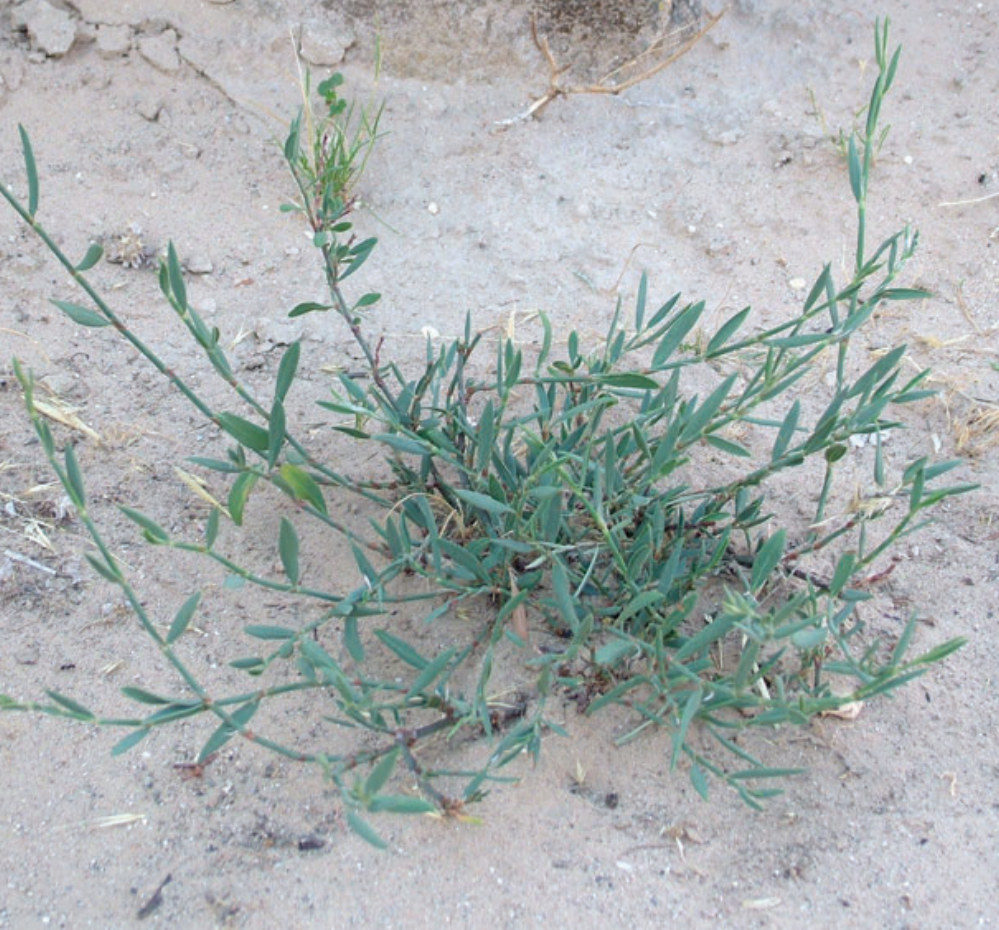
Plant name
nodular ligament
Latin name
Polygonum aviculare L
Common names
The knotted truffle, the truffle, the shepherd's staff
foreign names
Common knotgrass, French: Renouée des oiseaux
The group
nodular or acidic
Habitat and Geographic Distribution
Widespread in temperate and subtropical regions
Botanical description
A perennial herb, ascending or prostrate, glabrous, branching from the base.
The leaves are simple, alternate, and variegated; the lower leaves on the main branches are large, while those on the lateral and upper branches are small, entire, semi-peculiar, uterine or ovate, acutely apex, entire margin, and punctate.
The spathe is 10-2 x 25 mm or smaller, membranous, silvery, and dilobed.
The inflorescences are axillary, solitary (the stipules are fused in a sheath-like pattern), about 1 mm long.
The calyx is simple, composed of 1 mm; the peduncle is about 1-0.5 mm long.
The flowers are hermaphroditic, small (3-5 mm) or in uterine clusters, measuring five nearly equal segments, elliptical stamens, sclerotized filaments.
The male flowers are 0.5 x 2-1.5 mm, with sclerotia ending in 3 mm.
The ovary is superior, solitary, above which are 3 mm, ovate, tertiary, and primary stigmas.
The fruit is an acinus, ribbed, black, luminous, and striated. Flowering occurs from March to September.
Used part
flowering plant
chemical components
Quecetrimonium hyperoside, hyperoside, avicularin (most important: avicularin 0.1-1%), flavonoids, isovitexin, vitexin, quercitrin (partially water-soluble compound 1%), silicic acid, tannins, salivary substances, and silicon acid, scopoletin, umbelliferone (including: umbelliferone), hydroxycoumarins, aviculin, lignans
Properties and medical uses
The plant possesses antihypertensive and anticoagulant properties, affecting the cyclooxygenase.
It is used for bronchitis, chest colds, and inflammations of the mouth and throat.
A decoction of the plant is used topically as an antiperspirant, in the treatment of tuberculosis, as an expectorant, and to treat coughs, kidney and bladder diseases, simple urinary retention, digestive ulcers, gout, and rheumatism.
A decoction of the plant is also used topically to treat skin infections, stop bleeding, and heal slow-healing wounds.
In China, it is used to treat vaginal discharge, itching, jaundice, and to expel tapeworms.
Precautions: Increased salivation may be observed.
Habitat: It grows in neglected areas, roadsides, and along shores.
It prefers moist, acidic soils and thrives in sunny and partially shaded locations. It is considered a weed in agricultural fields.
Side effects and precautions
An increase in saliva production may be observed.
the environment
The plant grows in neglected areas, along roadsides, and on embankments.
It prefers moist, acidic soils and thrives in sheltered and partially shaded locations. It is considered a harmful weed in agricultural fields.
Agriculture and productivity
It is propagated by seed in spring, with easy germination.
It can also be propagated by division in spring and autumn.
Larger sections are sown directly in the permanent location, while smaller sections are kept in the nursery until their roots are strong.
The plant produces a very large quantity of seeds, which are a staple food for many bird species.
Rumex crispus L. Lapathum crispum (L.) Scop., Rumex patientia var. crispus (L.) Kuntze
History and Heritage
The genus name "polys" comes from the Greek word meaning "knee," referring to the numerous gonus and avicular nodes of this plant. The poison is also a descriptor for birds that eat its seeds.
Medical note
This information is for educational purposes only and does not constitute medical advice.
Poisonous or potent plants should only be used under the supervision of a qualified physician or pharmacist.
Related images


