Retama | A medicinal plant in the Akhdar encyclopedia
Senna leaves and fruits are currently among the best herbal laxatives and purgatives listed in European, American, Indian, and Chinese pharmacopoeias. Research on senna leaves and fruits has shown that it is a mild laxative when taken in small, moderate doses, but becomes a strong purgative when ta…
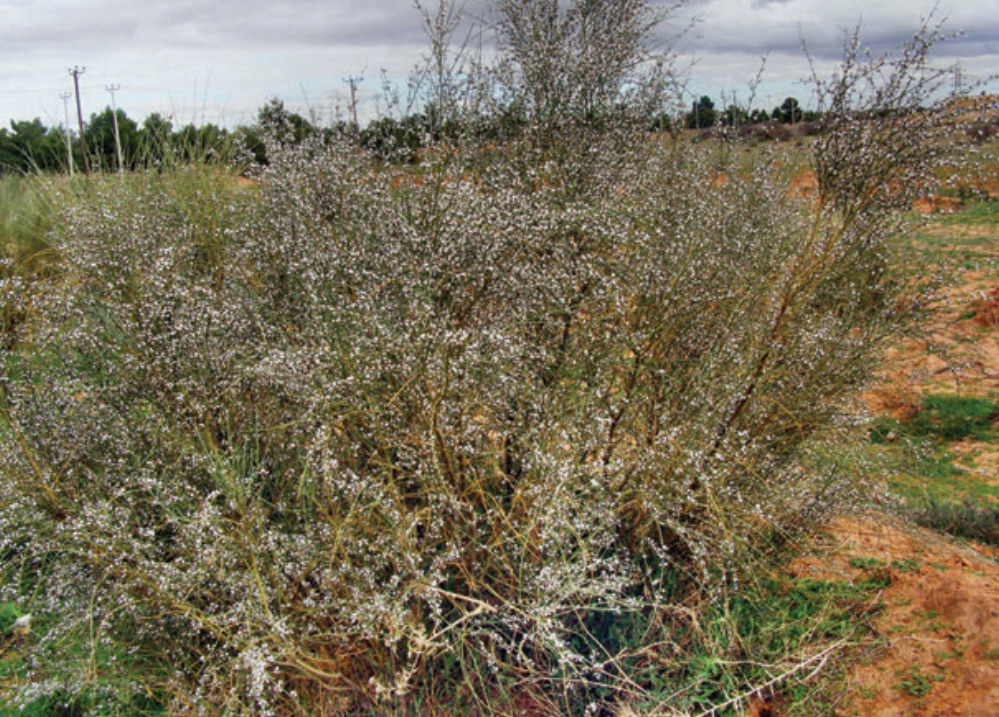
Plant name
rhythm
Latin name
Retama raetam (Forssk.) Webb
Common names
rhythm
foreign names
Eng. White broom, Fr. Genesis of the desert.
The group
Pea beans
Habitat and Geographic Distribution
It is found in the Arabian Peninsula, Egypt, Sudan, India, Pakistan, and Iran, which is one of the most important senna-exporting countries.
Botanical description
The roots are thick, sparsely branched, spreading vertically, penetrating deeply into the root system, where a 3-meter-long, reed-like shrub can grow.
The stems are thick and serrated; the branches are erect or prostrate, and young ones may be drooping.
The leaves are simple, reaching up to 5 mm in length.
The inflorescences are racemes of 8-3 × 20-5 oblong, with very short lifespans, linear in length.
The calyx is crimson, bilipped, with the upper lip 15 mm long.
The flowers are hermaphroditic, bisymmetrical, consisting of two broad, triangular teeth, and the lower lip of three short teeth.
The corolla is white, the petals are five with a downward brush-like arrangement, their tips crimson, the flag is violet-striped, obovate to rounded, the ray squamous in length, open or late-opening, ovate to oblong or 9-5 × 20-7 winged.
The fruit is a small, elliptical pod, its apex ending in a small, erect or curved beak.
The perianth is leathery or hairy, smooth or rough. The seeds are yellow or brown. Flowering occurs from February to April.
Used part
The market, leaves, and flowers that are gathered in the spring
chemical components
The fruits contain genistein, glycosides, and cytisine; they also contain the alkaloid valvone, proteins, and lipids...anagyrine. The flowers also contain the alkaloid anagyrine.
Properties and medical uses
Senna leaves and fruits are currently among the best herbal laxatives and purgatives listed in European, American, Indian, and Chinese pharmacopoeias.
Research on senna leaves and fruits has shown that it is a mild laxative when taken in small, moderate doses, but becomes a purgative when taken in large doses.
The action of anthraquinone compounds begins specifically in the colon (large intestine), where anthraquinone glycosides are broken down by intestinal bacteria into sennidin A and B.
These are further broken down into rhein and anthrone, which stimulate colonic motility.
Senna is characterized by its lack of effect on the stomach and small intestine.
Practically speaking, senna's laxative effect begins when it reaches the colon, requiring 6 to 12 hours or more.
Senna is used in the form of a decoction (ten leaves are sufficient for a laxative), an infusion, or in the form of manufactured granules or tablets, available in pharmacies.
An infusion of senna leaves can also be used topically as an enema for infants, using 1 gram of infusion per year of age.
For adults, the enema dosage is 10-15 grams per 500 milliliters of water.
Senna is traditionally used to treat kidney ailments and jaundice. Enlarged spleen, anemia, and typhoid fever
pharmaceutical forms
Pharmaceutical companies have produced many senna preparations, including Sennakot and Puresenid.
Side effects and precautions
Not recommended for use
the environment
It is widespread in hot regions.
In the Mediterranean bioclimatic zone, it is a xerophyte species that tolerates extreme and moderate aridity.
It grows on sandy and calcareous soils, including silty or sandy deposits, and on shifting sand dunes. It is resistant to burial by sand and to sand erosion.
Agriculture and productivity
The plant is propagated by seeds, which are sown at the beginning of spring.
Soaking the seeds in water for 12 hours before planting increases germination. One hectare produces approximately one ton of [product/plant].
History and Heritage
Rtm is an Arabic name and it is the origin of the scientific name for the genus and species, i.e., "Rtm Rtm".
Medical note
This information is for educational purposes only and does not constitute medical advice.
Poisonous or potent plants should only be used under the supervision of a qualified physician or pharmacist.
Related images


