White rubber plant | Medicinal plant in the Akhdar encyclopedia
The fresh juice of the plant possesses antibacterial properties, and it is believed that aucubigenin, a byproduct of the breakdown and hydration of aucubin and saponin compounds, contributes to these properties. The leaf sap accelerates blood clotting and wound healing and is used to treat coughs a…
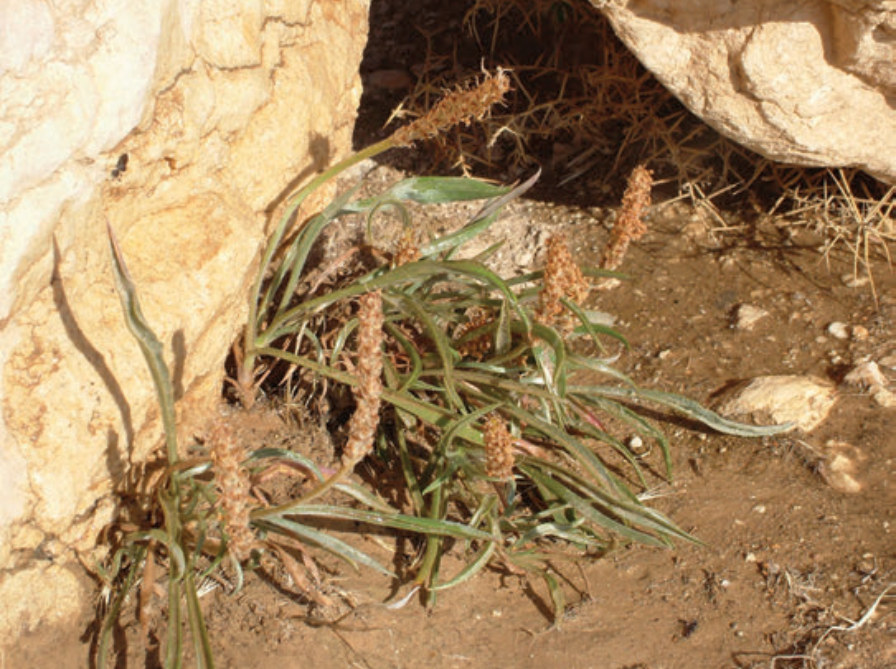
Plant name
white rubber
Latin name
Plantago albicans L
Common names
White rubber, white plantain
foreign names
Eng. Woolly plantain, Fr. Psyllium
The group
Plantain or plantain
Habitat and Geographic Distribution
It is widespread in the northern hemisphere, and is Mediterranean and Arabian desert.
Botanical description
A silvery, woolly perennial herb with a long, branching, brown rhizome covered in silky hairs.
The leaves are simple, alternate, auricular, basal, linear or uterine to ellipsoidal, acuminate, tapering to 35, with a gradually tapering base, entire margins, flat or wavy.
The flowers are gathered in a bract-like inflorescence, the rhizome of which is leafless, and the length of the inflorescence usually exceeds that of the leaves.
The spike is cylindrical, can be erect or ascending, and is sometimes discontinuous at its base.
The bracts are the length of the calyx or slightly longer, broadly ellipsoidal to nearly rounded, with a broad membranous margin, and the main stamen is broad, smooth, or bears fine, velvety hairs or long hairs.
The sepals are fused at their bases and bear four-segmented, small, slender flowers.
The calyx is fused with the fruit, composed of petals that fuse into a narrow tube, which soon splits into long hairs at its apex, and these hairs are not identical to one another.
The corolla consists of flattened, membranous, dry, whitish lobes.
The corolla lobes are broadly ovoid to rounded, pointed, and usually glabrous.
After fruiting, they detach from their bases and adhere to the upper part of the fruit.
The stamens are located on the corolla, alternating with its lobes.
The filaments are free and long, protruding outside the corolla.
The female reproductive organ is bicarpeled, and the ovary is superior and bistomous, with each lobe usually containing one ovule.
The style is solitary, ending in a simple, thread-like, and prominent stigma.
The fruit is an elliptical capsule with a dry, membranous pericarp.
It splits open in a cleft, so that the upper part falls off at maturity along with the seeds and the corolla lobes, containing two seeds.
The seeds are brown and elliptical, producing a gel when exposed. 3 - For humidity, its flowering period is from March to May
Used part
The leaves, the tender and dry parts of the plant, and the plant's sap.
chemical components
Salivary compounds (2%), including glucomannans, arabinogalactane, and rhamnogalacturonane.
Iridoide monoterpene glycosides (2%), primarily aucubin, rhinantin, and catalpol.
Flavonoids, primarily apigenin and luteolin.
Caffeic acid esters, primarily chlorogenic acid, neochlorogenic acid, and acteoside.
Tannins (6%) and traces of Saponin compounds, 1% salicylic acid, coumarin, aesculetin, tannins, formic acid, vitamin C, beta-carotene, and minerals, primarily zinc and potassium.
Properties and medical uses
The fresh juice of the plant possesses antibacterial properties, and it is believed that aucubigenin, a byproduct of the breakdown and hydration of aucubin and saponin compounds, contributes to these properties.
The leaf sap accelerates blood clotting and wound healing and is used to treat coughs and bronchitis.
The plant juice is also used as a diuretic and to treat cystitis, urinary incontinence, gastric colic, peptic ulcers, liver and respiratory tract diseases, and diarrhea.
It is used topically to treat inflammation of the mouth and throat, skin inflammations, wounds, and conjunctivitis.
It is also used to treat snake bites, toothaches, sore throats, wounds, boils, and as an antidote for poisoning, an expectorant, and a decongestant.
Side effects and precautions
Allergic reactions or drug interactions may occur; self-use should be avoided by pregnant and breastfeeding women, children, and patients with chronic diseases.
the environment
The plant grows in meadows, roadsides, fields, abandoned areas, and stream banks.
It thrives in various fertile soils and sunny locations, and can even survive in poor, dry, sandy soils. The plant is a food source for many caterpillars and butterfly species.
Agriculture and productivity
The plant is propagated by seed in the spring.
When the plants reach a suitable height, they can be transplanted early in the summer to their permanent location.
Alternatively, seeds can be sown in the spring if a sufficient quantity is available. (Plantago ovata Forssk. P. brunnea Morris E,. P. insularis Eastw)
History and Heritage
The genus name has been mentioned previously, while the descriptive name for the species lanceolate means "lanceolate" in reference to its shape.
Medical note
This information is for educational purposes only and does not constitute medical advice.
Poisonous or potent plants should only be used under the supervision of a qualified physician or pharmacist.
Related images


