Damascena | A medicinal plant in the Akhdar encyclopedia
The volatile oil and bitter compounds possess digestive properties by affecting taste receptors on the tongue, triggering a reflex that stimulates the stomach and digestive secretions. The volatile oil also has anti-inflammatory properties. Research has demonstrated the anti-tumor efficacy of the b…
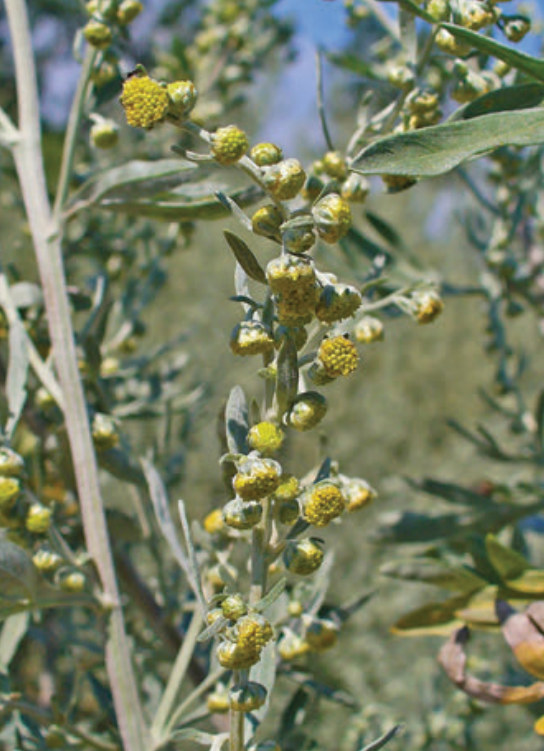
Plant name
The Damsisa
Latin name
Artemisia absinthium L
Common names
Damsisa, Fasnithin, Sheeba
foreign names
Eng. Wormwood, Absinthe، Fr. Absinthe
The group
Star
Habitat and Geographic Distribution
The plant grows wild in Central and Southern Europe and North Africa.
It is now cultivated in many temperate regions of the world, with Algeria, Italy, and France being the main areas of cultivation.
Botanical description
A perennial, aromatic herb, covered with layered silky hairs, reaching a height of about a meter or more, with a horizontal, woody underground stem and an erect, branching stem.
The stem is grooved, speckled, glandular, gray in color, abundantly leafy, and highly branched in the upper part.
The lower leaves are long-petioled (1 cm), ovate, with a blade 10 cm long, segmented to a depth of 8 cm and rough: 15 cm, ovate to linear lobes 3 mm long, the middle and upper leaves 4 mm long and rough: 10 mm long, the middle and upper leaves short-petioled to semi-petioled, with fewer lobes, the flowering leaves petiolate and trilobed or entire-margined.
The flowers are gathered in small, spherical head inflorescences (mm), short-petioled, approximately 4 cm in diameter, drooping; these head in turn form pyramidal, fragrant racemes, up to cm long.
The bracts are linear, layered, about 4 cm long, the receptacle of the inflorescence is 4 cm long and hairy, laid flat, densely hairy.
The flowers are yellow, the perianthic (mm), oblong (1-0.8 cm), fertile female, the discic hermaphroditic, fertile.
Prominent.
The fruit is a very small, cylindrical, smooth, and succulent acinus. Flowering occurs from June to September.
Used part
Dried fresh aerial growths, including bases
chemical components
Azulene, azulene, cis-epoxy ocimene, transsabinyl acetate, thujone (its main component is thujone 0.3%), volatile oil.
Artabsine, matricine, absinthine, anabsinthine: bitter sesquiterpene compounds. Quercetol (derived from crestisol), artemitine, and phenosides.
Properties and medical uses
The volatile oil and bitter compounds possess digestive properties by affecting taste receptors on the tongue, triggering a reflex that stimulates the stomach and digestive secretions.
The volatile oil also has anti-inflammatory properties.
Research has demonstrated the anti-tumor efficacy of the bitter compounds (mono- and sesquiterpenes).
The plant is used to treat loss of appetite, liver, gallbladder, and stomach dysfunction, and digestive disorders (increased digestive secretions in the stomach and liver).
It is also used to treat Crohn's disease (inflammation of the intestines).
The plant helps detoxify the body, particularly from lead and mercury compounds.
A decoction of the plant is traditionally used to treat depression, liver diseases, menstrual disorders, anemia, and to expel worms such as roundworms.
The plant extract is used topically as a poultice to treat ulcers, wounds, and insect bites.
The plant is traditionally used for diseases and disorders of the digestive system and microbial infections, and the ethanolic extract has strong antifungal properties.
Analysis of the polyphenolic compounds revealed twenty-one different components, to which the observed activities can be attributed.
Extracts of A.
absinthium demonstrated antibacterial activity against both Gram-positive and Gram-negative bacteria, but no activity against yeasts.
In traditional Asian and European medicine, it has been used for a general purpose as an effective treatment for gastrointestinal diseases, parasitic worms, anemia, insomnia, bladder disorders, slow-healing wounds, and fever.
It has also been used as an anti-ulcer agent, cytotoxic agent, analgesic, antidepressant, neurotrophic agent, cell membrane stabilizer, and antioxidant.
Azulene and its derivatives have been widely used in anti-allergic, antibacterial, and anti-inflammatory preparations, including anti-inflammatories for peptic ulcers, anti-tumor agents for leukemia, antidiabetic agents, and antivirals.
Side effects and precautions
Domestic acid is a highly potent drug, requiring caution when using it as it contains the toxic compound thujone.
Side effects may include vomiting, gastrointestinal cramps, headache, and seizures. 3 Larger doses (more than [amount missing]) can cause [effects missing].
the environment
The plant thrives in dry, neglected lands on barren slopes and roadsides.
It is drought-tolerant.
It grows well in all soil types and thrives best in dry, verticillium soils on warm slopes, where it has a longer lifespan and a higher essential oil content. It grows best in well-drained, slightly alkaline soils.
Agriculture and productivity
It is propagated by seeds sown in greenhouses from late winter to early summer, germinating after 2-6 weeks at 15°C.
Seedlings are then thinned and placed in bags, and can be transplanted to their permanent location in the summer or kept in a cooled greenhouse and planted in the permanent location in the spring.
It can also be propagated by semi-hardwood cuttings in the summer or by division in the spring or autumn.
Other related species include: Artemisia herba-alba (Asso.), Seriphidium herba-album (Asso.), Artemisia aragonensis (Lam.), Artemisia billardiereana (Besser.), and Artemisia gallica subsp. maroccana (Pau.).
History and Heritage
(B.C.) Considering 353-377 BC (around the reign of Carian's King Mausolus, wife of Artemis, named after the genus Artemisia, some sources say that the name comes from her being the first to use the plant to treat certain diseases.
Hippocrates highly valued it and gave it the name of the goddess Artemis (the goddess of the hunt and sister of Apollo in mythology; Artemis means "unpleasant," hence the Greek absinthion) in recognition of its merits.
The species name, however, is of Greek origin, derived from the word "unpleasant" due to its bitter taste.
The plant was of great importance in both the East and the West.
It is mentioned in ancient Egyptian writings, and the Romans planted it along roadsides.
They placed its stems in their shoes to prevent foot pain during long journeys.
It was also used to expel worms, and it was customary to offer its syrup to champion horse racers in Roman times as a sign of good health.
Medical note
This information is for educational purposes only and does not constitute medical advice.
Poisonous or potent plants should only be used under the supervision of a qualified physician or pharmacist.
Related images


