White mistletoe | A medicinal plant in the Akhdar encyclopedia
Argan-based preparations have been widely used in traditional Moroccan medicine for their biological properties, including for diabetes, particularly argan oil. However, the anti-hyperglycemic effect of argan fruit husk has not been evaluated. Argan oil possesses antioxidant properties…
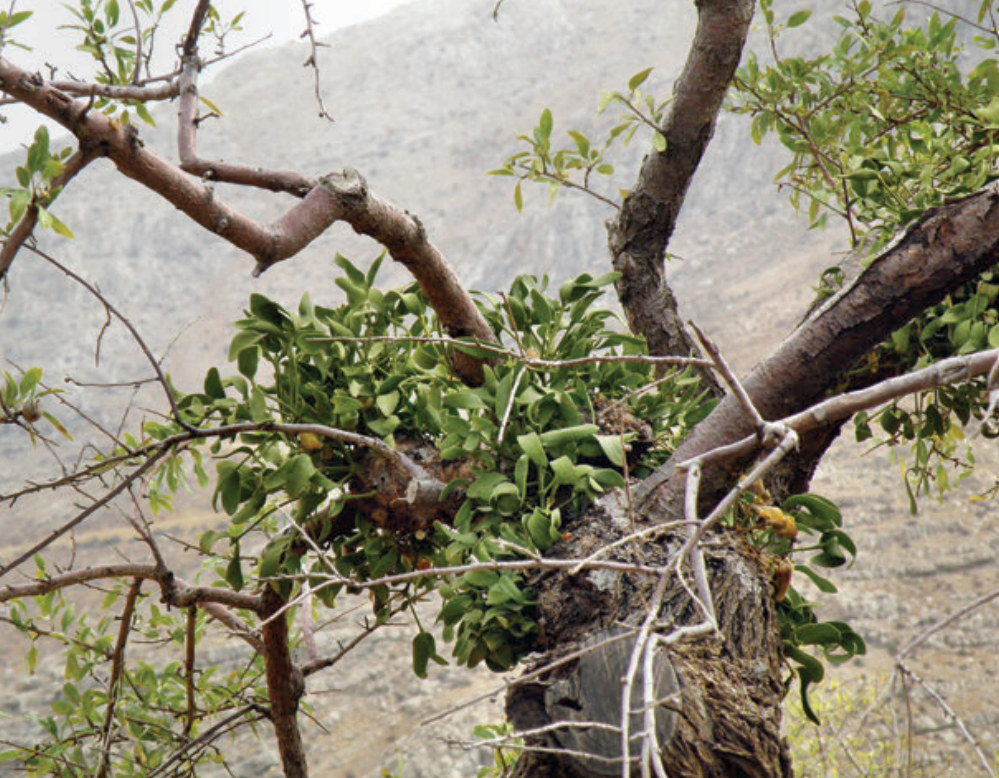
Plant name
white mist
Latin name
Viscum album L
Common names
White mistletoe, mistletoe, European mistletoe
foreign names
Eng. Mistletoe, Fr. Gui
The group
Dabke
Habitat and Geographic Distribution
Morocco is the native habitat of the argan tree, where it grows between Essaouira and Agadir in the Maghreb.
This region is characterized by arid and semi-arid climates with annual rainfall of less than 200 mm.
Some argan populations are also found in northeastern Morocco, near Oujda, and to a lesser extent in the Tindouf region of Algeria.
It grows naturally in Morocco, Algeria, and Tunisia, and is also found in Sudan.
Botanical description
A semi-parasitic, dioecious shrub that grows in clusters on the branches of many fruit and forest trees or on some shrubs.
4 - Some shrubs.
The twigs are soft, jointed, swollen at the nodes, dichotomous or cyclic, 7 cm thick.
The leaves are simple, sessile, opposite, ellipsoid to spoon-shaped, perennial, thick, entire margins, with parallel veins.
The flowers are unisexual, sessile, four-part, inconspicuous, often clustered 5-35 mm long, with a 35-mm blade, fringed.
The calyx is simple, with free, reddish-yellow segments in axillary spherical inflorescences.
The bracts are two, concave, about 1 mm long, obovate.
The fruit is a berry, spherical, stamen-bearing, sessile.
The ovary is inferior, about 4 mm long.
The male is about 1 mm long.
6 cm - contains one seed, 1 cm long, whitish to semi-transparent in color, its fruiting sheath is sticky, its diameter is towards flowering from March to May.
Used part
Seed oil.
Oil production: Argan oil is extracted in a traditional way, starting with collecting the ripe fruits from the tree or by collecting the nuts that goats and camels excrete with their droppings after eating the fruits.
The seeds are lightly roasted (though roasting is preferable for cosmetic uses to produce an odorless oil), then ground into a paste.
This paste is kneaded and cold-pressed to yield an edible oil with a reddish hue, darker than olive oil, and a taste similar to hazelnuts.
Argan oil is a significant economic product in Morocco and is of interest to many companies and consumers in several Western European countries, America, and Japan, due to its...
Due to its uses in diet foods and the manufacture of cosmetics and skincare products, demand for it has increased, driving its price up to between $80 and $100 per liter, making it one of the most expensive vegetable oils in the world.
chemical components
The fruit contains carbohydrates (11%), including glucoproteins (mistletoe lectins III, II, and I), commonly called viscotoxins.
It also contains 0.1-0.05% amino acids (46% polypeptides), viscotoxins A2, A3, B, and P, and 5% lectins (composed of polysaccharides called viscotoxins).
Additionally, it contains glycosides such as viscin, quebrachitol, and manitol.
Quercitin contains quercetin glucosides, flavonoids, sinigrin, rhamnazin, isorhamnetin, rhamnetin isomers and glucosides, syringaresinol (including syringaresinol), lignans, oleanolic acid, betuline acid, alpha-amyrine, and ursolic acid.
The market contains the same compounds found in the leaves but in smaller quantities.
Properties and medical uses
Argan-based preparations have been widely used in traditional Moroccan medicine for their biological properties, including for diabetes, particularly argan oil.
However, the anti-hyperglycemic effect of argan fruit peel has not been evaluated.
Argan oil possesses antioxidant properties (higher than those of olive oil), which help reduce the risk of cancer.
Linalool, the fatty acid in argan oil, is involved in the synthesis of prostaglandins, which effectively increase the permeability of the skin.
Furthermore, argan oil offers benefits for maintaining skin vitality and treating acne, burns, and skin cracks, most importantly by stimulating cell function through increased oxygen delivery.
It also stimulates enzymatic activity involved in eliminating toxins and free radicals.
In the skin cells responsible for skin aging (Vitamin E) - restores skin radiance, combats skin aging, and repairs its cells (Vitamin A) - nourishes, softens, and protects hair from damage, in addition to strengthening nails.
Global cosmetic laboratories currently use argan oil in the manufacture of numerous products, including lotions, moisturizing creams, massage oils, and transparent glycerin soaps.
Argan oil is traditionally used as an anti-inflammatory, antibacterial, and pain reliever.
It is also used topically to treat minor wounds and scars resulting from acne and chickenpox.
It has been found to possess properties that lower blood sugar and cholesterol levels, and exhibit antioxidant activity in cases of severe diabetes.
Moroccan women use argan oil to add shine and beauty to their hair.
Argan oil is a key ingredient in cosmetics.
Cosmetic companies use it in the production of fragrant soaps and various other cosmetic products.
Argan oil is used to treat rheumatism and burns.
It is also used as an aphrodisiac and to aid in sperm production. The tree root is used to treat diabetes and colitis.
Side effects and precautions
Allergic reactions or drug interactions may occur; self-use should be avoided by pregnant and breastfeeding women, children, and patients with chronic diseases.
Other uses
Argan oil, with its distinctive nutty aroma, is used in cooking much like olive oil.
Its lack of cholesterol makes it beneficial for diets aimed at lowering cholesterol levels, protecting the heart and arteries, and generally strengthening the body's defenses.
In Morocco, the oil is used to flavor couscous, salads, vegetables, meat, and fish.
Argan trees are used in artificial reforestation, agricultural projects, and combating desertification, as they stabilize the soil.
They are excellent for rehabilitating all sites within their natural range and can also be used as ornamental and shade plants in streets, gardens, and public spaces.
Argan wood is suitable for various industrial uses; it is of high quality, very hard, and heavy, making it useful in industry, fuel production, and the production of high-quality charcoal. Livestock feed on argan trees.
the environment
The plant spreads in forests and orchards as a semi-parasitic plant on forest and fruit trees (especially almond, poplar, apple, oak, and chestnut), and is rarely found on coniferous trees.
The parasitic tree must be at least one year old, and the host tree is rarely dead. It is found particularly on calcareous trees, 20 years of age or older.
Agriculture and productivity
The tree was on the verge of extinction due to overgrazing and illegal logging by local residents, but the Moroccan government is currently making efforts to preserve it.
Argan trees are difficult to propagate, whether by seed or vegetatively, and few experiments have been conducted on large-scale propagation.
Numerous attempts have been made to cultivate them in many countries, such as Tunisia, Libya, and more recently in the Arabian Gulf.
Cultivation has been successful in several Mediterranean countries, including Jordan, Palestine, and Tunisia. Breaking dormancy in the
History and Heritage
The name "argan" is of unknown origin and refers to the Argania spinosa tree.
It may be a Berber word, and it is the name of a tree considered blessed by Moroccans, famous for its fruit, oil, and global reputation.
The uses of argan oil have been known for centuries, and it has been used in food and some cosmetic products.
It was described in the book of Ibn al-Baytar, as well as in several books by early Western scholars. The name for the species, spinosum, means "thorny."
Medical note
This information is for educational purposes only and does not constitute medical advice.
Poisonous or potent plants should only be used under the supervision of a qualified physician or pharmacist.
Related images


