Lavender | A medicinal plant in the Akhdar encyclopedia
The flowering tops of the plant possess blood sugar-lowering properties and are popularly used for lung pain, asthma, chest colds, and stomach ailments. Lavender oil has been shown to reduce foot and ear edema in mice, as well as inhibit the skin's inflammatory response. It also exhibits anti-tumor…
Plant name
lavender
Latin name
Lavandula stoechas L
Common names
Lavender, thyme
foreign names
Eng. Arabian Lavender, Fr. Lavande
The group
oral
Habitat and Geographic Distribution
Around: the Mediterranean and Black Seas
Botanical description
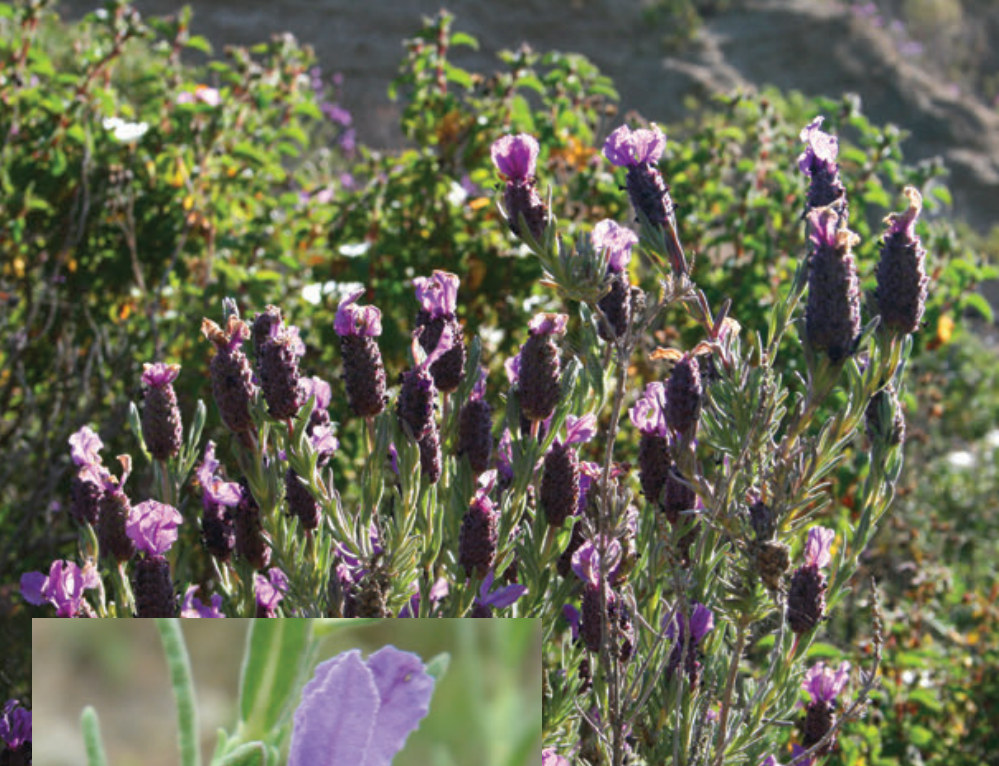
50 cm, highly branched, small shrub, its length covered with dense gray hairs.
The stem is erect, with many leaves.
The leaves are simple, oblong, entire, dull-tipped, linear-edged, curling downwards, gray on both surfaces.
Clusters of leaves are observed on very short branches in the axils of the larger leaves.
The flowers are gathered in closely spaced panicles, each containing flowers, forming oblong spikes 10 cm long.
The fertile bracts (1 x 3 cm) are ovate, with overlapping dimensions (those with flowers in their axils), inverted triangular in shape with rounded corners, bearing a network of rhizomes.
The sterile bracts (those without flowers in their axils) are obovate, purplish to violet in color, forming tufts, grayish and downy, composed of a tube ending in five brightly colored teeth at the tip of the spike.
The calyx is roughly triangular in length, the upper end ending in an inverted heart-shaped sepal.
The corolla is purple, the tube slightly longer than the calyx. Flowering occurs from February to May.
Used part
flowering peaks
chemical components
37% linalool, 17% camphor (a volatile oil rich in compounds such as camphor), 1.2-0.7% (contained in the flowering parts), 25% 1-8% cineole.
Properties and medical uses
The flowering tops possess blood sugar-lowering properties and are popularly used for lung pain, asthma, chest colds, and stomach ailments.
Lavender oil is known for its ability to reduce foot and ear edema in mice, as well as inhibit the skin's inflammatory response.
It also exhibits anti-tumor activity against various cancers, such as stomach and breast cancer.
The aqueous extract of the plant has a high phenolic content and possesses antioxidant activity. Side effects, interactions, and
Side effects and precautions
Using high doses of the oil causes symptoms of toxicity.
the environment
The plant spreads on sunny slopes and prefers siliceous varieties. The plant can grow in the shade and is relatively drought-tolerant.
Agriculture and productivity
The plant is propagated by seeds, which germinate within 1-3 months at 15°C, or by stem cuttings at any time of year.
(Marrubium vulgare L., M.
apulum Ten., M.
ballotoides Boiss.
& Balansa, M. hamatum Humb. Kunth., Prasium marrubium E. H. L. Krause, Lamiaceae)
History and Heritage
The genus name was mentioned in the previous species.
Some suggest that the species name derives from islands south of France, known as Astrès Chores, meaning "arranged in a straight line," while others believe it refers to the spike-shaped flowers (2009).
Medical note
This information is for educational purposes only and does not constitute medical advice.
Poisonous or potent plants should only be used under the supervision of a qualified physician or pharmacist.
Related images


