Devil's Ammi | A medicinal plant in the Akhdar encyclopedia
Preparations made from the seeds of the plant *Ammi visnaga* are used topically in the form of creams with caution in cases of skin discoloration, vitiligo, and psoriasis. After using the medication, exposure to sunlight for one to two hours daily is recommended. A decoction or infusion of the seed…
Plant name
Satanic trait
Latin name
Ammi majus L
Common names
The Devil's Friend, The Crow Man
foreign names
Eng. Common Bishop, Fr. Ammi des boutiques
The group
celery
Habitat and Geographic Distribution
Haw: the Nile Valley (Egypt, and Sudan) and Haw: the Mediterranean Valley (Syria, Morocco, Algeria, Libya).
Botanical description
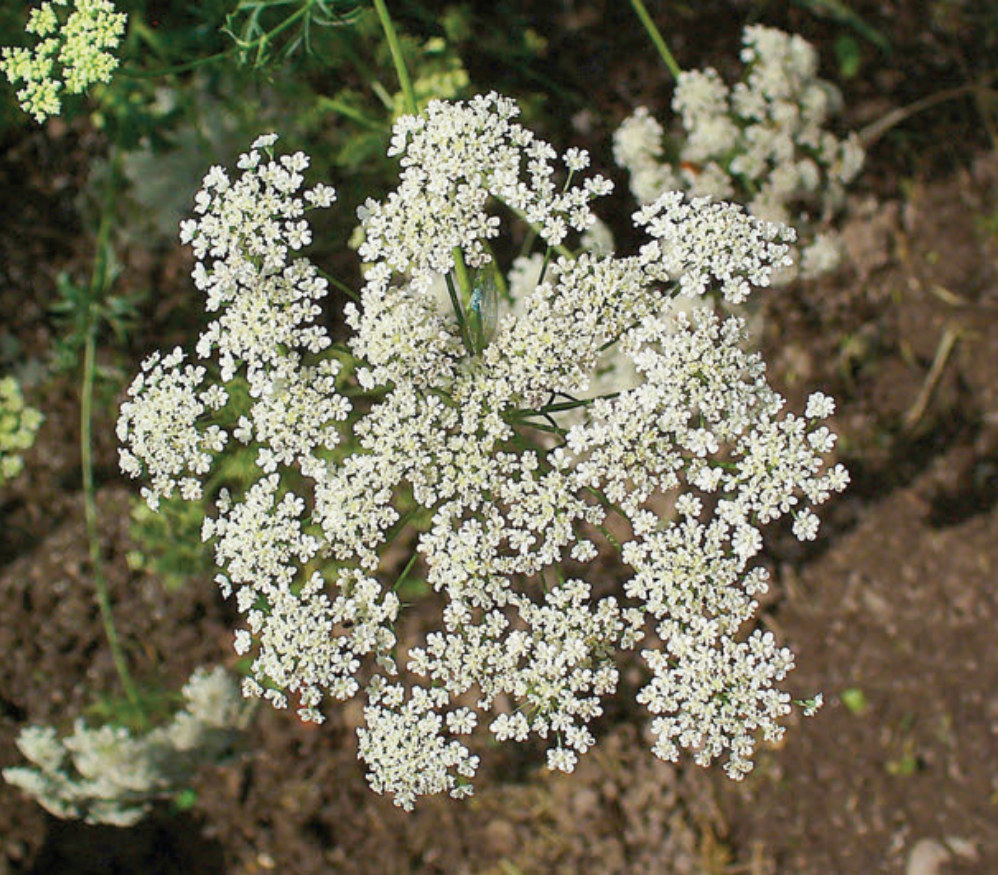
The stem is erect, highly branched, and the cymes are stiff and serrated.
The leaves are 70 - a perennial herb, glabrous, bluish-green in length.
- The lower leaves are long-petioled, trifoliate, deeply divided into oblong lobes; the upper ones are less divided.
The compound umbel is long, with a spikelet that reaches a diameter of about [missing information]. Flowering occurs from March to August.
Used part
Ripe fruits are harvested in late summer.
chemical components
The fruit contains coumarins and coumarin glycosides (1%), ammoidin (5%) (xanthotoxin), ammidin (0.3%), and majudin (10.0%) (bergapten).
It also contains biologically active compounds such as furanocoumarins and flavonoids.
The plant does not contain khellin.
Three new coumarin species have been isolated from the aerial parts of the plant, including pyrannocoumarin.
Properties and medical uses
Preparations made from the seeds of the plant *Ammi visnaga* are used topically in the form of creams with caution in cases of skin discoloration, vitiligo, and psoriasis.
After using the medication, exposure to sunlight for one to two hours daily is recommended.
A decoction or infusion of the seeds is used traditionally to relieve asthma attacks, lower blood sugar, alleviate digestive disorders, and expel flatulence.
The ethanolic extract of A.
majus seeds exhibits lipid-lowering, anti-inflammatory, analgesic, and antipyretic activities.
Pharmaceutical forms: Various pharmaceutical forms containing meladinine and neo-mela-dinine are available, including tablets and ointments.
Precautions: Side effects have been observed during use, the most significant being kidney inflammation.
pharmaceutical forms
Neo-meladinine is available in various forms, including tablets and ointments.
Precautions: Side effects have been observed during use, the most significant being kidney inflammation.
Side effects and precautions
Side effects were observed during use, the most important of which were kidney infections.
the environment
The khella plant is a light-loving species and thrives in regions with mild winters.
It grows in soils ranging from neutral to slightly alkaline.
Cultivation and productivity: 1 ton/hectare.
During the growing season, it requires 0.6-1.2 kg/hectare, and khella yields range from 5 tons/hectare.
It is propagated by seed and requires sufficient moisture, except during flowering and fruit ripening, as excessive moisture reduces production.
Agriculture and productivity
It is propagated by seed at a rate of 4-5 kg/hectare, with yields ranging from 0.6 to 1.2 tons/hectare.
During the growing season, it requires sufficient moisture, except during flowering and fruit ripening, as excessive moisture reduces production. Ammi visnaga (L.) Lam. Visnaga daucoides Gaertn
History and Heritage
The scientific name is derived from the Greek word for an unspecified eastern plant, a genus in the Apiaceae family.
Ibn al-Baytar used the plant *Ammi visnaga* in the treatment of vitiligo in the thirteenth century, mentioning it in his book "Mufradat al-Adwiya" (Dictionary of Medicines) under the name *Astrelal*, a Berber word meaning "bird's foot." In Egypt, it is known as *Rawd al-Ghurab* (crow's foot), *Jadr al-Shaytan* (devil's root), and *Ammi visnaga* (devil's khella).
Galen, however, called it *Amir*.
One tribe in the Maghreb region of North Africa recognized its benefits for vitiligo and its members used to sell the medicine to vitiligo patients, but they kept it secret.
It is worth noting that the first to mention vitiligo were the ancient Egyptians in the Ebers Papyrus.
Medical note
This information is for educational purposes only and does not constitute medical advice.
Poisonous or potent plants should only be used under the supervision of a qualified physician or pharmacist.
Related images


