Khella | A medicinal plant in the Akhdar encyclopedia
The compounds khellin, visnadine, and visnagin stimulate the heart muscle and improve its blood supply by dilating the coronary arteries (a coronary vasodilator). Until recently, this drug was used to treat angina pectoris, heart failure, and episodes of tachycardia. The compounds in the fruit of t…
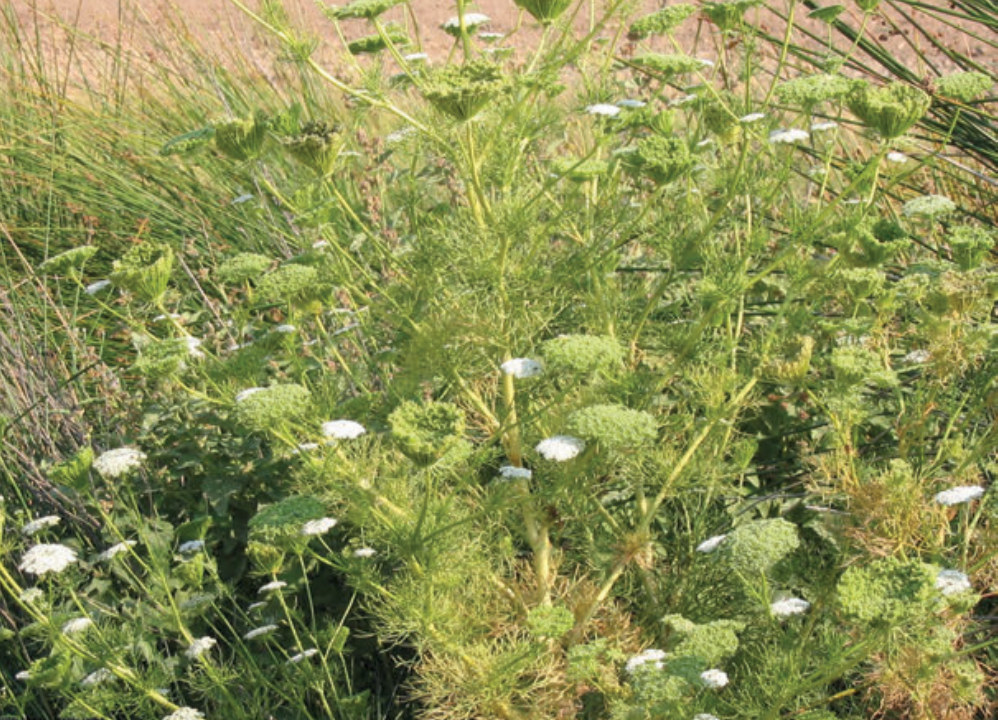
Plant name
The khalla
Latin name
Ammi visnaga (L.) Lam
Common names
Khella, local khella, medicinal khella, Ethiopian cumin, miswak herb
foreign names
Toothpick (English), Toothpick herb (French)
The group
celery
Habitat and Geographic Distribution
Native to the Mediterranean, the Middle East, and North Africa (including the Nile Valley, Cyprus, and Sudan), and extending westward to the Iranian-Turanian region, it is cultivated in Mediterranean countries, particularly in Cyprus and Morocco, and also in some parts of North America.
Botanical description
The stem is erect, branched, and lobed.
It is a glabrous, biennial herb.
The leaves are ovate in general shape, the basal leaves are pinnately compound, and the stem is bipinnate or tertiary.
The leaf blade segments are linear to thread-like, complete, 1-0.5 x 1 cm (non-toothed), dichotomously branched.
The flowers are white, clustered in terminal compound umbels, with long stalks, 13 cm, then shrink at fruiting.
The bracts are 3-7 cm long and harden.
The external stalks of the compound inflorescence are as long as or longer than the stalks, deeply divided into thread-like lobes, and laterally drooping.
The bracts of the simple umbels are complete.
The flower stalks are longer than the flowers and the fruits.
The petals are equal in size.
The styles are long and recede backward.
The inflorescence is layered, nearly spherical, and nest-like, opening in moist conditions after rainfall.
The fruit is ovoid to oblong, glabrous, with thick ribs. The fruit is a double acinus, with flowering occurring from April to August.
Used part
The fruit, harvested before full ripeness in late summer, contains volatile oil.
chemical components
The fruits contain furanochromones, including khellin (1%), khellin (2-4%), and furanochromones.
These include visnagen (0.05-0.3%), visnagen (0.5-0.2%), pyranocoumarins, ammiol, visnadin, and other pyranocoumarin compounds, as well as a fixed fatty oil, sorhamneti, kaempferol, and quercetin (0.03-0.02%).
They also contain 33% methyl butanoate and 2-methylbutyle. Compounds 0.03-0.02%, volatile oil %, proteins 18-12%
Properties and medical uses
The compounds khellin, visnadine, and visnagin stimulate the heart muscle and strengthen its blood supply by dilating the coronary vessels (a coronary vasodilator).
Until recently, this drug was used to treat angina pectoris, heart failure, and episodes of tachycardia.
The compounds in the fruit of the khella plant, particularly khellin, are known for their antispasmodic effect, which relaxes smooth muscles throughout the body.
Khella fruit is used to relieve whooping cough, bronchial asthma, bronchitis, and to soothe stomach and intestinal disorders.
Khellin, visnagin, and khellin glycoside help increase urine output and treat urinary tract spasms caused by kidney stones.
They relax and widen the ureter muscles, facilitating the passage of small kidney and ureter stones and reducing the pain of ureteral irritation.
The plant exhibits antibacterial activity against Gram-positive bacteria.
The essential oil of khellin is used internally as an antispasmodic and is used for asthma and renal colic.
It is also used externally to treat various skin diseases.
The fruits have shown Its main components (khellin and visnagin) have beneficial effects on kidney stones caused by hyperoxaluria in male rats by reducing the precipitation of calcium oxalate crystals and increasing urine excretion.
Khellin is commercially available in tablet and ointment form.
Side effects, interactions, and precautions: The skin becomes phototoxic during drug use; therefore, sun exposure should be avoided while taking the drug, and it should not be used for extended periods.
Research has shown Prolonged use of khellin is not without side effects, manifesting as a toxic accumulation of khellin in the body, causing insomnia, nausea, and vomiting.
It may also lead to an increase in liver enzymes, which has limited its current use in America.
However, it is still used traditionally in Mediterranean countries.
Khellin should not be used by patients taking blood thinners or vasodilators except after consulting a specialist physician. It may cause bile stasis. Warqan
Side effects and precautions
While taking this drug, the skin becomes sensitive to sunlight (phototoxic), so sun exposure should be avoided during treatment.
It should also not be used for extended periods.
Research has shown that prolonged use of khellin can have side effects, including toxic accumulation in the body, causing insomnia, nausea, and vomiting.
It may also lead to elevated liver enzymes, which has limited its use in the United States, although it remains popular in Mediterranean countries.
Patients taking blood thinners or vasodilators should not use khellin without consulting a doctor. It may cause cholestasis (bile stasis) and jaundice.
Other uses
The flower heads of the khella plant are used in many countries for teeth cleaning.
the environment
The plant *Khella* grows wild on heavy alluvial soils, roadsides, marshes, rock crevices, and neglected soils.
It thrives in arid, semi-arid, and semi-humid climates and is drought-tolerant.
Its vegetative and fruit production is high at low winter temperatures, as this leads to a significant increase in the plant's active ingredient content.
It can be cultivated in all types of soil, but prefers fertile, sandy, and loamy soils with good drainage. It is salt-tolerant. The ideal soil type is pH 6.8-8.3.
Agriculture and productivity
The plant is propagated by seeds sown during the fall, but it can also be sown in the spring, where the land prepared for cultivation is divided into basins or beds.
One hectare needs 4-7 kg of seeds.
The plants need thinning when they reach 10-15 cm in length.
They also require moisture (irrigation) at the beginning of the flowering season, taking care that excessive moisture during flowering negatively affects production.
The plant responds well to fertilization.
It flowers at the beginning of summer, and the fruits and seeds ripen at the end of the season.
The plants are harvested early in the morning and dried in the sun for a week.
The fruits are then separated, sifted, and stored.
The inflorescences are collected before the stage of Full maturity is necessary because its mature inflorescences shatter, causing crop loss.
The yield of the local variety of Ammi visnaga can reach up to 1 ton/ha from seeds.
(Anethum graveolens L., Anethum arvense Salisb., Angelica graveolens L.
Steud., Ferula graveolens L.
Spreng., Pastinaca graveolens L.
Bernh., Peucedanum graveolens L. Benth. & Hook. f. ex Hiern., Selinum graveolens L. Vest.)
History and Heritage
Ammi is the Greek scientific name for an unspecified eastern plant belonging to the Apiaceae family.
The plant was mentioned in the books of Ibn al-Baytar and Ibn Sina, who noted that it contains extremely bitter substances that are useful in treating renal colic.
The plant *Ammi visnaga* was mentioned in the Egyptian Ebers Papyrus 1500 years before Christ for its benefits in treating diseases of the heart, respiratory system, and urinary system (kidney stones).
Tea prepared from the fruit of *Ammi visnaga* was traditionally used by kidney stone sufferers in Egypt.
*Ammi visnaga* has been used in folk medicine by the inhabitants of the Eastern Mediterranean since ancient times.
A decoction of the fruit was used to treat renal colic by the ancient Egyptians and nephritis in Iraq.
In Palestine, and in Algeria, it was used to treat urinary retention and prostate pain, and its use became so widespread that it was the most recommended type for treating urinary tract infections.
Medical note
This information is for educational purposes only and does not constitute medical advice.
Poisonous or potent plants should only be used under the supervision of a qualified physician or pharmacist.
Related images


