Castor bean | A medicinal plant in the Akhdar encyclopedia
Castor oil possesses laxative and digestive-cleansing properties. This property is attributed to the presence of ricinoleic acid. Pure, ricin-free castor oil is used to cleanse the digestive system before surgery and childbirth. Castor oil is also traditionally used for acute constipation and infla…
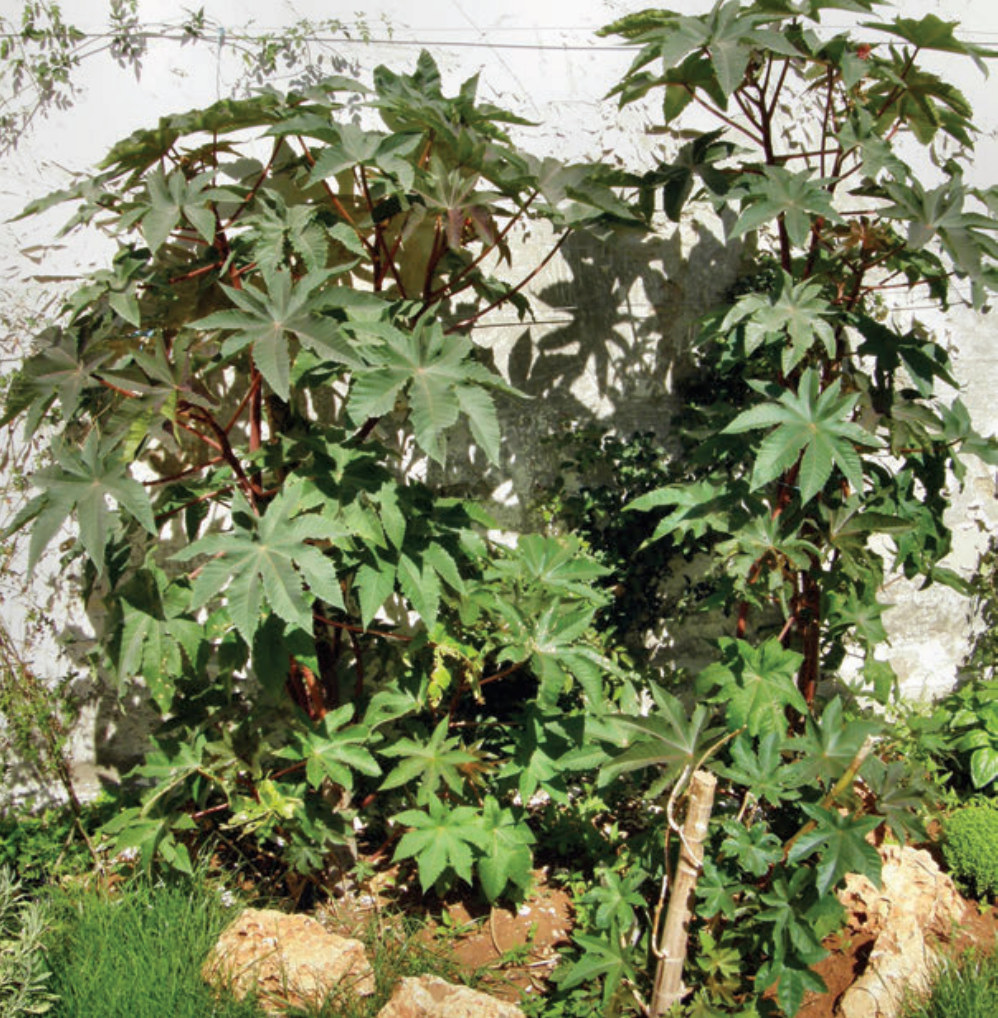
Plant name
castor
Latin name
Ricinus communis L
Common names
castor
foreign names
Eng. Oil castor, Fr.Ricin
The group
Afro-European
Botanical description
The stem is erect, densely branched from above, thick, shrubby or woody, grayish-green, glabrous, 11 cm (or more) long, pedicel-shaped.
The blade is palmate, lobed, and comprises 25 lobes.
The leaves are simple, alternate, uterine in length, and toothed at the margin.
The stipules are fused.
The flowers are unisexual, monoecious, and clustered in axillary or terminal racemes, where the male flowers are arranged in lobes 5 cm long.
The simple spathe consists of 1 at the top of the inflorescence, and the female flowers are at the bottom.
The male flowers are numerous and fused towards the stamens, branching several times to a height of 5 cm.
The spathe has numerous anthers.
The female flowers are in deciduous lobes.
The ovary is simple, composed of trilobes, spherical or ovoid, with a short style.
The stigmas are trilobed, red, and bilobed, each lobe containing one ovule.
The fruit is elliptical, covered, oblong, and has a capsule with soft spines, rarely smooth.
Each stone opens to a depth of 1.5 cm.
The seed is glabrous, mottled, and bears a very small, two-lobed papilla at its apex.
Flowering occurs from March to November.
Native to India and tropical Africa, it has become cosmopolitan and is well adapted to tropical and temperate regions worldwide.
It is widely cultivated in Brazil, North America, India, Sudan, Mars, and China.
Used part
Castor oil (seeds and oil extracted from them; Latin name: Ricinus communis L.)
chemical components
E: In addition to traces of ricinin, all parts of the plant contain alkaloids from the pyridine derivatives, including ricinoleic acid cyanhydride.
The leaves contain phenolic compounds, and the stems contain terpene compounds, sterols, and steroids (to which the laxative effect is attributed).
It is rich in ricinoleic acid (55%).
The seeds contain a toxic fatty oil and the alkaloid ricin.
They also contain the alkaloid ricinoleic acid, linoleic acid, and non-toxic linoleic acid.
Castor oil is prepared by cold pressing the seeds. The oil is then exposed to sufficient heat to inhibit lipase enzymes.
Properties and medical uses
The oil has laxative and cleansing properties for the digestive system.
This property in castor oil is due to the presence of ricinoleic acid.
Pure, ricin-free castor oil is used to empty the digestive tract before surgery and childbirth.
Castor oil is also used traditionally for acute constipation, intestinal inflammation, and to eliminate worms.
It is also used topically for skin inflammations, boils, abscesses, otitis media, and headaches (in the form of compresses).
The plant has strong antimicrobial effects, particularly against Pseudo-, Staphylococcus aureus, and Escherichia coli.
It is effective against Candida albicans, Klebsiella pneumoniae, and Monas aeruginosa.
pharmaceutical forms
Castor oil is available as a medicine in solid and semi-solid forms, and in pharmaceutical preparations for internal and external use.
Side effects and precautions
It should not be used in cases of intestinal obstruction, inflammatory bowel diseases, appendicitis, abdominal pain of unknown origin, during pregnancy and lactation, or in children under 12 years of age.
Side effects, such as allergic skin rash, may occur in rare cases.
Overdosage can lead to gastric irritation with nausea, vomiting, colic, and severe diarrhea.
Long-term use leads to electrolyte loss, particularly potassium, which may result in hyperaldosteronism, inhibition of intestinal motility, and potentiation of the effects of cardiotoxic steroids.
Other uses
Castor oil is used in the manufacture of soaps and shampoos for hair care, increasing shine and preventing hair loss and breakage.
The plant's residue, after detoxification, can be used as organic fertilizer.
Side effects, contraindications, and precautions: It should not be used in cases of intestinal obstruction, inflammatory bowel diseases, appendicitis, abdominal pain of unknown origin, during pregnancy and breastfeeding, or given to children under 12 years of age.
In rare cases, an allergic skin rash may occur.
An overdose can lead to gastric irritation with nausea, vomiting, abdominal cramps, and severe diarrhea.
Long-term use leads to electrolyte loss, particularly potassium ions, which may result in hyperaldosterone, inhibition of intestinal motility, and potentiation of the effects of cardiac-active steroids.
Pharmaceutical preparations: Castor oil is available as a complete medicine in solid and semi-solid forms and in pharmaceutical preparations for internal and external use.
the environment
The plant grows in fallow and neglected lands, along roadsides, and in valleys throughout tropical and temperate regions.
It thrives in light, well-drained, and aerated sandy soils.
Cultivation and Productivity: Sow seeds one hour before planting.
It propagates easily from seeds that require no treatment or can be soaked in plain water.
Sow during February and March in temperate and hot regions, and in April and May in colder regions.
Sow 3 kg of seeds, sown at a depth of 10 cm, in rows 50x75 cm at a spacing of 3 cm, at a depth of 10 m².
Water moderately.
Harvest the fruits when they are ripe and bright yellow, about once every four days.
The harvesting process continues for a month.
Store the fruits in a clean, dry place where their halves open and the seeds fall easily.
Agriculture and productivity
The plant is propagated by seeds, which do not require any special treatment, or they may be soaked in ordinary water for 24 hours before planting.
Seeds are sown during February and March in temperate and warm regions, and in cold regions during April and May.
One dunam (approximately 0.25 acres) requires 10 kg of seeds, sown at a depth of 3 cm in the soil, in rows spaced 50x75 cm apart, and watered moderately during the summer.
Harvesting begins when the fruit is ripe and light yellow, approximately every four days, and continues for a month.
The fruit is then stored in a clean, dry place, where its slits open, making it easier for the seeds to fall out.
Acacia arabica (Lam.) willd., A.
nilotica (L.) Del., A.
adansonii Guill. & Perr, Vachellia nilotica subsp. tomentosa (Benth.) Kyal. & Boatwr
History and Heritage
The name Ricinus is the scientific name for the Latin genus of this plant, meaning "dog tick," referring to the shape of the seeds.
The genus name means "common." Castor oil has long been known for its medicinal properties.
Archaeological evidence shows its seeds have been found in some ancient Egyptian tombs.
The belief was that a routine laxative at least three times a month was essential for maintaining good health.
Ancient Babylonian texts also recommended using its oil to treat abdominal disorders, and it was used for the same purpose by the Greeks and Indians.
Medical note
This information is for educational purposes only and does not constitute medical advice.
Poisonous or potent plants should only be used under the supervision of a qualified physician or pharmacist.
Related images


