Wild mallow | Medicinal plant in the Akhdar encyclopedia
The plant, with its mucilaginous properties, protects against irritation of mucous membranes. It is also anti-hemolytic. The flowers and leaves are used for dry coughs, bronchitis, chest colds, mouth and throat infections, and digestive tract infections. The flowers and leaves are used traditionall…
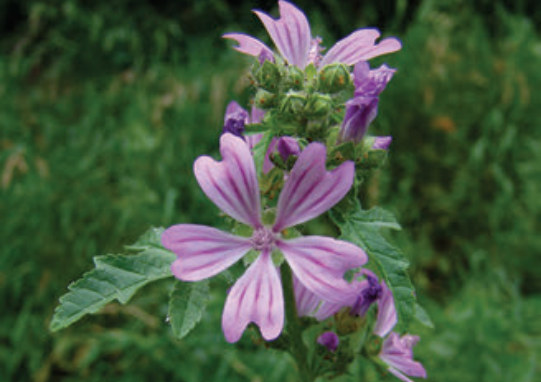
Plant name
wild mallow
Latin name
Malva sylvestris L
Common names
Wild mallow, mallow, mallow, mallow
foreign names
Common mallow (English), Wild mauve (French)
The group
bakery
Habitat and Geographic Distribution
Siberian and extended to the Mediterranean and European regions. Entered South America – Iranian, North America, and Australasia.
Botanical description
70 - A perennial or biennial herb, hairy, 7 cm long.
The stem is erect to ascending, sometimes prostrate, and branched.
The leaves are simple, long-petioled, rounded, toothed lobes.
7 - General form: lobed to the margin, heart-shaped at the base, hairy, palmately innervated, and varying in size.
The stipules are ovate to oblong, acuminate.
3 - The flowers are axillary, found in clusters of one or more flowers.
The inflorescences are erect.
Supports - free, oblong, 3 The calyx is composed of a septum, its length equal to two-thirds of the calyx length.
The calyx is 5 mm long, its lobes are joined, 10 - The sepals are ovate to triangular, bearing genus hairs.
The petals are five, free, pinkish-purple, four times the length of the calyx, ovate, oblong, scalloped at the apex, obovate, obtuse, with stamens whose filaments fuse and a base is hairy.
The male stamens fuse together to form a stomatal tube that branches into numerous anthers.
The female stamens are numerous.
Each fruit consists of approximately [number] segments, the diameter of which is equal to the number of carpels. Flowering occurs from February to April.
Used part
Dried flowers, dried leaves, and tender flowering plant.
Latin name: Malva sylvestris L., M. sylvestris L. var. mauritiana (L.) Boiss., M. sylvestris L. var. oxyloba Post
chemical components
Gossypetin-3-glucoside, hypolaetin-3-glucoside: The leaves contain flavonoids.
Arabinogalactans, galacturonorhamane: These are mucilaginous substances, polysaccharides similar to those found in the leaves, and mucilaginous substances.
Malvin: This includes anthocyanin compounds. The flowers contain anthocyanin compounds found in the leaves.
Properties and medical uses
The plant, with its mucilaginous properties, protects against irritation of mucous membranes.
It is also anti-hemolytic.
The flowers and leaves are used for dry coughs, bronchitis, chest colds, mouth and throat infections, and digestive tract infections.
The flowers and leaves are also used traditionally to treat coughs, asthma, bronchitis, tonsillitis, throat and mouth irritation, and digestive tract irritation.
A decoction of the flowers or leaves is used topically to treat wounds and skin abrasions, swelling and irritation of highly sensitive skin, toothaches, and insect bites.
Extracts of the raw leaves, flowers, and leaves are anti-inflammatory and have cytotoxic effects on various types of cancer cells.
Research is currently underway to develop copper oxide nanoparticles using mallow leaf extract, with potential applications in food and medicine.
Mallow is available in dried form and as a liquid extract.
It is sold under names such as Malvedrin and Malveol.
Precautions: The plant should be avoided by pregnant or breastfeeding women. It is also not recommended to use it for a long period of time.
Side effects and precautions
The plant should be avoided by pregnant or breastfeeding women. Prolonged use is also not recommended.
the environment
Summer-growing, it thrives in diverse environments from semi-arid and dry to moderately humid - mallow is a spring and warm wild plant, cultivated in various soil types and prefers the moist red soil. It gives high yields in fertile medium soils and responds well to irrigation.
Agriculture and productivity
Mallow is grown as a winter crop in warm regions, and its vegetative and flowering continues into spring, summer, and even late autumn when adequate moisture is available.
In colder regions, it is sown in spring.
Planting is done in rows, at 60x25 or 30x25 cm spacing, and sometimes at a higher density in beds or basins measuring 3x4 m.
It is recommended to bury the seeds at a depth of 3 cm.
Appropriate cultivation practices such as hoeing and weed and pest control are carried out.
Harvesting of leaves and flowers begins two months after planting and continues throughout the summer.
Flowers are gathered on hot, dry, sunny days around midday and dried in the shade at 40°C to preserve their color. Leaves are gathered and dried in the same way. (Ficus carica L.)
History and Heritage
The scientific name for the genus comes from the Greek word meaning "soft," alluding to the softness of its leaves (malakos) and its laxative properties.
Mallow was used as a culinary herb and in traditional medicine; it was mentioned by al-Ghassani and al-Antaki.
Medical note
This information is for educational purposes only and does not constitute medical advice.
Poisonous or potent plants should only be used under the supervision of a qualified physician or pharmacist.
Related images


