Black poplar | Medicinal plant in the Akhdar encyclopedia
The bark of the stem and leaves possesses antibacterial, anti-inflammatory, analgesic, and antispasmodic properties, attributed to salicylic acid derivatives and flavonoids. The zinc lignans it contains are beneficial in treating urinary disorders resulting from prostate enlargement. The ointment m…
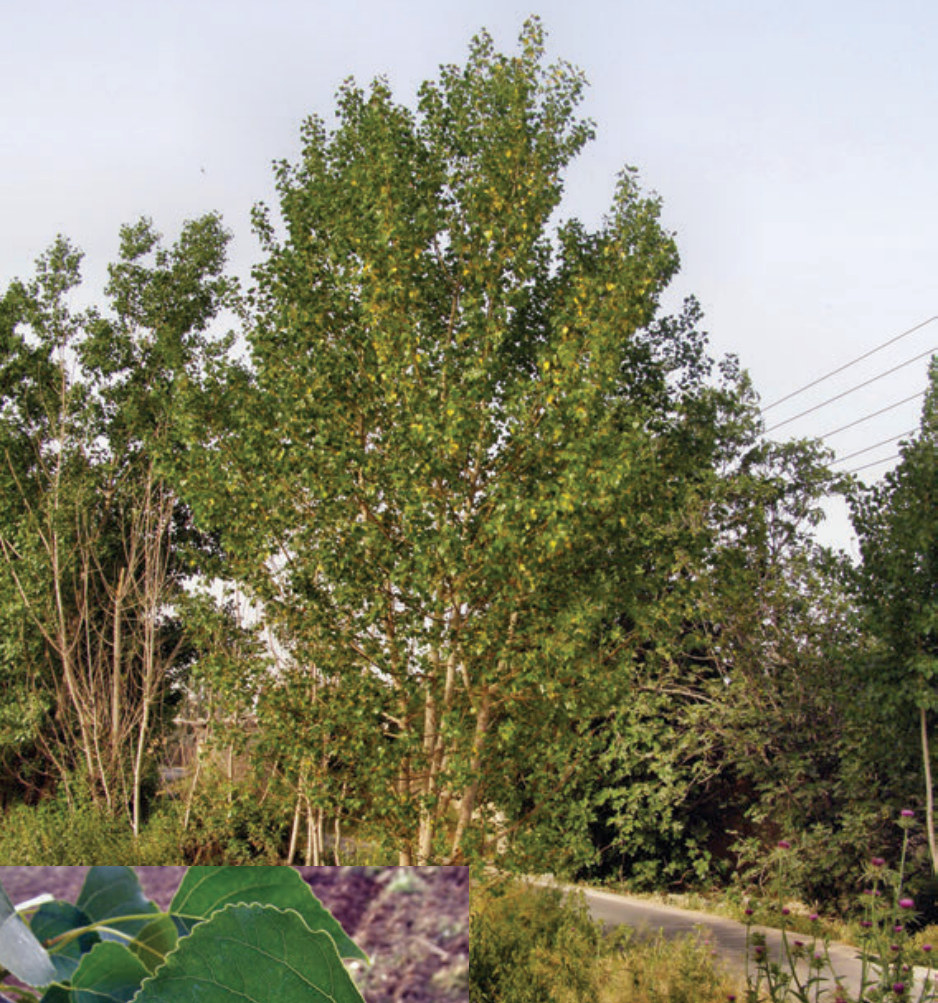
Plant name
black poplar
Latin name
Populus nigra L
Common names
Black poplar, Persian poplar, Hama poplar
foreign names
Eng. Black poplar, Fr. Peuplier noir
The group
Willow
Habitat and Geographic Distribution
The black poplar is native to riverbanks in Europe, Iran, and Turkey.
The white poplar is native to Europe and southwestern Asia, and grows naturally across large areas of North Africa and northern and western Asia. It is cultivated in many Arab countries.
Botanical description
Tall trees, sometimes reaching dioecious height.
Vegetative buds are small, glabrous, resinous, and sticky.
The stem is fissured.
Branches are ascending.
Leaves are simple, alternate, deciduous, relatively long-petioled, glabrous, heart-shaped, acuminate, and cristulate.
Stipes are membranous, small, and fall off quickly.
The inflorescence is catkins, appearing before the leaves, with a toothed, cup-shaped nectar disc.
Male inflorescences are drooping, reddish, emerging from the axil of a serrated bract.
The male contains free stamens.
Female flowers have an ovoid disc, the female is bicarpel, the ovary is monocarpal, surmounted by a simple style, ending in two large stigmas.
Pollination is windborne.
The fruit is a capsule, ovoid, opening in two (or three) valves.
The seeds are small, numerous, and bear a cluster of silky hairs.
They mature in May.
Flowering occurs from February to March.
Other species found in the Mediterranean region include *P.
euphratica Oliv.* and *P.
alba.L.*.
The white poplar is one such species. The components and uses of white and black poplar are similar.
Used part
The bark of the stem, leaves, and buds are harvested in the spring before they open. These parts can be used fresh or dried.
chemical components
The bark of the stem and leaves contains glycosides and esters that give salicylic acid, and includes the compounds salicin, tremulacin, and salicortin.
The buds contain 0.5-0.7% volatile oil, the most important components of which are α-β caryophylene and β-caryophyllene.
They also contain favonoids (especially in the cocoon that coats the bud and the resulting propolis), the most important of which are chrysin, tectochrysin, galengine, izalpinine, and quercetin.
They also contain phenolic glycosides, the most important of which are salicoside and populoside, as well as phenols, phenolic acids, phenylpropanoids, and terpenoids (mono- and sesquivalent).
Terpenoids (and vavones) (apigenol and quercetin), vavonones (pinocembrin and pinostrombin), caffeic and ferulic acids and their derivatives, and more than 48 plant compounds in essential oils.
These include fla-, rutin, quercetin-3-O-rutinoside, calendoflavobioside, quercetin-3-O-neohesperidoside, ferulic acid, vonoids, phenols (nigracin, populin), phenylpropanoids (3-O-β-D-glucopyranoside of caffeic acid), lignans, tannins, vitamins (C and E), carotenoids (neoxanthin, violaxanthin, lutein), and organic acids.
(formic, oxalic, malonic, glyceric, succinic, fumaric, malic acids), tartaric, α-ketoglu.taric, citric, quinic acids
Properties and medical uses
The bark of the stem and leaves possesses antibacterial, anti-inflammatory, analgesic, and antispasmodic properties, attributed to salicylic acid derivatives and flavonoids.
The zinc lignans it contains are beneficial in treating urinary disorders resulting from prostate enlargement.
An ointment made from the leaf buds, filled with resinous sap and salicin, is used topically for its anti-inflammatory properties in treating arthritis, rheumatism, hemorrhoids, anal fissures, and burns.
The steam from boiled poplar buds is traditionally inhaled to treat bronchitis, sinusitis, and nasal congestion.
The stem bark is used similarly to the buds.
The resinous secretions on the buds are a primary source of propolis produced by bees.
Numerous studies have demonstrated its antioxidant, anti-inflammatory, antibacterial, antifungal, antidiabetic, antitumor, hepatoprotective, and anti-leukemic properties, as well as its effects on melanin production.
Black poplar buds are a valuable and important source of bioactive compounds and are used to stimulate hair growth, treat nervous system disorders, and as a balm-based antiseptic, diaphoretic, diuretic, and antipyretic.
Side effects and precautions
Not to be used by people who are allergic to aspirin
Other uses
The wood of young branches is used to produce medicinal charcoal used for expelling intestinal gases.
The high cadmium content in the roots and relatively low content in the leaves indicates that *P.
nigra* is a good candidate for phytoremediation of sites contaminated with heavy metals such as cadmium.
Its wood is suitable for carpentry and match making. Precautions: Do not use if you are allergic to aspirin.
the environment
Black poplar thrives in damp areas, along riverbanks, streams, and springs.
It is characterized by its rapid growth, high light requirements, and intolerance of shade.
It tolerates drought well and resists strong winds.
It can live in various soil types but is affected by waterlogged and saline conditions.
It prefers deep, moist, fertile soils with a slightly alkaline to slightly acidic pH. The soil should be well-drained.
Agriculture and productivity
The black poplar is naturally propagated by seeds, which are easily dispersed by the wind.
It can also be propagated by cuttings, a method used in production stations.
Note that its seeds germinate quickly but lose their viability rapidly, and they do not tolerate long-term storage.
The plant is pruned after planting during the winter and fertilized with organic fertilizer in winter and with mineral fertilizer in spring and summer.
Poplars are susceptible to several pests, such as thrips and poplar stem borers, which are controlled by removing and burning infected branches along with appropriate pest control measures.
White poplars are propagated by root suckers and cuttings in February (tolerant of heavy pruning in winter and autumn).
They can be planted as windbreaks. *Salix alba* L. *Argorips alba* Raf., *Salix pallida* *Salix*
History and Heritage
The tree's name comes from Latin and means "popular" or "public." It is said that this tree, *populus* (the scientific name for the genus), meaning "black," was cultivated in public places during the time of the ancient Romans.
The descriptive term for the species *Cerbère* is related to the Greek myth of Hercules, who, after the battle with the guardian of Hell, carried black poplar leaves.
The leaves turned white after the battle.
The tree is also a symbol of death and grief for some cultures, while for the Celtic peoples it symbolizes doubt and uncertainty.
Medical note
This information is for educational purposes only and does not constitute medical advice.
Poisonous or potent plants should only be used under the supervision of a qualified physician or pharmacist.
Related images


