Harmal | A medicinal plant in the Akhdar encyclopedia
Harmal has monoamine oxidase inhibitory activity, making it a central nervous system stimulant. It is also an emetic, antispasmodic, anticonvulsant, hypnotic, and narcotic. It is used as a sedative and an anthelmintic for malaria and dysentery. The seeds have anti-tumor properties (against some typ…
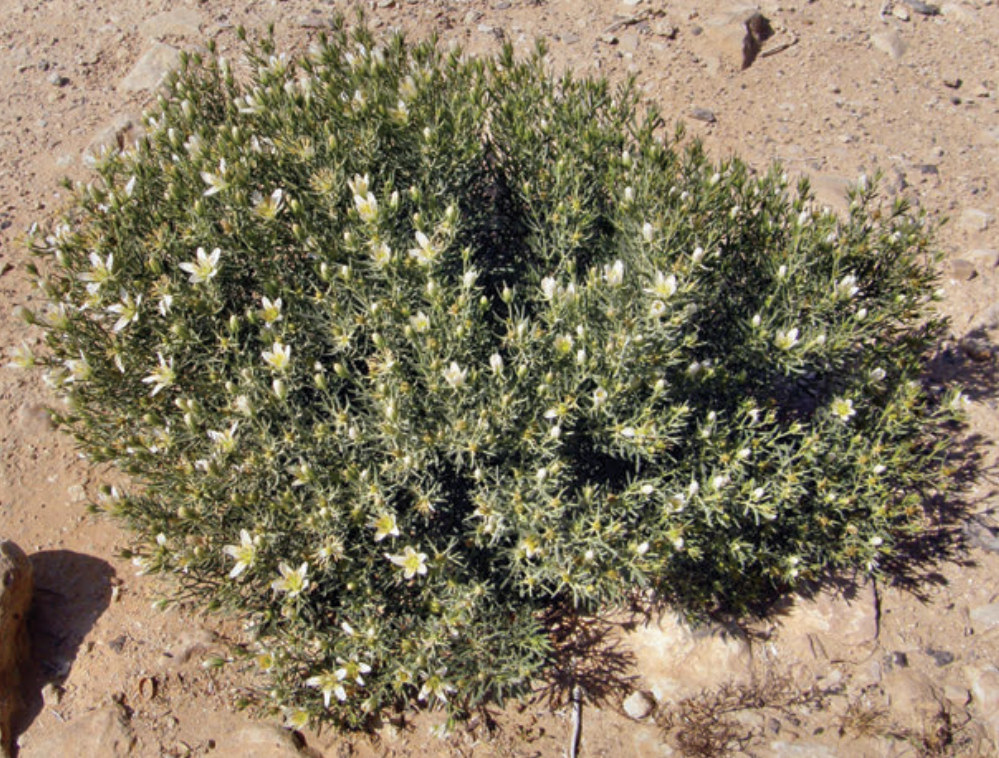
Plant name
harmal
Latin name
Peganum harmala L
Common names
Harmal, wolf's balm, desert harmal, dog's balm
foreign names
Engl. Hermala, Fr. Syrian rue
The group
Gharqadiya
Habitat and Geographic Distribution
Mediterranean countries, where it was mostly cultivated, and from there it spread to many countries on the five continents, where similar climates are available.
Botanical description
The stem is highly branched, angular at the top.
It is a perennial plant, woody at the base, glabrous, ranging in length from 1.5 to 2.5 cm, with small, erect or ascending stipe.
The leaves are alternate, with stiff hairs, the blade deeply and irregularly divided into erect, linear, uterine, entire-margined lobes.
The inflorescence is terminal cymose.
The flowers are hermaphroditic, large, with long spikes.
The sepals are five-pointed, 4 cm long, sometimes linear-trilobed, with scales between the sepals (forming what resembles permanent 2-1.5 lobes, 0.7-0.5 cm long and 1.5 cm wide, white or yellowish, oblong).
The petals are five-segmented, about 1 cm long, arranged in two rows on a cup-like disc.
The ovary is trilobed, spherical, 12-15 cm (elliptical, numerous stamens), spherical with a compressed apex, trilobed, polysperm, glabrous, 0.8-1 cm (numerous ovules).
The fruit is a brown, tuberous capsule, - mm, triangular, blackish-white, splitting into three valves, style nematous. Seed-setting occurs towards flowering from March to May.
Used part
Leaves, flowers, and fatty oil extracted from the fruit
chemical components
Harmaline is a poisonous plant in all its parts due to its richness in numerous alkaloids of the indole-pyridinaceous nature (harmalin).
The alkaloids are concentrated particularly in the seeds, where they constitute 0.52% (harmalol, harman, harmine, and harmine) and in the leaves, where they reach 0.36%, compared to 3–4% in the roots and stems.
The alkaloid harmalin makes up two-thirds of the total alkaloids in the seeds and is twice as toxic as harmine.
The alkaloid concentration is highest during the summer months, during the seed ripening period and the period immediately preceding harvest.
In addition to alkaloids, harmaline contains amino acids (valine, proline, histidine), flavonoids, coumarin compounds, tannins, sirtuates, and others. The outer seed coat contains a red pigment known as "Turkish red."
Properties and medical uses
Harmal has monoamine oxidase inhibitory activity, making it a central nervous system stimulant.
It is also an anthelmintic, emetic, antispasmodic, hypnotic, and narcotic.
It is used as an anesthetic and an anthelmintic for malaria and dysentery.
The seeds possess anti-tumor properties (against some types of cancer cells) and antioxidant properties.
The seed extract is used traditionally as a sedative, diaphoretic, vermifuge (by paralyzing the worms and rendering them immobile, thus facilitating their expulsion), antispasmodic, and for digestive disorders.
It is also used to treat hemorrhoids.
A decoction of the leaves is used to treat diabetes.
Topically, the seed extract is used as an antiseptic, antibacterial, and antifungal agent.
It aids in wound healing, burn recovery, and the treatment of certain skin conditions (itching, itching, boils, eczema).
Studies have shown that aborted fetuses and sperm can cause infertility in women.
Side effects and precautions
The seeds have a toxic effect; large doses cause digestive disturbances such as vomiting accompanied by nausea and sweating, cardiac disturbances (palpitations), and neurological disturbances (hallucinations, tremors, convulsions, muscle twitching, numbness or paralysis of the extremities accompanied by dizziness and a drop in temperature).
They are contraindicated in large doses, and prolonged use may lead to addiction.
Other uses
The seed dye "Turkish red" is used in Türkiye and Iran to obtain the colors used in carpet making.
the environment
The olive tree is one of the trees that are resistant to harsh environmental conditions.
The Mediterranean basin region is one of the best regions for growing olive trees, as it is characterized by a cold, rainy winter and a hot, dry summer.
Exposure of trees to high temperatures accompanied by dry winds and low humidity during the flowering, fruit set and early fruit growth period leads to flower drying and incomplete pollination and fertilization processes, resulting in significant fruit drop.
Not withholding water from the trees during this period reduces these harmful effects.
Olive trees can be grown in various types of soil, provided there is good drainage.
Olive trees also thrive in calcareous soils, but their growth is negatively affected in heavy, poorly drained soils. The tree has the ability to tolerate drought and soil salinity.
Agriculture and productivity
Olives are propagated vegetatively, and planting olive seeds does not produce plants that are identical to the variety.
Therefore, vegetative propagation of desirable varieties is the best method for producing offshoots, whether by grafting onto seedling or vegetative rootstocks, or by using cuttings of various types, or suckers separated from trees growing on their roots.
Attention must be paid to ensuring that they are free from diseases or pests, and that they are taken from certified, high-productivity mother trees.
Olive trees can tolerate thirst and dry weather.
The trees' need for irrigation varies depending on the soil, weather conditions, age of the trees, growth stage, irrigation system used, and water deficiency in the soil.
Pruning is one of the most important agricultural practices affecting production.
It is usually carried out after the harvest, from December to January.
In rainfed agriculture, pruning is postponed until after the heaviest rainfall.
Pruning is light to moderate when rainfall is plentiful and heavy when it is scarce.
The application of organic and chemical fertilizers in the appropriate manner and at the right time makes the trees stronger, more resistant to environmental factors, and more productive.
The tree begins to bear fruit in its second year, and by the sixth year, the olive tree pays for its planting.
The olives are pressed to extract the oil, which is used to make olive oil soap.
Olive wood is excellent, with a honey-brown color, and is rich in preservatives that prevent spoilage and insect infestation.
(Oxalis acetosella L., Oxalis vulgaris Gray, Oxys acetosella (L.) Scop., Oxys vulgaris Rupr)
History and Heritage
The genus name originates from the Greek colloquial word elaï(f)a, meaning the same, and europaea, meaning "European," referring to the tree's widespread presence in the region.
The olive is an oil-producing fruit tree, both wild and cultivated, known since ancient times in the Mediterranean basin.
Its fruit has been used for food and medicine for a long time.
It is noted that 3,500 years ago, the Phoenicians, followed by the Greeks, Romans, and ancient Egyptians, developed and disseminated the cultivation of this tree throughout the Mediterranean region.
The olive tree held a high status among the Greeks and was mentioned in their poetry.
Many tablets were discovered in the kingdom of Euboea that refer to olive oil, indicating that it was presented as a gift to kings and athletic champions.
The olive tree is called the blessed tree and is mentioned in all holy books.
The Holy Quran refers to the importance of the olive tree and its oil in several verses, describing it as blessed, meaning abundant in yield and benefit.
The Prophet Muhammad (peace be upon him) instructed his companions and all Muslims to consume olive oil and use it for anointing themselves.
It is also mentioned in the Bible through the mention of the holy Mount of Olives near Jerusalem, where Christ, peace be upon him, prayed. This tree remains a symbol of peace, wisdom, and strength in many cultures.
Medical note
This information is for educational purposes only and does not constitute medical advice.
Poisonous or potent plants should only be used under the supervision of a qualified physician or pharmacist.
Related images


