Grey germander | Medicinal plant in the Akhdar encyclopedia
Research has demonstrated the effectiveness of the aqueous extract of the aerial parts, including its flavonoid content, in lowering blood sugar levels, although this has not been definitively proven clinically. Animal studies have shown positive indications of ulcer regression after the drug's use…
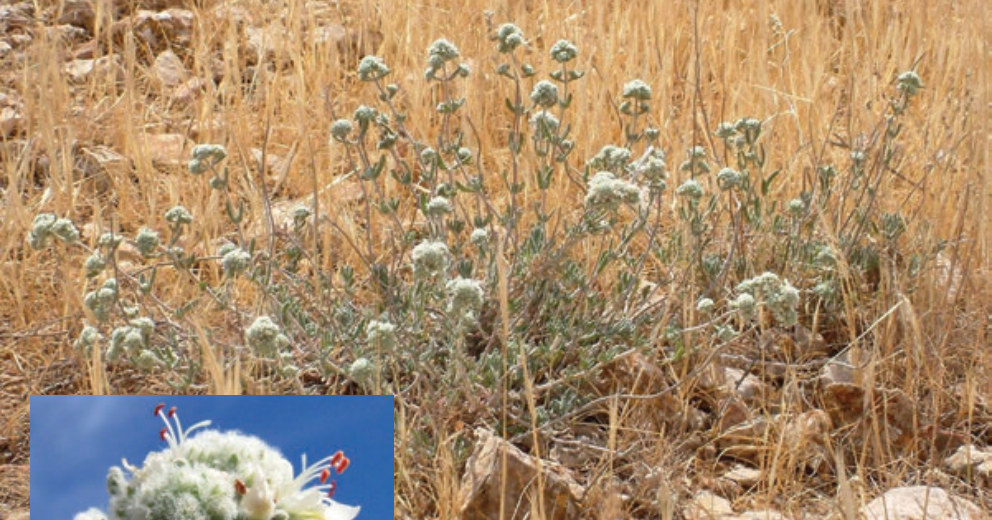
Plant name
gray curly
Latin name
Teucrium polium L
Common names
Grey germander, windgrass, curly
foreign names
Eng. Germand golden, Fr. Germandrée tomenteuse
The group
oral
Habitat and Geographic Distribution
Touraine - Mediterranean and Western Iran
Botanical description
The stem is covered with down and has 20 small, dense, grayish-brown or white woolly bracts, branching from the base.
The branches are cylindrical, tapering to erect, and are 1 cm long, each terminating in a comb-like or raceme-like inflorescence.
The leaves are simple, sessile, oblong to linear, dull-tipped, with cristulate margins that curl sharply downwards, rarely flattened, and are 3 cm long.
The flowering leaves are linear-oblong, with sharply curled margins, and are flatter than the flowers.
The flowers are hermaphroditic, bilaterally symmetrical, and clustered in dense carpels to form spherical to ovate heads with short pedicels.
The flowers are semi-sessile.
The calyx is densely or woolly, about 1 mm long, bell-shaped, with five teeth, and hidden among the hairs.
The corolla is white to cream-colored, appears solitary, and falls off quickly.
It consists of a tube that remains embedded in the calyx and a prominent, broad, flat, five-lobed blade.
The male is bisexual, with stamens slightly raised from the corolla.
The female is bicarpal, bistomous, divided by a false septum into four locules, each containing one ovule.
The fruit is a four-petaled inflorescence, obovate in shape. Flowering occurs from April to August.
Used part
flowering plant
chemical components
a-b pinene, cedrenol, linalool, a-cadinol, a-humulene (rich in terpene and alcohol compounds, 0.1-1% volatile oil, etc.).
b-caryophyllene, caryophyllene oxide, terpine-4-ol, picropolinol.
These vary depending on the source, including: picropolene diterpenes (diterpene compounds), gnaphalidin, teupolins, montanines, teucrin, picropolinon, acacetine, cirsiliol, eupatorin, cirsimaritin, salvigenin, luteolin, apigenin, falvonoids (including apigenin), teucardoside, harpagide (including harpagide), and iridoide glycosides.
Brassicasterol, campesterol, stigmasterol, β-sitosterol: 7 Sitols, including sugars (glucose, fructose), tannins
Properties and medical uses
Research has demonstrated the effectiveness of the aqueous extract of the aerobic parts, including its flavonoid content, in lowering blood sugar levels, although this has not been definitively proven clinically.
Animal studies have shown positive indications of ulcer regression after the drug's use.
The aqueous extract of the leaves and stem (flavonoids) possesses antioxidant properties (for example, preventing the oxidation of beta-carotene).
Research has also shown the effectiveness of the leaf extract in lowering blood pressure.
Studies indicate that the plant extract reduces cholesterol (by approximately 40%) and triglyceride levels in mice.
The volatile oil of the flowering plant has antispasmodic properties that help relieve digestive disorders accompanied by fever and diarrhea.
The drug also possesses antibacterial properties.
The plant contains fungi (volatile oil, flavonoids, sterols).
Extracts are used topically as antiseptics, and in the treatment of skin infections, wounds, and gingivitis.
A decoction of the plant is used systemically as a diuretic, diaphoretic, antipyretic, hypoglycemic agent, and in the treatment of enteritis and ulcers.
The plant has been used since ancient times as an insecticide and to combat malaria.
Traditionally, Palestinians have used hot water extracts of the plant's leaves for centuries to treat intestinal and cardiac disorders, and the leaf infusion is drunk after each meal for its antifungal effect.
It is used as an antispasmodic and antidiarrheal.
Also known in traditional Palestinian veterinary medicine as "al-Sibyan," it is administered orally to sheep, cattle, and goats to treat diarrhea, colic, mange, and flatulence.
Powdered leaves are applied topically to treat mange.
A standardized decoction is prepared from 50 grams of the plant's leaves and taken orally in doses of 100 ml three times daily to treat kidney and liver diseases, diabetes, stomach and intestinal pain, and inflammation.
Parts of the plant are also used.
The plant, either in its fresh leaves or as an infusion, was used by Bedouins to treat fever, stomach and intestinal disorders, and as a vermifuge.
It was also used in steam baths to treat colds and fever.
In Saudi Arabia and Jordan, it was used to treat various ailments such as inflammation, pain, diabetes, kidney stones, cancer, fever, and rheumatism.
A direct correlation was found between the plant's antioxidant activity and its β-caryophyllene content.
The plant's effect on cancer cells was linked to the presence of a mixture of α-bisabolol and (+) compounds.
Epibicy-closesquiphellandrene is derived from the oil extracted from the plant or from compounds such as caryophyllene, α-humulene, δ-cadinene, caryophyllene oxide, and α-cadinol.
It is found in the leaves.
Precautions: Prolonged use of this drug in large quantities may cause hepatitis, manifesting as jaundice and other symptoms. Its use has been banned in France, for example, due to these symptoms.
Side effects and precautions
Prolonged use of the drug in large quantities may cause hepatitis, which manifests as jaundice and other symptoms. Its use has been banned in France, for example, because of these symptoms.
the environment
This plant is widespread in sandy steppe soils and dry, stony slopes.
It prefers sunny locations and neutral to alkaline soils.
It is considered an indicator of vegetation degradation and overgrazing.
It grows in diverse habitats, from alluvial sandy areas to mountains and plateaus.
Agriculture and productivity
The plant is propagated by seeds sown in the spring in a nursery and covered with a thin layer of soil.
After germination, the seeds are transplanted into small pots and then to their permanent location after a year.
The plant can also be propagated by semi-hardwood cuttings or by division.
In the latter case, large divided plants are planted directly in their permanent location, while smaller plants are best left in the nursery until the following year. (Thymus syriacus Boiss. Origanum syriacum) Boiss. (Kuntze)
History and Heritage
The scientific name of the genus is the Greek and Latin name for these plants and literally means "Trojan herb".
The descriptive name of the species polium comes from the Greek polios, meaning "shiny gray-white." The part used is the flowering plant.
Chemical constituents: volatile oil (0.1-1%) rich in terpene and alcohol compounds (α-hu-, α-cadinol, linalool, cedrenol, α, Ο pinene, caryophyllene oxide, Ο-caryophyllene, mulene, etc.), germacrene, terpine-4-ol (varies depending on the source), diterpenes (diterpene compounds), picropolinol, picropolin (including picropolin, montanin, teucrin, picropolinon), gnaphalidin, teupolins, montanines, cirsimaritin, eupatorin, cirsiliol.
acacetine, luteolin, apigenin (flavonoids), salvigenin, iridoid glycosides (including harpagide, teucardoside, β-sitosterol, stigmasterol, campesterol, brassicasterol), sterols (including sugars, fructose), and tannins.
Medical note
This information is for educational purposes only and does not constitute medical advice.
Poisonous or potent plants should only be used under the supervision of a qualified physician or pharmacist.
Related images


