Watercress | A medicinal plant in the Akhdar encyclopedia
The plant is traditionally used fresh and cooked as food and for medicinal purposes, such as for respiratory ailments. Freshly harvested leaves are used, as dried leaves lose their astringent properties. Fresh green leaves are added to dishes, appetizers, and salads, as they are considered an appet…
Plant name
arugula
Latin name
Nasturtium officinale R.Br
Common names
Al-Jarjari, Qura Al-Ani, Harf, Kabusni, Tartur Al-Basha
foreign names
Eng. Water cress, Fr. Cresson de fontaine
The group
cabbage
Habitat and Geographic Distribution
Growing in Europe, the Mediterranean region, and Western Asia, it has become globally widespread.
Botanical description
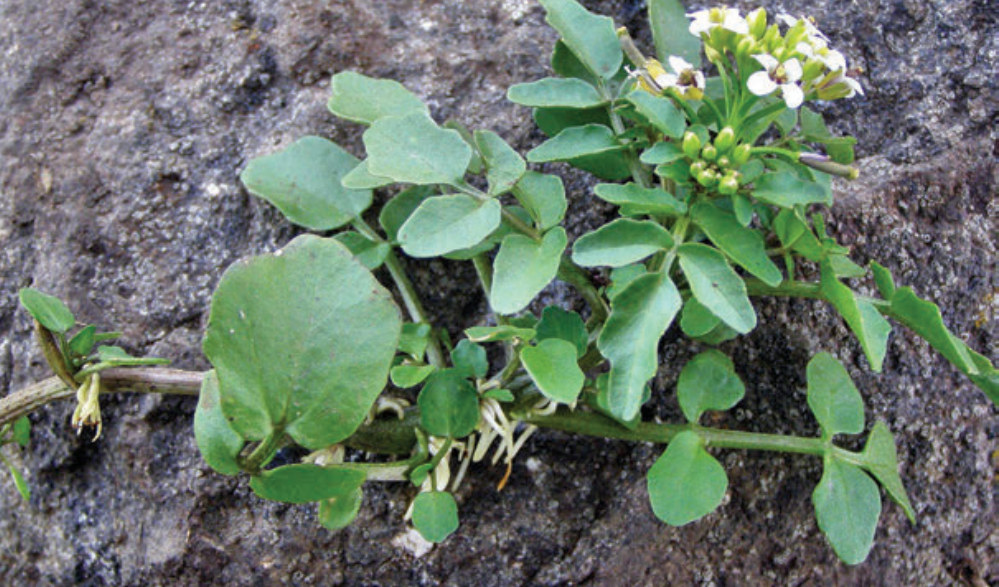
70 cm - A perennial herb, hairless, with a thick, angular stem that spreads along the ground and produces bare roots.
The leaves are compound pinnately arranged in pairs of leaflets, 7 cm long.
The lateral leaflets are ovate or elliptical, and the terminal leaflet is rounded and toothed.
The petioles are ovate and thick.
The inflorescence is a raceme, linear, about 4 cm long.
The sepals are linear, often curved, twice the length of the sepals, and white.
The fruit is a mustard seed, oblong, with horizontal or slightly drooping stipules.
The midrib is clearly visible, while the lateral veins are not.
The seeds are ovate, brown, pitted, and located in rows within each stone. Flowering occurs from February to September.
Used part
tender flowering aerial parts
chemical components
(of wet weight) The most important of these are: 0.9% thioglucosides.
The flowering plant contains sulfate glycosides that break down by enzymatic hydrolysis, giving a volatile sulfate compound with a pungent taste (mustard oil, gluconasturtiin, which is considered an anticancer compound, phenyl ethyl isothiocyanate, glucotropaeolin).
It also contains other sulfate compounds, as well as anticarcinogenic agents, mineral salts, especially iron, calcium, magnesium, and zinc, several vitamins, flavonoids, amino acids, especially lysine (1.5%), proteins (2%), sugars (B, A, and an important precursor to vitamin C), and fiber (0.3%), and fats (lysine).
Properties and medical uses
The plant is traditionally used fresh and cooked as food and for medicinal purposes, such as treating respiratory ailments.
Freshly harvested leaves are used, as dried leaves lose their medicinal properties.
Fresh, green leaves are added to dishes, appetizers, and salads, as they are considered an appetite stimulant and digestive aid.
The plant has both external and internal uses, depending on the ailment and the desired treatment.
It is used to treat bronchitis and coughs.
The decoction of the leaves, which is rich in iron and vitamins, is used in cases of anemia, to treat scurvy, to get rid of kidney stones, and to reduce liver disorders.
The juice of the leaves is used for its diuretic and antibacterial properties (gum inflammation, tuberculosis), to treat tumors, to remove toxins from the body, to expel worms and internal parasites, and to lower blood sugar levels.
A decoction of the leaves is used topically as a poultice to treat skin ulcers, rheumatism, gout, and arthritis, and as a scalp treatment to strengthen hair follicles and reduce hair loss.
Precautions for use: High doses of mustard oil or the young plant can cause irritation of the mucous membranes.
It is used in cases of stomach and intestinal ulcers and kidney infections. It is not prescribed for pregnant women or children.
Side effects and precautions
Allergic reactions or drug interactions may occur; self-use should be avoided by pregnant and breastfeeding women, children, and patients with chronic diseases.
the environment
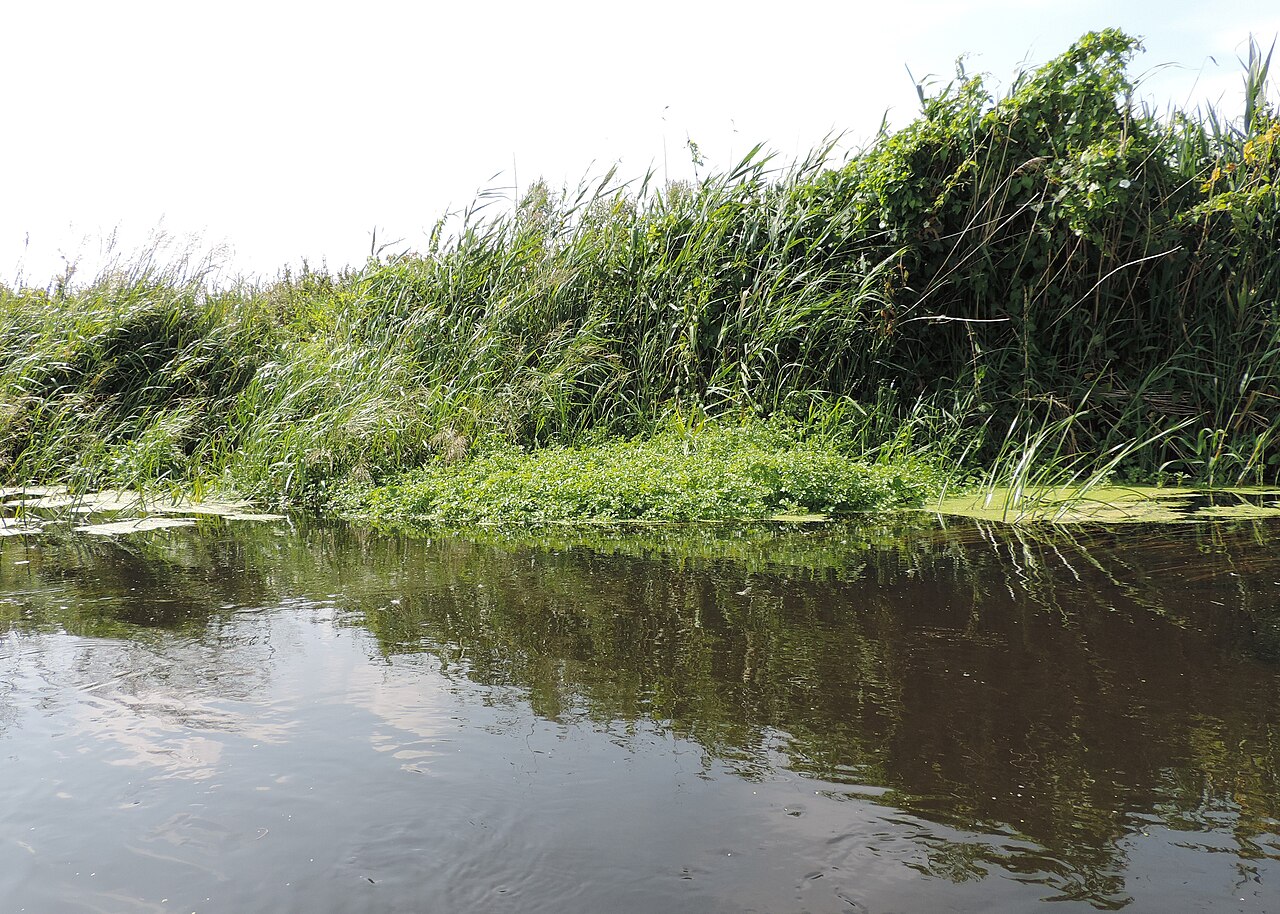
Watercress grows along the edges of streams and irrigation ditches, and in shallow, flowing water.
It can be cultivated in moist soils if provided with suitable light and temperature conditions.
It tolerates low temperatures but prefers mild winters. The plant is sensitive to pollution, so it needs water from a clean source.
Agriculture and productivity
A fast-growing plant, its stems grow on land or float on water, producing new roots at the leaf nodes, making it easy to propagate vegetatively.
It can also be propagated by seed near lakes and water bodies.
Plants are harvested 40–45 days after sowing.
Boswellia sacra Flueck, Boswellia carteri Birdwood, Boswellia bhaw-dajiana Birdw., Boswellia undulatocrenata Engl
History and Heritage
The scientific name of the genus is derived from the Latin words nasus, meaning "nose," and torque, meaning "I twist," referring to the plant's pungent taste and the strong aroma of its flowers.
It was once called "body health" due to its properties as a tonic, appetite stimulant, and remedy for anemia and scurvy.
The plant was traditionally eaten as a vegetable or in salads, and its leaves were widely used as a blood purifier, diuretic, expectorant, and to lower blood sugar and cholesterol.
It was also used to treat lung diseases, high blood pressure, and cardiovascular diseases.
Furthermore, it was used to treat abdominal pain, ulcers, scurvy, tuberculosis, bronchitis, influenza, and asthma.
Medical note
This information is for educational purposes only and does not constitute medical advice.
Poisonous or potent plants should only be used under the supervision of a qualified physician or pharmacist.
Related images