Garlic | A medicinal plant in the Akhdar encyclopedia
Its most important benefits include: 1. Antimicrobial action and disinfection of the respiratory tract, protecting against colds and flu and alleviating their symptoms. 2. Treatment of cardiovascular diseases and stimulation of blood circulation, lowering: blood pressure. 3. Reduction of coronary a…
Plant name
garlic
Latin name
Allium sativum L
Common names
garlic
foreign names
Eng. Garlic, Fr. Ail
The group
onion
Habitat and Geographic Distribution
Central Asia and the Mediterranean countries. Its cultivation is widespread throughout the world.
Botanical description
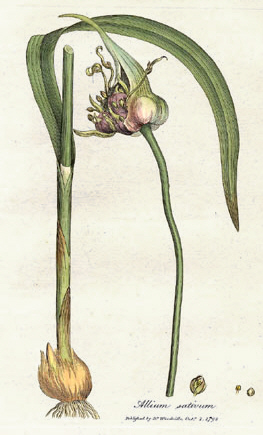
A perennial herb with bulbs, measuring 1 cm in length.
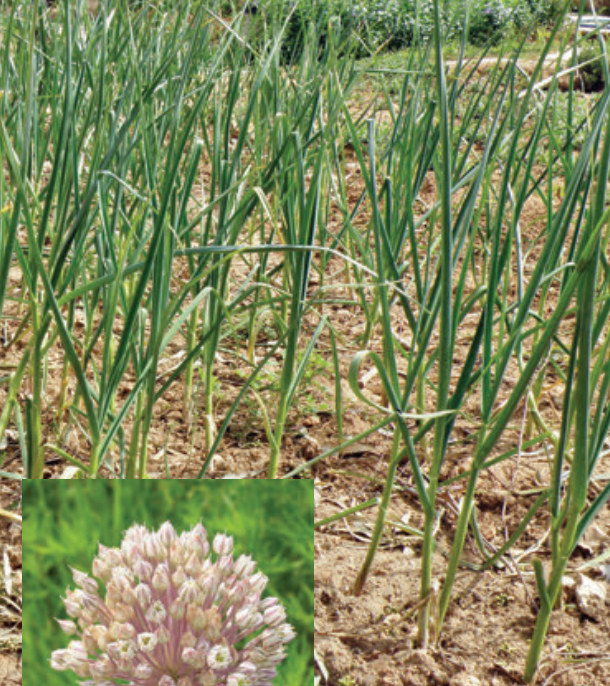
The aerial stem is erect, sturdy, and fleshy, bearing leaves up to about halfway up the stem.
The leaves consist of a sheath surrounding the stem and a broad, leaf-like blade with a smooth or rough edge.
The flowering stem terminates in an umbel-like inflorescence, composed of a single flower surrounded by violet-colored stamens or buds called aerial bulbs.
These bulbs are attached by a weak stalk that easily detaches from the inflorescence and are capable of immediate growth upon falling without remaining dormant.
The inflorescence is surrounded by a bract with a pointed tip.
The stamens are located in a small, reddish-brown capsule containing white pistils.
The fruit is a three-stone capsule containing triangular seeds.
At the end of summer, alongside the main bulb, a large number of secondary, curved bulbs, commonly called "garlic teeth" or "garlic cloves," form.
The main bulb and the bulbs are covered with dry, scale-like leaves that are white or purplish-white, forming a continuous sheath.
The bulb consists of an oval, curved, disc-shaped stem, masked by a thick basal leaf, surrounded by several dry, scale-like leaf bases that form a continuous sheath around the disc.
The disc-shaped stem produces a terminal bud that gives rise to an aerial shoot, and on its lower part, bare roots develop: a fibrous root.
Used part
Fresh or dried garlic cloves, garlic clove essential oil
chemical components
Fresh garlic cloves contain a volatile oil, composed mainly of a mixture of mono-, di-, or polysulfur derivatives called alliins (alkylcysteine sulfoxides).
These are odorless compounds, including allyl alliin, propenyl alliin, and methyl alliin.
When fresh cloves are cut or crushed in the presence of the enzyme alliinase, these compounds are converted into an unstable compound with a distinctive odor.
Allicin (a sulfur compound responsible for bad breath) is converted in the presence of water and air to allyl disulfide.
The lobes also contain fructosanates (polysaccharides), saponins, enzymes, antiseptic compounds including allicin and garlicin, vitamins A, B1, B2, and D, minerals, and compounds with effects similar to sex hormones.
Properties and medical uses
Its most important benefits include: 1.
Antimicrobial and antiseptic for the respiratory tract, protecting against colds and flu and relieving their symptoms.
2.
Treats vascular diseases and stimulates blood circulation, lowering blood pressure.
It reduces coronary artery disease, lowers cholesterol, and reduces blood lipids, thus decreasing the risk of heart disease and protecting against strokes.
Scientists confirm that the best types of medications for heart disease are those containing garlic.
The secret behind garlic's mechanism of action in strengthening and maintaining the heart muscle has been revealed.
It lies in the breakdown of allicin, which produces carboxyl compounds that react with red blood cells to produce glutathione (glutathione hydroxypropyltrimethylamine), which helps cells communicate with each other better and activates the cells lining blood vessels, causing them to relax and widen, thus allowing blood to flow easily.
This leads to a decrease in blood pressure and allows more oxygen to be carried to vital organs in the body, reducing the burden on the heart.
It is a compound that resists premature cell aging.
Garlic also raises glutathione levels.
It is known that glutathione is an effective oxygen molecule, similar to hydroxylated glutathione.
An antioxidant, garlic reduces the risk of developing four highly toxic compounds, including single oxygen, peroxy radicals, and peroxy-free radicals, which are major contributors to cancer (especially stomach and colon cancers).
Scientists have found that garlic consumption inhibits the activity of cancer cells.
Garlic (allicin) acts as a broad-spectrum antibiotic, eliminating many microbes (bacteria, fungi, viruses) and parasitic worms (important in boosting the body's immunity and protection, and which are natural killer cells).
It improves the performance of natural killer cells, which attack cancer cells, viruses, and some types of bacteria that cause inflammation.
It has blood sugar-lowering properties.
Garlic, with its carbohydrate compounds, has proven effective in protecting the liver, treating indigestion, cleansing the intestines, and eliminating putrefaction.
Dried garlic powder is used to treat food poisoning caused by several types of bacteria.
Experiments have demonstrated the ability of garlic powder to kill Escherichia coli, Staphylococcus aureus, Pseudomonas aeruginosa, and Bacillus subtilis.
Garlic also has antiplatelet aggregation properties.
Platelets involved in the formation of blood clots can cause migraines, so consuming garlic reduces the effect of these platelets, thus alleviating headaches or migraines.
Garlic is used topically to treat and disinfect wounds, and it treats various skin diseases (boils, alopecia), and it is beneficial in treating hair loss.
Note: To obtain the desired benefit from garlic, it should be used without cooking or processing, as it loses most of its antibacterial properties when exposed to high heat.
Therefore, it should be dried in the shade, then crushed and dried at a low temperature.
Garlic retains its antioxidant properties after cooking and high-heat treatment, but it loses its antibacterial and anticoagulant properties after high-heat treatment.
pharmaceutical forms
Garlic is available in several forms, including garlic oil infusion, dry extract, aqueous extract, and volatile oil obtained by steam distillation.
Drug interactions and precautions: Garlic may pose a risk to the health and lives of AIDS patients because it interferes with treatments for this disease.
It has been found to reduce the effectiveness of the drug 7-saquinavone in the blood by half.
Caution should be exercised when consuming concentrated garlic before surgery and before labor and delivery, especially in diabetic patients.
It should also not be used with aspirin.
Garlic may cause indigestion, irritation of the intestines, accompanied by heartburn, or irritation of the urinary tract when combined with blood-thinning drugs (anticoagulants) such as heparin.
Therefore, it should be avoided in large quantities or avoided by those with intestinal disorders or kidney failure.
Excessive garlic consumption may cause itching and hemorrhoids. Latin name: Allium sativum L.
Side effects and precautions
Garlic may pose a risk to the health and lives of AIDS patients because it interferes with medications used to treat the disease.
It has been observed that garlic reduces the effectiveness of the drug saquinavir in the blood by half.
Caution should be exercised when consuming concentrated garlic before surgery, labor, and delivery, especially for diabetic patients.
It should also not be used with blood thinning medications (anticoagulants) such as heparin and aspirin.
Garlic may cause indigestion, intestinal irritation accompanied by heartburn, or urinary tract irritation.
Therefore, it should be consumed in moderation or avoided by those with intestinal disorders or kidney failure. Excessive garlic consumption may also cause itching and hemorrhoids.
the environment
Garlic is a long-day plant that tolerates low temperatures.
Storing garlic at low temperatures (from 13°C to 13°C) shortens the growing season compared to storing it at high temperatures, especially during the period of clove germination, rapid leaf growth, and the formation of cloves and flower stalks.
Garlic requires fertile, loose soil and thrives in light soils.
It does not succeed in sandy soils because they do not retain enough moisture for plant growth.
Agriculture and productivity
The plant is propagated by cloves, which are sown in rows 40-50 cm apart, with 10-12 cm between cloves, or in beds or raised beds, the dimensions of which vary depending on the soil's levelness and the amount of available water.
The necessary maintenance practices, such as fertilization, weeding, and irrigation, are provided, gradually reducing irrigation and stopping it altogether when signs of maturity, such as yellowing, begin to appear.
History and Heritage
It means cultivated.
Garlic is one of the most important and oldest plants.
The scientific name for the genus is the ancient Latin toxin of this species.
The ancient Egyptians used garlic as both food and medicine.
The importance of garlic has been known since ancient times, and many offered it as a sacrifice to their gods.
They also consumed large quantities of garlic before undertaking any strenuous work.
The first recorded instance of a work stoppage in the world is attributed to garlic.
During the construction of the Great Pyramid of Giza, the supply of garlic to the world was halted, leading to workers refusing to work because they believed garlic provided them with energy, vitality, and strength, and prevented them from contracting diseases and infections.
The Greeks also knew garlic and gave it great importance in their food and medicine.
A mixture of garlic and vinegar helped save thousands of lives from the plague epidemic in France in 1720.
note
To obtain the desired benefits from garlic, it should be used without cooking or processing, as it loses many of its antibacterial properties when exposed to high heat.
Therefore, it is dried in the shade, then crushed and dried at a temperature of 60°C.
Garlic retains its antioxidant properties after cooking and high-heat treatment, but it loses its antibacterial and anticoagulant properties after high-heat treatment.
Medical note
This information is for educational purposes only and does not constitute medical advice.
Poisonous or potent plants should only be used under the supervision of a qualified physician or pharmacist.
Related images