Fig | A medicinal plant in the Akhdar encyclopedia
Figs are easily digestible, rich in energy, and suitable for children, convalescents, athletes, and those who are underweight. However, they are not recommended for diabetics, obese individuals, or those with digestive problems. Figs possess laxative properties beneficial for constipation in genera…
Plant name
figs
Latin name
Ficus carica L
Common names
figs
foreign names
Eng. Fig, Fr. Figue
The group
mulberry
Habitat and Geographic Distribution
It is widespread in southwestern Asia, the eastern Mediterranean region, Turkey, Syria and Iran, and is cultivated in all countries of the Mediterranean basin, and in most warm and temperate regions.
Botanical description
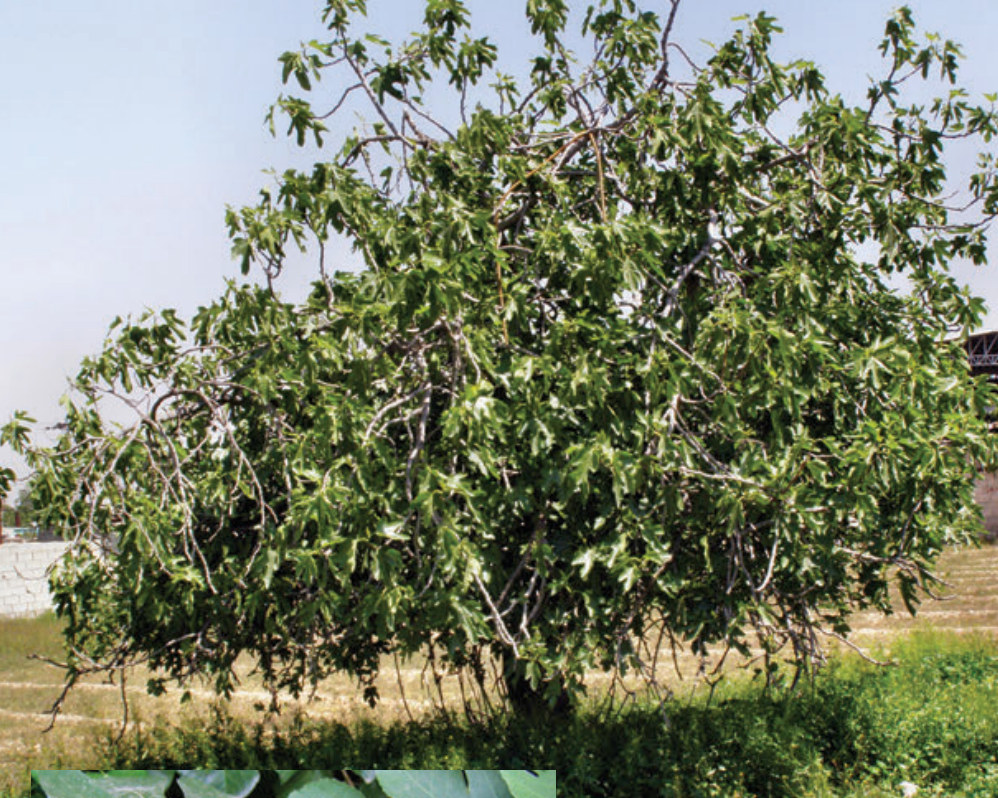
4 - A small, deciduous tree, about 1 m tall, but can also grow to a shrub-like shape branching from the bottom.
The crown is rounded or broadly oval, and its parts contain irritating white sap.
The bark is grayish and smooth, and the buds are glabrous.
The leaves are large, about 1 cm wide, thick and rough, with long petioles.
The blade is palmate, semi-round, and divided into 5-cylindrical lobes, deeply divided to toothed edges.
They are separated by rounded sacs.
The flowers are very small, lacking corollas, and are gathered in a special inflorescence called a fig inflorescence.
In this inflorescence, the fleshy receptacle takes the form of a waterskin that connects to the outside through a small osteum.
Hundreds of unisexual flowers are scattered inside it.
The male flowers are located near the osteum, while the female flowers occupy the larger part of the inflorescence.
Fig blossoms have multiple colors when ripe, depending on the variety.
Pollination is carried out by a special vine, although some varieties are self-pollinating.
Figs produce several generations throughout the year, but the edible generation ripens mainly between June 2nd and September 3rd.
Used part
) that circulates in the plant's vessels (a substance that irritates the skin).
Sap latex (fresh or dried ripe fruits, and milky sap: chemical components, especially organic acids, 50% dextrose.
The fruits contain: simple sugars, especially dextrose).
And minerals such as iron, copper, calcium, and potassium.
Mucilage (lemon and malic acid).
Mucilaginous substances, pectins, and flavonoids.
Vitamins A, B1, B2, C, manganese, and rhubenzyme (milk fermentation enzyme).
The milky sap contains the enzyme fermentin, bergapten, and psoralen, including: psoralen, furanocoumarins.
chemical components
Some of its components strengthen the heart, while others lower blood pressure and stimulate the central nervous system.
Studies have also shown that the leaves and bark of the fig tree, rich in tannins, have astringent properties and are beneficial in treating diarrhea and dysentery, as well as stopping internal and external bleeding.
Studies have shown that the alcoholic extract of the fig is bactericidal, particularly against Escherichia, Staphylococcus aureus, coli, and Candida albicans fungi.
The latex is rich in polyphenolic compounds, thus acting as an antioxidant and antiproliferative agent.
Studies have indicated that latex has antiproliferative and cytotoxic effects.
It is used to treat wounds and prevent their spread.
Figs have been found to have genotoxic effects on MDA-MB-23 cancer cells derived from breast cancer.
Properties and medical uses
Figs are easily digestible, rich in energy, and suitable for children, convalescents, athletes, and those who are underweight.
However, they should be avoided by diabetics, the obese, and those with digestive problems.
The fruit has laxative properties, beneficial for constipation in general and especially for the elderly.
It also aids digestion (in cases of sluggish bowels) and is used to treat whooping cough, chest infections, and urinary tract infections.
An extract of the fruit is traditionally used to treat sore throats and swollen gums, and is applied as a poultice to treat tumors.
A decoction of the leaves is used to treat diabetes and gingivitis.
The milky sap secreted by the petioles and tender branches is traditionally used to treat skin diseases (warts, boils, and skin ulcers), and is also used as a laxative and vermifuge.
Side effects and precautions
The milky sap should not be used.
Food uses
The fruits are used for food, fresh, dried, or as jams.
the environment
It is hardy in winter, but needs protection and care to withstand the cold.
The fig variety is light-tolerant, resistant to frost and even wind.
It is relatively drought-tolerant and thrives in hot summer conditions: it produces good quality fruit.
It prefers fertile, well-drained soils, although it can tolerate various other soil types.
Agriculture and productivity
It grows wild and is rarely cultivated.
Ficus sycomorus L., Ficus chanas Forssk., Ficus cocculifolia Baker., Sycomorus gnaphalocarpa Miq., Sycomorus rigida Miq., Sycomorus trachyphyllus Fenzl ex Miq.
History and Heritage
Derived from the ancient Phoenician language, the word for the species is sykos or Sykê from the Greek ficus.
The genus name originates from an ancient country in the Near East (Turkey).
Caria, or Carra, originates from carica.
It was known to the Greeks and Romans, and it is said that the fig was a favorite fruit of Cleopatra.
Fig cultivation dates back to more than 5000 BC, and it is said that the snake that killed her was hidden in a basket of figs.
The Phoenicians used figs on their sea and land journeys for food and to treat skin diseases, boils, and gum inflammation.
Many wars throughout history were fought to occupy the lands where this species grows.
The fruit has been used since ancient times as a traditional remedy for constipation and digestive disorders.
Medical note
This information is for educational purposes only and does not constitute medical advice.
Poisonous or potent plants should only be used under the supervision of a qualified physician or pharmacist.
Related images


