Blackberry (Syrian) | Medicinal plant in the Akhdar Encyclopedia
Blackberry fruits, with their flavonoid, phenol, and anthocyanin compounds, possess antioxidant and anti-inflammatory properties. The anthocyanins and acids they contain may help protect against colon cancer. Experiments on mice have shown that an extract from the leaves has analgesic properties (a…
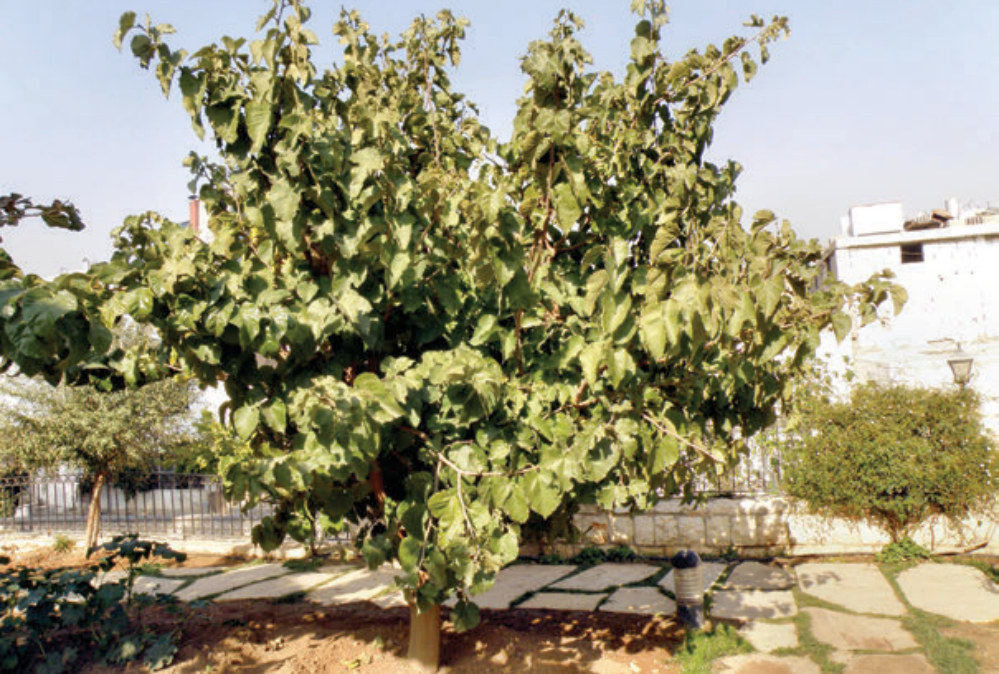
Plant name
Blackberry (Syrian)
Latin name
Morus nigra L
Common names
Blackberry (Syrian)
foreign names
Eng. Black mulberry, Fr. Black mulberry
The group
mulberry
Habitat and Geographic Distribution
It originated in northern Iran and Armenia, and its cultivation has spread to regions of Syria and many other countries around the world.
Botanical description
M, a dioecious, deciduous tree, reaching the height of a single or solitary structure.
The bark is brownish-black.
The leaves are simple, 1.5-2.5 cm, alternate.
The stipules are uterine, membranous, and pubescent.
The petioles are 1 cm long and pubescent.
The leaf blade is broadly ovate, grayish-lobed, with a heart-shaped base and a pointed or slightly acuminate apex.
The margin is serrated, 2 cm longer than that of a white mulberry, and thick.
One leaf surface (Akhdar) is pale and pubescent, while the other (Akhdar 4) is dark and rough.
The male inflorescences are cylindrical, 2.5 cm long, and pubescent.
The female inflorescences are elliptical, 1 cm long.
The peduncle is very short (shorter than that of a white mulberry).
The corolla is completely absent in mulberry, and the calyx consists of four sepals, which become dreamlike when the fruit is ripe.
The male flowers are in the stamens.
The male flowers are composed of female flowers with a distinct grayish style.
The stigma is two-branched.
The fruit is clustered (in the inflorescence), lacking a stalk, and dark brown and sugary after a few centimeters.
It is very acidic before full ripening, then becomes sour.
The dimensions are 1.5 x 2.5 cm.
The color is [missing information - likely a color in this context].
The Middle Atlas region is interested in this variety, and there are many cultivated cultivars.
The taste of these fruits is highly valued.
Flowering occurs in late spring and early summer, and fruiting begins in late summer.
Used part
The ripe fruit and leaves (its leaves are unsuitable for silkworm rearing due to their toughness and thickness) contain the following chemical components: The fruit contains fruit acids (2%), the most important of which are malic acid, citric acid, betulinic acid, and sucrose (10%), pectins, phenolic compounds, and flavonoids, the most important of which is rutin.
It also contains anthocyanin pigments (responsible for the black color of the fruit), several vitamins (vitamin C or ascorbic acid 17%), vitamins B2 and B3, and minerals (potassium K, calcium Ca, magnesium Mg, sodium Na, iron Fe, zinc Zn, and nickel Ni).
The leaves contain flavonoid compounds (2-6%), the most important of which is rutin.
Tree bark contains flavonoid compounds, including moracin M and albanin E-A, which possess antioxidant properties. This antioxidant capacity is attributed to the presence of rutin.
chemical components
The fruit contains: fruit acids, sucrose, betulinic acid (mainly malic acid, citric acid), anthocyanin pigments (responsible for the black color of the fruit, mainly rutin, pectins, phenolic compounds, and flavonoids, the most important of which is rutin), vitamin B, vitamin B, vitamin C, vitamin B1, vitamin B1, vitamin B2, vitamin C, vitamin C, vitamin B1, vitamin B1, nickel (Ni), zinc (Zn), iron (Fe), iron (Na), sodium (Mg), magnesium (Ca), calcium (K), and minerals: potassium.
The leaves contain flavonoid compounds with antioxidant properties.
The bark of the trees contains flavonoid compounds, including albane (E), albane (A), and moracin (M).
Properties and medical uses
Blackberries, with their flavonoid, phenol, and anthocyanin compounds, possess antioxidant and anti-inflammatory properties.
The anthocyanins and acids they contain may help protect against colon cancer.
Experiments on mice have shown that the leaf extract possesses analgesic (antenoceptive) and anti-inflammatory properties for the mucous membranes of the respiratory system.
Mulberry juice is used as a nutritious drink rich in sugars, minerals, acids, and vitamins.
It is also a hydrating agent, relieves feelings of heat and thirst, and acts as a cleanser and laxative in cases of constipation.
It helps lower blood sugar levels and is beneficial for stomach acidity, enteritis, anemia, and liver weakness.
Mulberry juice is also used as a gargle to treat gingivitis.
The fruit pulp is used to treat acne and cleanse the skin. Mulberry juice is also used to color and improve the taste of some medications.
Side effects and precautions
Allergic reactions or drug interactions may occur; self-use should be avoided by pregnant and breastfeeding women, children, and patients with chronic diseases.
the environment
This species is tolerant of both cold and high temperatures, as well as drought.
It thrives in various soil types, though it prefers moist, well-drained soils.
It tolerates salinity and alkaline gravelly soils.
It requires sunny locations sheltered from the wind.
It is used to prepare jams, vinegars, juices, wines, and cosmetics.
The plant possesses biological and pharmacological therapeutic effects, including analgesic, anti-inflammatory, antimicrobial, anti-melanin, antidiabetic, anti-obesity, anti-hyperlipid, and anticancer properties.
The plant offers a protective effect on the body's organs, thanks to its antioxidant properties.
Research suggests its potential as a promising food source for managing and preventing various chronic diseases.
The leaves and fruits have demonstrated numerous pharmacological properties, including anti-keratocongestive activity.
The plant also exhibits protective and therapeutic effects on the central nervous system, liver, kidneys, digestive system, and female reproductive system.
Mulberry fruits and leaves possess laxative properties, antibacterial activity, anti-atherosclerotic activity, and hepatoprotective properties.
It is used to treat and prevent diabetes due to its blood sugar-lowering effect. Studies have not shown any toxic effects from consuming the plant.
Agriculture and productivity
A multi-purpose tree, propagated by seed in spring and autumn, and by cuttings or grafting at the end of winter.
Young trees are pruned to encourage branching; afterwards, pruning is limited to removing diseased and overcrowded branches.
Organic fertilizer is applied during the winter.
A drawback of this species is the tangling of branches and the tendency for fruit to fall to the ground, staining clothing and roads with colors that are difficult to remove.
Other names for this species include: Morus alba L., Morus sinensis G.Don., Morus subalba Steud., Morus tatarica L., Morus tokwa (Bureau) K.Koch, and Morus tortuosa Audib. ex Moretti, Morus venassainii Steud., Morus venosa (Delile) Spach
History and Heritage
The name Moringa, the genus name of the plant, originates from the state of Albar in western India.
The word "moringa" means "oil," and the species name "moringa" means "dreamer." The name derives from the plant's characteristic properties, as oil is extracted from its seeds.
The plant is used as both food and medicine.
Al-Antaki says of it, "All parts of the plant prevent tumors and catarrh, improve perspiration, strengthen the body, and heal wounds." Ibn Sina says, "When mixed with vinegar and water, it opens blockages in the intestines." Al-Muzaffar says, "The best part is the fragrant caper seed, which removes warts from the face and is beneficial for hard tumors when used in an ointment.
It also removes hardness from the liver and spleen when its seeds are drunk with red vinegar." The parts used are the fruits and seeds (the plant has a taste similar to that of hot radish), roots, and leaves. Its Latin name is Morus nigra L.
Medical note
This information is for educational purposes only and does not constitute medical advice.
Poisonous or potent plants should only be used under the supervision of a qualified physician or pharmacist.
Related images


