White mulberry | Medicinal plant in the Akhdar encyclopedia
Berries possess antioxidant properties. Research has shown that the compound proanthocyanidin can inhibit the replication of the hepatitis C virus, which causes liver cirrhosis or cancer. The compound gamma-aminobutyric acid helps lower blood pressure, and the compound deoxynojirimycin helps lower…
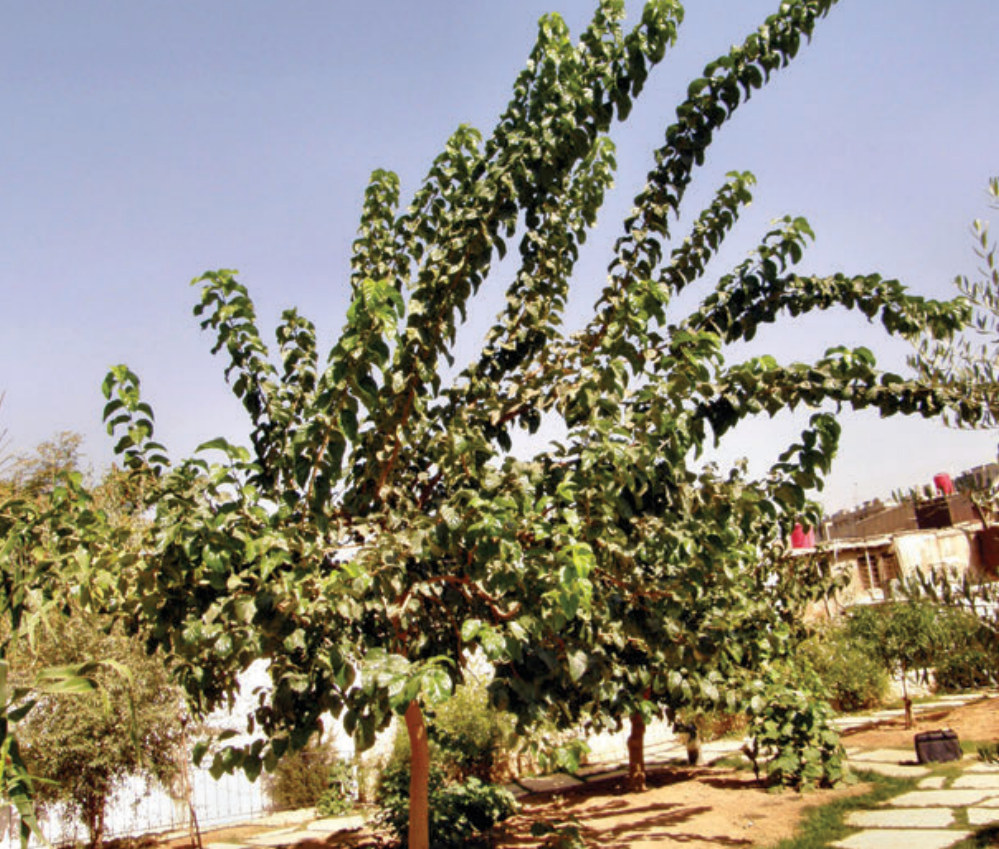
Plant name
white mulberry
Latin name
Morus alba L
Common names
white mulberry
foreign names
White mulberry (English), white mulberry (French)
The group
mulberry
Habitat and Geographic Distribution
It is believed to have originated in Central Asia and northern China, from where it spread to many parts of the world, and has been introduced to many countries for silkworm breeding.
Botanical description
M, produces plant milk.
The sap is gray, with superficial fissures.
The branches are covered with downy hairs.
10 - Deciduous tree, cm long, downy.
Blade 5.5 - 1.5 mm.
Petioles 3.5 - smooth.
Winter buds are reddish-brown, ovate, downy.
The stipules are uterine, cm long, smooth surface.
12 - Leaf is ovate, serrated to serrated at the margin, rounded to heart-shaped at the base, acuminate at the apex, upper length and downy only along the midrib on the lower surface.
Flowers are unisexual, lacking corolla, cm long, covered with dense white hairs.
Inflorescences 3.5 - monoecious.
Male inflorescences are catkins, drooping, cylindrical, mm long.
The calyx has four sepals in male flowers, lobes 10 - cm long, spathe 2 -; female flowers are catkins with semi-spherical stamens.
The female is a broad, ellipsoidal dicotyledon, with ovoid lobes bearing hairs along their edges.
The male is a carpel.
The fruit is a cluster that develops into a raceme-like inflorescence, white and reddish when ripe, ovoid, ellipsoid, or cylindrical.
Its taste is slightly sweet before ripening and becomes intensely sweet after full ripening. 2.5 - Shape, length, flowering from April to May, and fruiting from May to June
Used part
The fruit and leaves contain the following chemical components: The mulberry fruit (100 g) consists of 87 g of water, 3.8 g of monosaccharides (sometimes reaching 20 g), 1.5 g of protein, 49.0 g of fat, 4.1 g of fiber, 9.0 g of minerals, and several vitamins.
The leaves contain aromatic amino acids, including gamma-aminobutyric acid, flavonoids such as isoquercitrin, scopolin, and astragalin, polyphenols including proanthocyanidins, and deoxynojirimycin.
Pentahydroxyflavone is considered one of the important compounds in Many plants belong to the mulberry family (Moraceae).
Morin has antiviral, antibacterial, and antioxidant properties.
It inhibits the enzymes Δ5-lipoxygenase, iodothyronine deiodinase, and aldose reductase, thus inhibiting the secretion of arachidonic acid.
chemical components
The mulberry fruit contains approximately 100 grams of water (g), monosaccharides (which can reach 8.3g and 0.49g), protein (1.5g), minerals (0.9g), fiber (1.4g), fat, vitamins, and gamma-aminobutylic acid.
The leaves contain aromatic amino acids, including astragalin, scopolin, and isoquercitrin.
Other flavonoids include deoxynojirimycin and polyphenolic compounds such as ribonucleic acid (RuNO).
Properties and medical uses
Mulberry fruits possess antioxidant properties.
Research has shown that the compound proanthocyanidin inhibits the replication of hepatitis C virus, which causes liver fibrosis or cancer.
The compound gamma-aminobutyric acid helps lower blood pressure, and the compound deoxynojirimycin helps lower blood sugar levels.
Consuming the leaves has been shown to reduce cardiac fibrosis and activate mitogen-activating protein kinase (MAPK), endothelin-1, and VEGF.
This is in addition to the fact that the leaves have significant benefits for improving heart function and in treating cardiomyopathy resulting from inflammation of the heart muscle.
Side effects and precautions
Allergic reactions or drug interactions may occur; self-use should be avoided by pregnant and breastfeeding women, children, and patients with chronic diseases.
Other uses
A multi-purpose tree, used as a fruit tree and for silkworm rearing.
Its wood is strong and shiny, suitable for carpentry, carving, and making agricultural tools.
It is planted in gardens and along streets as a shade tree, and its leaves have fodder value.
the environment
It is tolerant of drought, high temperatures, and salinity, and can be used for afforestation of saline lands.
Agriculture and productivity
It is propagated by seeds in spring and autumn, by cuttings or scion grafting at the end of winter, and by bud grafting in summer.
Moringa oleifera Lam., Gualandinia moringa L., Hyperanthera moringa (L.) Vahl, M.
edulis Medic., M.
erecta Salisb., Moringa parvifolia Noronha, M. polygona DC., M. pterygosperma Gaertn., M. zeylanica Pers.
History and Heritage
Its origin is from Morus, the scientific name of the genus, which is the ancient Greek name for the tree, Morea alba, a descriptive term for the species referring to its white fruit.
The common Arabic name is mulberry, which has been used for a long time to refer to the genus.
Medical note
This information is for educational purposes only and does not constitute medical advice.
Poisonous or potent plants should only be used under the supervision of a qualified physician or pharmacist.
Related images


