Elderberry | A medicinal plant in the Akhdar encyclopedia
It is used in folk medicine to treat many ailments, including joint pain, colds, wounds, and inflammations. All parts of the plant are poisonous, especially the seeds, and the fruit of this species may cause stomach upset. The toxic substance in the fruit breaks down when cooked. The leaves are use…
Plant name
Elderflower
Latin name
Sambucus ebulus L
Common names
Elderflower
foreign names
Eng. threw elder, Fr. Hieble
The group
Adoxia
Habitat and Geographic Distribution
Europe, Southwest Asia, North Africa, the Mediterranean basin, Iran, and it is cultivated on a large scale in Spain.
Botanical description
A perennial plant that grows to a height of one meter or more.
The branches are woody, branching, and bare, bearing compound leaves composed of toothed leaflets.
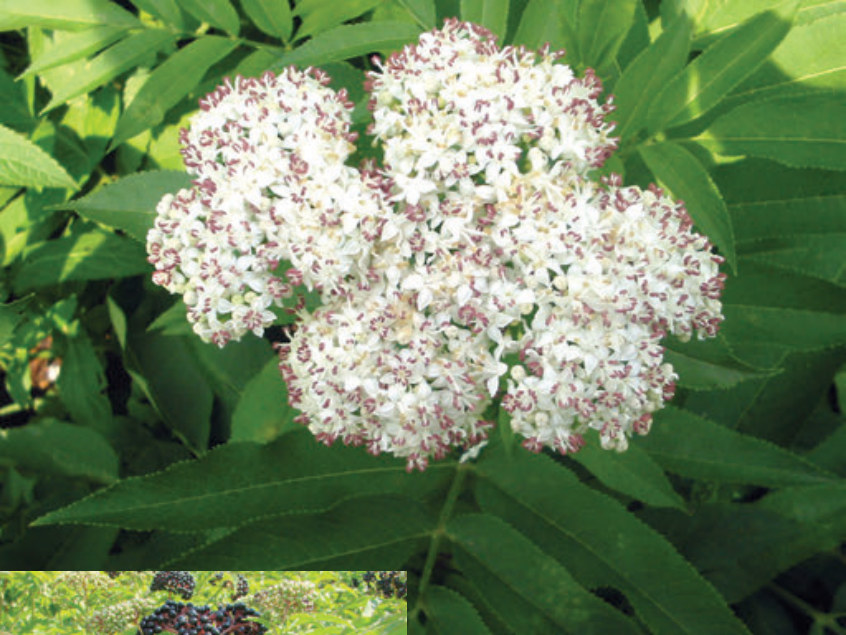
The flowers are fragrant, resembling bitter almonds in their scent, and grow in a large cluster.
The petals are reddish-white, and the fruit is reddish-black, filled with red juice.
Used part
Leaves, fruits, flowers, and roots.
Chemical components: The plant contains various phytochemicals, including flavonoids and lectins.
The leaves contain volatile oil (linseed oil), bitter compounds, cyanogenic compounds, emulsin yeast, and sugars.
The fruits contain volatile oil, cyanidins, sterols, cyanogenic glycosides, some aliphatic alcohols, and unsaturated fatty acids.
Green fruits also contain free and polymerized forms of epolein.
The flowers contain traces of volatile oil, cyanogenic glycosides, and sugars.
The seeds contain α-linolenic acid, linoleic acid, oleic acid, and palmitic acid, which are essential polyunsaturated fatty acids (PUFAs).
The roots contain iridoglycosides such as ebulosid and isoswerosid, traces of volatile oil, sucrose, inositol, catechin tannins, and cyanogenic glycosides.
chemical components
The leaves contain volatile oil (elderflower oil), bitter and cyanogenic compounds, emulsinol, sugars, and some cyanogenetic glycosides.
The fruits contain volatile oil, sterols, flavonoids, cyanogenic glycosides, aliphatic alcohols, and unsaturated fatty acids.
The flowers contain traces of volatile oil, cyanogenic glycosides, sugars, and iridoglycosides such as ebulosid.
The roots contain iridoglycosides, catechin glycosides, catechin tannins, inositol, traces of volatile oil, sucrose, and inositol.
Properties and medical uses
It is used in folk medicine to treat many ailments, including joint pain, colds, wounds, and inflammations.
All parts of the plant are poisonous, especially the seeds, and the fruit of this species may cause stomach upset.
The toxic substance in the fruit is broken down by cooking.
The leaves are widely used in Turkish folk medicine for inflammatory conditions, where prepared poultices are applied externally to treat burns, edema, eczema, and abscesses.
The leaves are anti-inflammatory, diuretic, diaphoretic, expectorant, and laxative.
The fruit is sometimes used, but less potent than the leaves.
This herb is widely used to treat liver and kidney ailments, and can be used as a poultice to treat edema and bruises.
The root is a mild diaphoretic, diuretic, and laxative.
It is dried, then crushed and taken as a tea.
The leaves, flowers, and bark are used for their diuretic, laxative, and diaphoretic properties.
All parts of the plant except the fruit are considered laxatives.
Leaf extract has antibacterial properties.
It is popularly used for dropsy, rheumatism, chronic joint pain, colds, constipation, and as an emetic.
pharmaceutical forms
Medicinal tea.
Side effects and precautions: It should be used under medical supervision as it can cause nausea and dizziness.
Caution is advised due to the plant's toxicity, as it contains apolipoline.
Elderberry berries should be avoided, as they may cause specific toxicity (cyanide poisoning).
High doses can cause a drop in blood pressure, nausea and vomiting, bloody diarrhea, tinnitus, cyanosis (bluish discoloration of the face), headache, loss of consciousness, and may lead to death.
Side effects and precautions
It should be used under medical supervision as it can cause nausea and dizziness.
Caution is advised due to the plant's toxicity, as it contains apollin.
Elderberry berries should be avoided, as they can cause specific toxicity (cyanide poisoning).
High doses can cause a drop in blood pressure, nausea and vomiting, bloody diarrhea, tinnitus, cyanosis (bluish discoloration of the face), headache, loss of consciousness, and may lead to death.
Other uses
The young elderberry fruit is used in the production of beverages, and a blue dye and ink are obtained from the fruit. The root sap is also used to dye hair black.
the environment
Elderberry is widespread in temperate and cold regions of the world, growing wild in scrubland.
It is a gas plant, tolerant of most soil types, including calcareous soils, but prefers moist loamy soils.
It grows well in heavy clay soils.
It thrives in neglected lands and forests, and in light, medium, and heavy soils.
It also grows in moderately acidic, neutral, and alkaline soils.
It can grow in shady forests, and it can withstand strong winds but not sea winds. It can also tolerate air pollution.
Agriculture and productivity
The plant is propagated by seed, either by direct sowing in the soil or by planting in a nursery, after which the seedlings are transplanted to their permanent location.
It can also be propagated by root cuttings in winter and requires watering in summer.
(Sambucus nigra L., Sambucus graveolens Willd., Sambucus nigra subsp.
nigra., Sambucus nigra f.
pendula Dippel., Sambucus nigra f. luteomarmorata Geerinck., Sambucus laciniata Mill.l)
History and Heritage
The scientific name for the genus is the ancient altinoid of this plant.
The genus is associated with a wealth of traditions, customs, tales, and folk sayings, and is often described as a "complete medical treasury" due to its numerous therapeutic and preventative benefits.
It was known to the ancient Egyptians and was a common remedy for clearing phlegm in the 7th century.
Nicholas wrote that a decoction of the roots could cure snakebites. (Calberb general)
Medical note
This information is for educational purposes only and does not constitute medical advice.
Poisonous or potent plants should only be used under the supervision of a qualified physician or pharmacist.
Related images


