Fragrant Violet | Medicinal Plant in Akhdar Encyclopedia
Violet roots, containing saponins with expectorant properties, are beneficial in treating coughs, asthma, and dry and chronic throat and bronchial inflammation. Large doses have a hypotensive, emetic, and laxative effect (violin alkaloid). A decoction of the roots is used topically to treat skin di…
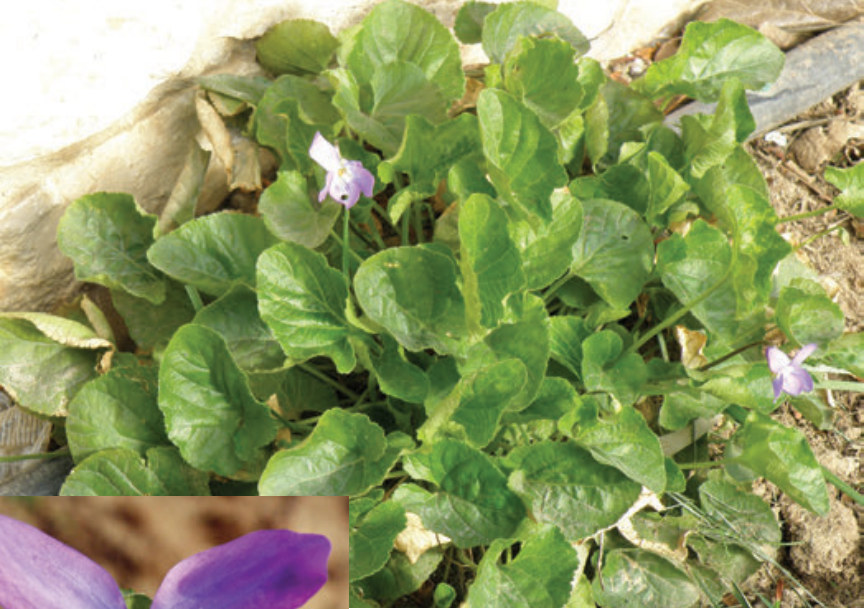
Plant name
fragrant violet
Latin name
Viola odorata L
Common names
fragrant violet
foreign names
Eng. Sweet violet, Fr. Violette
The group
Violet
Habitat and Geographic Distribution
The native habitat of the fragrant violet is the Mediterranean and western Atlantic regions.
Botanical description
The market is a hardy, perennial herb, 15 cm long, which allows the plant to form colonies that vary in size.
The stipe (s) are 4 cm long.
The leaves are simple, alternate, uterine, fringed, and twice the length of the petioles.
They are ovate or round-ovate, with a strongly heart-shaped base.
The leaf blade is ovate or ovate.
The petioles are long, with a complete to crest-like margin.
The flowers are solitary, hermaphroditic, bilaterally symmetrical, oriented towards the bracts, almost in the center.
The sepals are five, nearly equal, oblong, dull, half the length of the stamens, and flattened near their base.
The corolla is purple, with five petals, the lower ones being the largest and forming a spur.
The stamens are five, free, with very short and broad filaments.
The female is tricarpal, the ovary is solitary and superior, and the style is stomata.
The seeds are numerous and small.
The plant is simple.
The fruit is a bare, hairy capsule that opens via inflorescence from February to April.
Used part
Roots, flowers, and flowering calamus grass
chemical components
Salicylic acid, its main component being acetalmethyl salicylic acid (0.04%), is present in the roots and herb, which contain volatile oils (odoratine, violin), saponins, and alkaloids (beta-nitropropionic acid, which forms during drying).
Methyl ester, iridine, and iridine glycoside (which gives a bright blue-violet color) are also present.
Violamine oil is present.
The flowers contain anthocyanin pigments such as violamine, isoborneol, undecan-2-one, 2,6-nonadien-l-al, dihydro-beta curcumene, and zingiberene (0.003%).
The leaves contain various flavonoids, saponins, rutin, and mucilage. The flavonoids include rutin and potassium salts.
Properties and medical uses
Violet roots, containing saponins with expectorant properties, are beneficial in treating coughs, asthma, and dry and chronic throat and bronchial inflammations.
Large doses have a hypotensive, emetic, and laxative effect (violin alkaloid).
A decoction of the roots is used topically to treat skin diseases, bruises, and to accelerate wound healing.
It is also used to treat rheumatism and inflammation of the oral mucous membranes.
The flowers possess expectorant, laxative (mucilaging), and antiseptic (antimicrobial) properties.
A decoction of the flowers (violet syrup) is used to treat respiratory illnesses, whooping cough, dry cough, bronchitis, asthma, headaches, and migraines.
Violet flowers are now widely used as a natural dye and in perfumery.
The leaves have diuretic properties (potassium sulfate) and have been used to treat insomnia, skin disorders, cancer, headaches, epilepsy, palpitations, shortness of breath, urinary retention, and skin diseases.
This plant also has anti-inflammatory and analgesic properties.
For pain relief and as an antioxidant.
Precautions: It is recommended to avoid taking large doses as they may cause nausea due to their saponin content. May cause vomiting. May interact with laxatives.
Side effects and precautions
It is recommended to avoid taking large doses as it may cause nausea due to its saponin content. It may also cause vomiting. Furthermore, it can interact with laxatives.
the environment
This plant grows in pastures, meadows, forest edges, and mountainous areas on sandy and rocky soils.
It thrives in light, moderately moist, well-drained, and slightly shaded loamy soils.
For flowering, the plant requires short days; long days lead to increased stem length, fewer flower buds, and low temperatures, which may prevent flowering altogether.
Agriculture and productivity
Fragrant violets are propagated by division, where the creeping stem is split into sections, each containing leaves and a cluster of flowers.
They can also be propagated by terminal cuttings and seeds.
Plants are grown in alternating rows in beds, spaced 30-50 cm apart.
Regular watering is essential, as drought damages the shallow roots.
The plant requires regular maintenance, including hoeing, weeding, and fertilization.
The plant blooms from late winter to mid-spring, with the possibility of a second bloom in autumn.
The green herb is harvested during the flowering stage.
One hectare of fragrant violet yields 10-12 tons, producing 8-9 kg of essential oil.
Species include: Viola tricolor L., Jacea tricolor L., Opiz, Mnemion tricolor L., Spach, Viola tricolor subsp. erecta, Ehrh., Viola tricolor var. major, Roth, and Viola versicolor Salisb.
History and Heritage
The name odorata means perfume or fragrance.
The scientific name for the genus is violet, and the species name is Viola odorata.
In medicine, the species name has been Viola odorata since ancient times.
Homer recounts how the Athenians used violets "to calm anger," while Pliny recommends wearing a violet wreath to prevent headaches.
Bartholomew wrote in 1250 AD, "The small quantity of the substance is compensated for by the richness of its taste and effect." The parts used are the roots, flowers, and flowering herb. Latin name: Viola odorata L.
Medical note
This information is for educational purposes only and does not constitute medical advice.
Poisonous or potent plants should only be used under the supervision of a qualified physician or pharmacist.
Related images


