Egyptian henbane (Ashwagandha) | A medicinal plant in the Akhdar encyclopedia
A mydriasis, parasympathomimetic, and acetylcholinesterase antagonist. High doses cause central nervous system spasm of the smooth muscles of the digestive, urinary, and bronchial systems. It inhibits glandular secretions. It is used to treat respiratory tract infections (colds) and for the symptom…
Plant name
Egyptian anesthesia
Latin name
Hyoscyamus muticus L
Common names
Egyptian anesthesia, Egyptian drunkenness
foreign names
Eng. Egyptian henbane, Fr. Jusquiame de Egypte
The group
eggplant
Habitat and Geographic Distribution
Iranian-Turanian and Saharan-Arabian varieties.
It grows naturally in the desert regions of North Africa from Mauritania to Sudan, and is also found in Saudi Arabia and the Eastern Mediterranean. Major producing countries are India, Afghanistan, and Egypt.
Botanical description
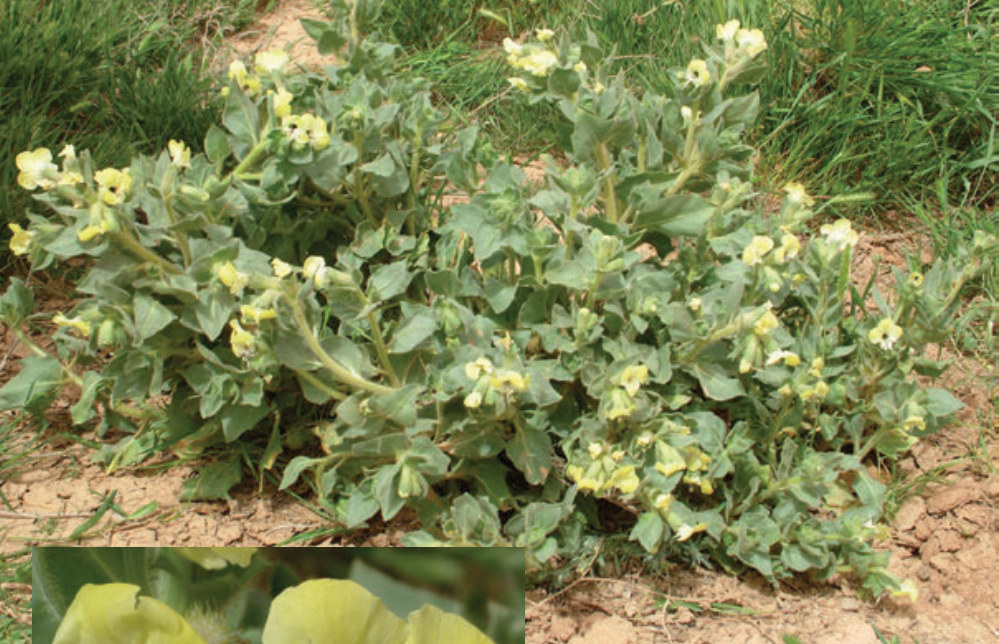
A perennial herb with an unpleasant odor.
The stem is erect, thick, and covered with hairs.
The upper leaves are oval, toothed, thick, and pointed at the tip.
They are pinnate, petiolate, and alternate on the stem.
The flowers are trumpet-shaped and yellowish-white.
The fruit is a capsule containing numerous small, brown or gray seeds.
The roots are creeping, and the stem is fixed and erect.
The leaves are dull.
Other types of henbane grow in the Mediterranean and North Africa, similar in chemical composition and uses, such as *Hypericum aureus*, *Hypericum niger*, and *Hypericum albus*.
Among the Egyptian henbane are *Hypericum falezler* and *Hypericum reticulata*.
Egyptian henbane is distinguished from other henbane varieties by its high alkaloid content, which has increased its global popularity.
Used part
Leaves, flowers, stem and seeds
chemical components
Hyoscyamine, the most important of which is scopolamine, is a group of alkaloids, including scopolamine and scopolamine. All parts of Egyptian henbane contain scopolamine and scopolamine.
Properties and medical uses
It is a mydriasis, a parasympathomimetic, and an acetylcholinesterase antagonist.
High doses cause centrally acting spasmolytic effects on the smooth muscles of the digestive system, urinary tract, and bronchi.
It also inhibits glandular secretions.
It is used to treat respiratory tract infections (colds) and for the symptomatic treatment of chronic infectious bronchitis.
A decoction of the leaves is used topically to treat liver, gallbladder, and pancreatic diseases, intestinal colic, asthma, and spasmodic cough.
A paste made from the cooked leaves is used topically as a poultice to treat infections, wounds, burns, parasitic diseases, neurological disorders, rheumatic pains, and phlebitis.
In small doses, it is used for chesty coughs and asthma, and as an analgesic and sedative (0.1 ml dose).
The concentration should not exceed 0.4 g.
It exhibits antioxidant activity similar to that of methanol (IC50) at a rate of 0.19 ± 0.541 mg/ml, while the essential oil showed a lower antioxidant activity of 0.89 ± 6.26 mg/ml.
Atropine and scopolamine are used in ophthalmology as analgesics, and scopolamine is used to treat or prevent motion sickness.
These tropane alkaloids are classified as anticholinergics because they bind to acetylcholine receptors.
Side effects and precautions
The plant is poisonous.
Use of the tender leaves can cause local allergic reactions, dry mouth, tachycardia, decreased secretions, constipation, and delirium.
It should not be given in cases of tachycardia, prostate cancer, glaucoma, acute pulmonary edema, or physical changes in the digestive tract and colon.
the environment
Hyssop grows in abandoned areas and fields in temperate regions.
It tolerates low temperatures, which leads to weak vegetative growth and a lower content of active ingredients, unlike warmer conditions that accelerate and advance vegetative and fruit growth.
Hyssop is a long-day plant; long daylight hours and intense light promote growth and increase alkaloid content.
The amount of alkaloids decreases in areas with high humidity.
The plant is cultivated in most soils, but it prefers silty and light soils. Soil salinity increases the concentration of alkaloids in the leaves.
Agriculture and productivity
The plant is propagated by seeds sown directly or in winter, either in autumn or spring, although the latter is preferable.
The seeds are sown in the permanent soil in holes along rows spaced 70 cm apart, and 50 cm apart within each row, with 4-8 seeds placed in each hole.
After a month of germination, the plants are thinned, leaving only the strongest in each hole.
Sowing takes place in winter by first broadcasting the seeds in raised beds.
When the seedlings reach 8 cm in length and have 3 leaves, they are transplanted to the permanent field.
Transplanting occurs during irrigation, in rows spaced 75-80 cm apart, with 40-50 cm between plants.
Moderate irrigation is required.
It responds well to fertilization.
One hectare yields 2.2-3.1 tons of dry leaves and 40-500 kg of seeds.
Lycium barbarum L.
Dulcamara flexuosa Moench, Lycopersicon dulcamara (L.) Medik., Solanum ruderale Salisb., Solanum scandens neck
History and Heritage
The word "henjal" comes from the Hindi word "al-biz," which was Arabicized long ago.
"Al-sakran" is a name used in the Syrian desert.
The scientific name for the genus *Ful* is *Kuamos al-khanaz* (pig's bean), and the Greek *uos* indicates that the seeds of this plant were given to pigs as an aphrodisiac during estrus.
It was mentioned by Hippocrates, Dioscorides, Ibn al-Baytar, al-Antaki, and Ibn Sina, and was historically used as an anesthetic.
Medical note
This information is for educational purposes only and does not constitute medical advice.
Poisonous or potent plants should only be used under the supervision of a qualified physician or pharmacist.
Related images


