Atlantic Pistacia | A medicinal plant in the Akhdar encyclopedia
The fruit and leaves are used in folk medicine as an antidiarrheal and antiseptic. Some research has shown the benefits of an aqueous extract of the plant in lowering blood sugar levels. The Atlantic pistachio has been widely used in the Middle East and Mediterranean regions since ancient times for…
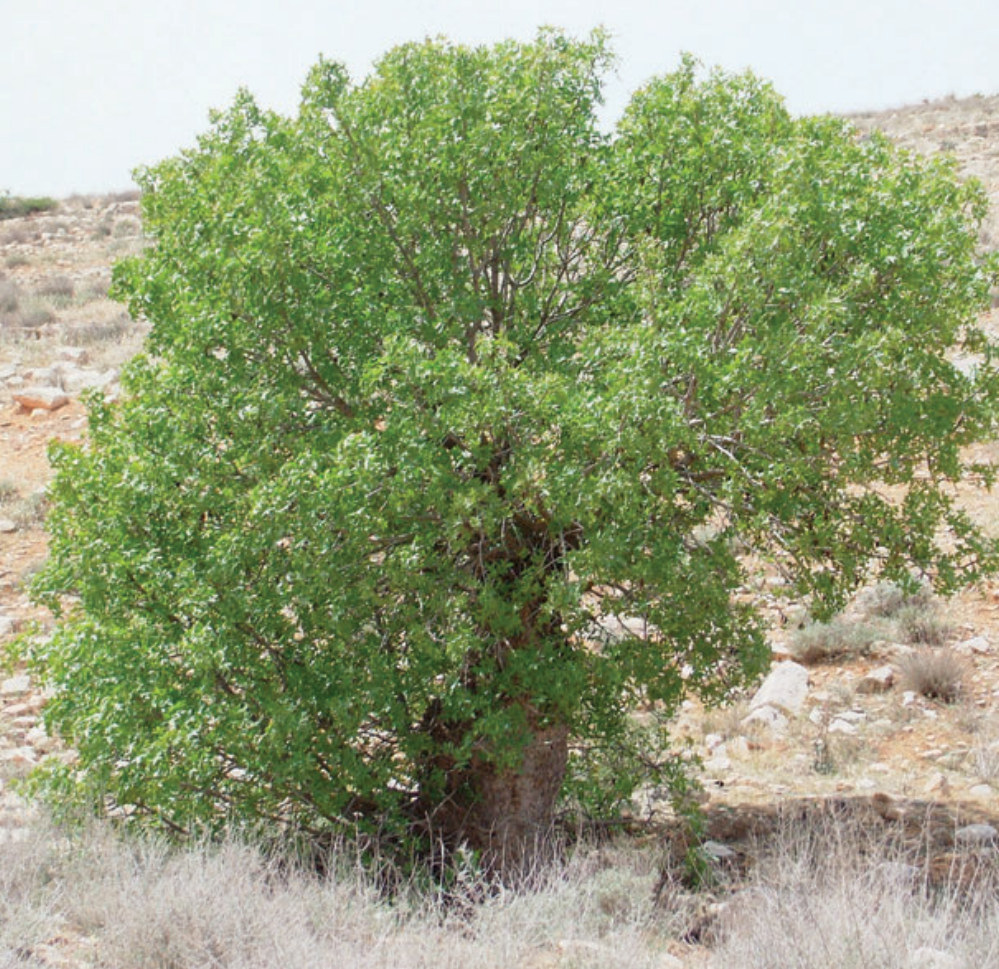
Plant name
Atlantic pistachio
Latin name
Pistacia atlantica Desf
Common names
Atlantic pistachio
foreign names
Eng. Atlantic pistachio, Fr. Pistachio de,Atlas
The group
heart
Habitat and Geographic Distribution
Iranian-Turanian.
Its native range includes North Africa, the Levant, and Western Asia, extending to Iran.
The Atlantic pistachio is naturally found in North Africa, the Middle East, and the Canary Islands in the Atlantic Ocean.
It is also found in Wadi al-Batim in the Sinai Desert, which is its driest natural habitat, and in Syria and Jordan.
Botanical description
The branches are brown to gray.
The leaves are alternate, pinnately compound.
20 - A deciduous tree, 20 mm long, uterine or 20 - 6×70 - The leaflets are ovate to oblong in shape, the petioles are flat.
The leaflet is oblong, with a dull apex.
The flowers are unisexual, and the plants are dioecious.
The male flowers are gathered in racemes, 10 cm long, the flowers are tightly packed and become loose later.
10 - 10 cm long.
The flowers are semi-substrate.
The male flowers are surrounded by bracts.
15 - The female inflorescences are also compound racemes, the length and number of parts of which together form a false five-lobed cyme.
The stamens have very short filaments, and the anthers are long.
The female flowers are composed of several parts: the male ovary, unistone ovary, uniovule.
3 - Membranous, dry, female ovule, obovate to spherical.
The outer pericarp becomes compact when the fruit is 6-5x7 cm.
The drupe is drupe-shaped, and its dimensions dry.
The inner pericarp is bony.
The seeds are compressed, and the cotyledons are oily and sulfur-bearing. Flowering occurs from March to April.
Used part
The leaves, fruits, and oily resin secreted by the plant
chemical components
On the leaves.
The oil components are differentiated: 32.6% - 0.8% - 0.2%.
The leaves, fruits, and resin contain volatile oil, the percentage of which depends on its source.
The volatile oil from the resin is rich in monoterpene hydrocarbons (13% β-pinen, 43% α-pinen) and monoterpene oxygen compounds, including 3.8% α-pinen.
The volatile oil from the fruits contains [unspecified compound] as a primary component.
The volatile oil from the leaves is rich in oxygen compounds, including 21% bornylacetate.
20% elemol, 8.4% eudesmol (mono- and tetra-oleic acid) by dry weight.
The seeds contain a fixed oil (Fe, P, Mn, Mg, Na), fiber, and minerals (linoleic acid), as well as nitrogenous compounds.
The bark (enlarged tissue resulting from the growth of some trees) contains 22% tannins. The leaves contain tannins.
Properties and medical uses
The fruits and leaves are used in folk medicine as an antidiarrheal and antiseptic.
Some research has shown the benefits of an aqueous extract of the plant in lowering blood sugar levels.
The Atlantic pistachio has been widely used in the Middle East and Mediterranean regions since ancient times for various purposes, such as treating stomach ailments, kidney disorders, wounds, and coughs.
Modern studies have shown that it possesses numerous medicinal properties, including antioxidant, antidiabetic, and antilipid effects, and may also be effective for digestive disorders.
The pistachio tree, its oil, and its resin have a distinguished medicinal place, as mentioned by Ibn Sina and Ibn al-Nafis al-Dimashqi, in treating tumors, liver diseases, and chalazion (a condition affecting the eyelid).
It is also highly beneficial for joints, a powerful antiseptic, and useful in treating and repelling insect bites.
The large galls (nuts) caused by some insects on the tree's buds are antibacterial and antifungal.
Side effects and precautions
Allergic reactions or drug interactions may occur; self-use should be avoided by pregnant and breastfeeding women, children, and patients with chronic diseases.
Other uses
The fruit is sold in markets as a food product that is processed, salted, and consumed as a refined product. The fatty oil extracted from the seeds has many uses.
Food uses
The resin that oozes from the tree is used in the manufacture of wax and soap, and is also an ingredient in cosmetic ointments, pastes, and compounds used in the photographic film industry.
Tannins extracted from the bark and leaves are used in the manufacture of weapons, dyes, and leather tanning.
the environment
The terebinth tree (Pistacia terebinthus) is cold-resistant and grows naturally in arid and semi-arid regions on sunny slopes, even up to a certain height.
It is characterized by its slow growth and tolerance of calcareous, stony, and rocky soils, preferring deep, light, well-drained (loamy, sandy), moderately acidic, and slightly dry soils.
The roots and trunk of the terebinth tree are sometimes affected by spore-forming infestations, resulting in enlarged tissues in the form of galls.
Galls (Pistacia atlantica): Cultivation and productivity: An excellent type of tree, relatively easy to propagate and suitable for arid environments.
It is propagated by seeds and cuttings.
Seedlings are produced in nurseries and then planted in the spring in forested areas, with sufficient irrigation at planting.
Pollination in the Atlantic pistachio tree is cross-pollination and wind pollination, which explains its presence near pistachio trees.
It can be used as a rootstock for grafting these trees.
It bears fruit during the autumn.
The Atlantic pistachio enters the economic production phase starting from the first year (October). (September 7)
Agriculture and productivity
An excellent species for afforestation, well-suited to arid environments.
It is propagated by seeds, which are best treated with scarification or acid and then soaked in water for 24 hours.
Seedlings are produced in a nursery and then transplanted to their permanent location, ensuring adequate irrigation at planting.
Pollination in the Atlantic pistachio tree is cross-pollination and wind-borne, which explains its proximity to pistachio trees (Pistacia vera), and it can also serve as a rootstock for grafting these trees.
The Atlantic pistachio enters its economic production phase at 5-7 years of age, and its fruits are harvested during the autumn season (September-October).
(Pistacia lentiscus L.
Lentiscus vulgaris Fourr., Terebinthus lentiscus L.
(Moench., Pistacia lentiscus subsp. Lentiscus., Pistacia brevifolia Gand., Pistacia gummifera Salisb.)
History and Heritage
The word "pistachio" comes from the Akkadian language, dating back to the pre-Christian era in Mesopotamia.
The Babylonians used it to name these trees, calling them "pistachios." Other civilizations that inhabited the region, including those in the Mediterranean, continued to use it until our time.
It is likely derived from the corruption of the word "pistachio" from the Greek "pistacia." The scientific name for the genus (i.e., true pistachio) is the well-known Aleppo pistachio, *Pistacia vera*.
The Persian word "fustuq" (pistachio) specifically refers to the species, meaning "Atlantic," referring to the Atlas Mountains in North Africa (Atlantica), which are widely cultivated for their fruit in Aleppo.
The species name refers to the tree found in its natural state and first described as a tree that once formed vast forests in North Africa and the Mediterranean. It is now in severe decline due to overlogging. (Nahal)
Medical note
This information is for educational purposes only and does not constitute medical advice.
Poisonous or potent plants should only be used under the supervision of a qualified physician or pharmacist.
Related images


