True Chamomile | A medicinal plant in the Akhdar encyclopedia
The flowers and essential oil possess anti-inflammatory properties, relieve smooth muscle spasms, and aid in the healing of wounds and skin ulcers. They are antibacterial and inhibit bacterial growth, and stimulate the exchange of substances across the skin. The drug is used to treat digestive spas…
Plant name
True chamomile
Latin name
Matricaria recutita L
Common names
The real babujin
foreign names
Eng. Chamomile German, Fr. Camomill
The group
Star
Habitat and Geographic Distribution
Taurine.
- Siberian, Mediterranean, and European varieties include: M.
aurea, a Mediterranean variety, the golden chamomile, widely distributed and with numerous medicinal benefits.
The true or amylin chamomile is known as Matricaria chamomilla, and the species is called Anthemis nobile (chamomile nobile). Roman or English chamomile.
Botanical description
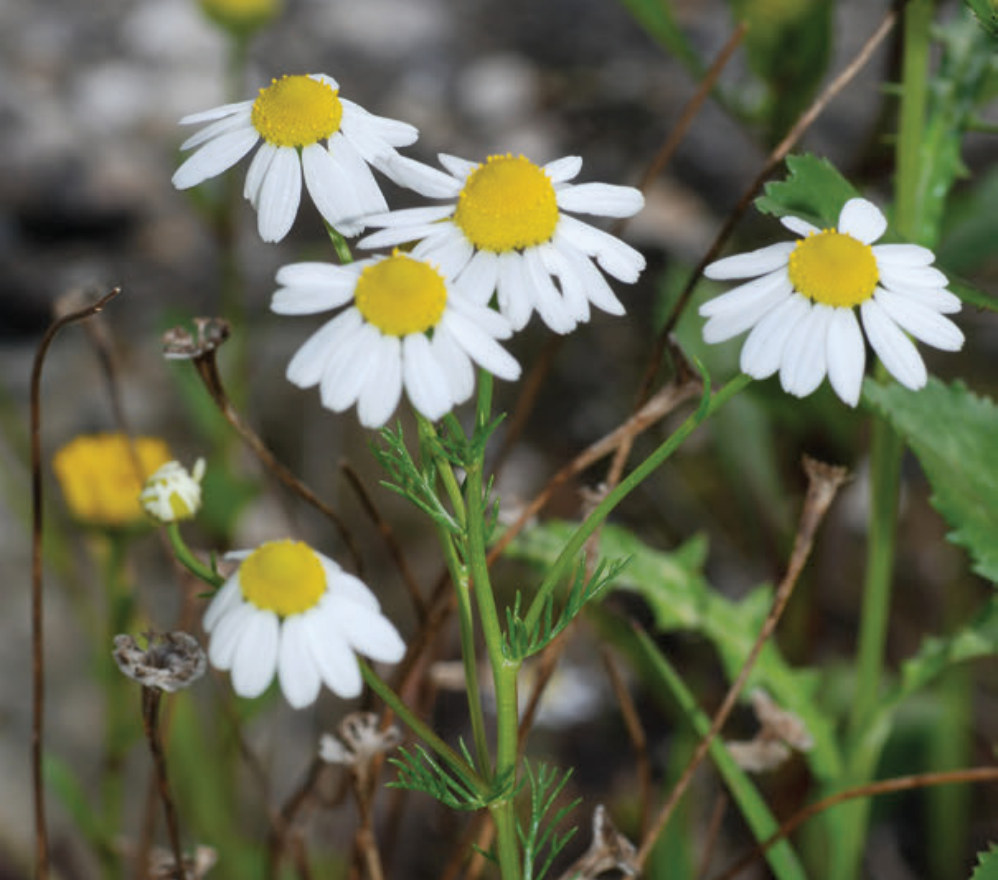
The stem is simple or branched from the base, erect or ascending, branching into 40-year-old, glabrous, aromatic herb, with a head that grows in a raceme-like pattern.
The leaves are deeply lobed: narrow, entire, and ending in a stamen.
The flower heads are 1 cm in diameter, with long stalks, and consist of ligules peripherically and tubular flowers in the center.
The bracts are oblong, 1.5-2 cm long, glabrous, with broad, membranous margins, and entire.
The receptacle is long and reddish-brown.
The ligules are white, elliptical, and slightly curved downwards after flowering.
The central tubular flowers are yellow.
The fruit is a small acinus, about 1 cm long, ribbed ventrally. Flowering occurs from April to May.
Used part
Flowering heads, and the essential oil extracted from them
chemical components
From a blue compound called gamma azulene, containing over 1.5% volatile essential oil, reaching a percentage of monoterpenes (matricin monoterpenes) through saponification (matricin monoterpene), chamazulene (produced by the conversion of matricin), reaching a percentage of farnesen.
The volatile oil also reaches a percentage of umbelliferone and herniarin, such as herniarin, coumarin, and polyine derivatives.
It reaches a percentage of apigenine in the petals in the form of mono-apigenine glycosides, flavonoids, vanilic acid, and vanillic acid.
Aromatic organic acids: anisic acid, simple hexasorbates, and starch. 10% polysaccharides.
Properties and medical uses
The flowers and essential oil possess anti-inflammatory properties, relieve smooth muscle spasms, and aid in the healing of wounds and skin ulcers.
They are antibacterial and inhibit bacterial growth, stimulating the exchange of substances across the skin.
The preparation is used internally to treat digestive spasms and inflammatory diseases of the digestive system.
It is also used to treat irritation of the mucous membranes of the mouth, throat, pharynx, and upper respiratory tract, as well as to treat coughs, fever, colds, wounds, and burns.
Chamomile is used topically as a gargle to treat gingivitis, as an inhalant to treat inflammatory respiratory diseases, and as a wash or bath to treat infections of the genital tract, skin and mucous membranes, M.
aurea, and bacterial skin diseases, and for the supportive treatment of wounds and skin ulcers.
Chamomile preparations are used as sitz baths or baths to relieve hemorrhoid pain, especially after hemorrhoid surgery, and to treat eczema, fistulas, and inflammatory gynecological diseases.
It is popularly used to treat insomnia, digestive disorders, eye irritation, menstrual irregularities, bleeding, skin ulcers, hemorrhoids, acne, and in infant baths.
Other uses: Chamomile oil is used in the preparation of many cosmetic products and is available in the form of capsules, liquids, creams, and ointments, etc.
Chamomile flowers, organic chamomile, classic chamomile—its preparations are sold under various names.
Side effects and precautions
Possible side effects of chamomile include allergic conjunctivitis (eye inflammation), skin irritation, severe allergic reactions (shortness of breath, wheezing, itching, and rash), and vomiting.
Chamomile should not be taken with blood thinners such as coumarin or any other medications, as it reduces their effectiveness.
It should also be avoided by pregnant or breastfeeding women, as it can induce abortion.
Caution is advised because some components of chamomile have been shown to harm animal fetuses.
The herb should be used with caution by those with allergies to the essential oil components or a history of skin irritation.
the environment
Chamomile is a light-loving plant that thrives in temperate and warm climates, provided humidity is moderate and water is available.
It tolerates low temperatures, but warmer conditions stimulate growth and increase the concentration of its active compounds.
It prefers well-drained, light loamy or loamy soils with a slightly to moderate alkalinity and is relatively tolerant of salinity.
Agriculture and productivity
Chamomile is propagated by seeds, which are sown in a nursery. One dunam requires approximately 150g of seeds.
History and Heritage
The word "baboojin" originates from the Persian word "baboonak." The scientific name for the genus is the Latin translation given by ancient botanists to the genus, which was originally called Parthenum (chrysanthemum).
The term "Chrysanthemum" was later reserved for this genus.
The descriptive term for the species is from Latin and means "standing." The parts used are the flower heads and the essential oil extracted from them.
The Latin names are: Matricaria recutita L., Matricaria chamomilla L., M. suaveolens L., and Chamomilla officinalis L.
Medical note
This information is for educational purposes only and does not constitute medical advice.
Poisonous or potent plants should only be used under the supervision of a qualified physician or pharmacist.
Related images


