Eucalyptus | A medicinal plant in the Akhdar encyclopedia
The essential oil possesses antibacterial and antifungal activity, inhibits prostaglandin biosynthesis, is a mild local irritant, expectorant, and promotes bronchial secretions. It is also antitussive and improves lung function. Eucalyptus leaves have similar properties; they are expectorant, promo…
Plant name
Eucalyptus
Latin name
Eucalyptus camaldulensis Dehn
Common names
Eucalyptus, camphor (called kina in Syria)
foreign names
Eng. Eucalyptus, Fr. Eucalyptus
The group
Asian
Habitat and Geographic Distribution
Eucalyptus, widespread globally, particularly in subtropical regions, has adapted to the Mediterranean climate.
The genus Eucalyptus includes several important species, the most important of which are: E. globules Labill, E. polybractea T. Baker, and E. camaldulensis ehn.
Botanical description
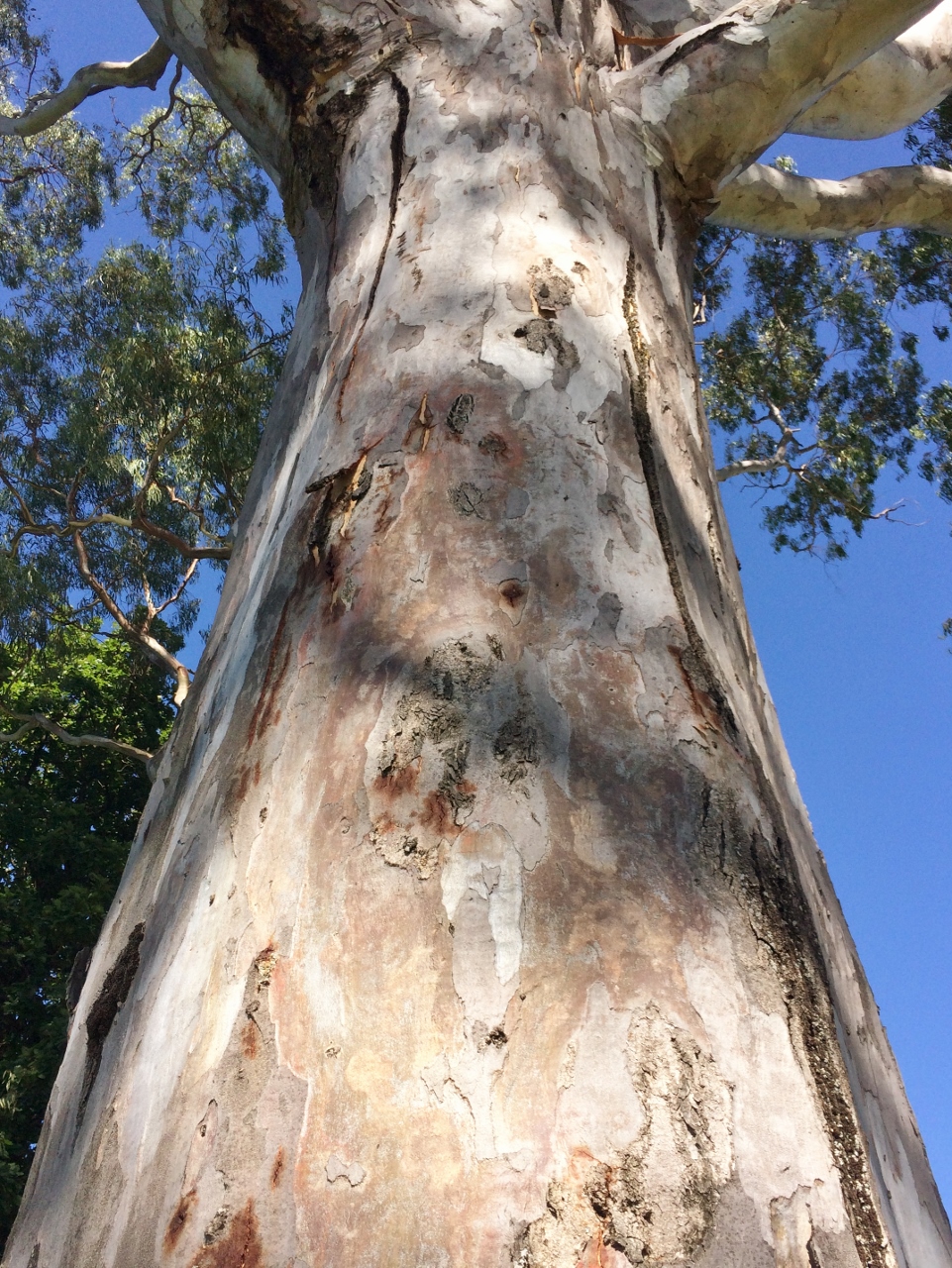
The trunk is smooth, and its diameter reaches 50 cm.
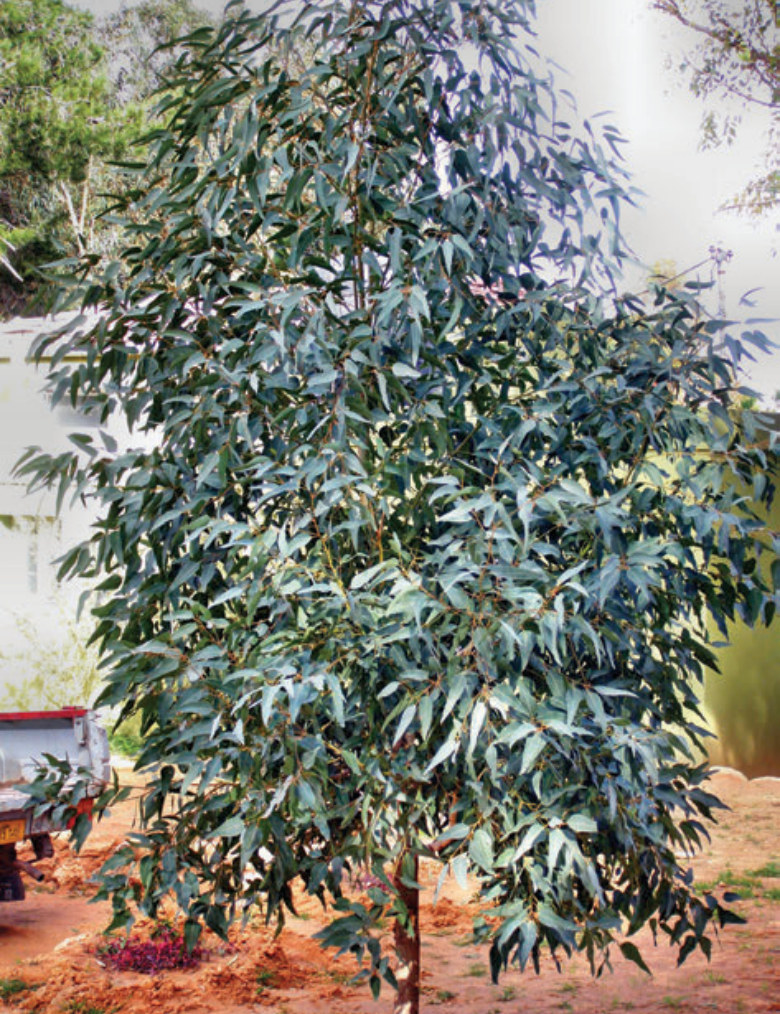
The tree is massive, evergreen, and fast-growing, reaching a length of bluish-gray.
The trunk in the middle section of the trunk separates annually in the form of elongated plates.
The branches and leaves are drooping.
The leaves are long, petiolate, and exhibit polymorphism.
On young branches, they are oval and thin, with smooth, slightly thick edges.
On older branches, they are sepal to sword-shaped and thick, and gray in color.
The flower has a distinctive form, with the calyx (the fused sepals and corolla) taking on a conical shape that covers the male and female parts.
It gradually separates and falls off, allowing the numerous stamens to emerge.
The fruit is a woody capsule, 6 mm in diameter, hemispherical, topped by a prominent cylinder.
The diameter of the capsule contains the seeds and it opens with four valves. It blooms for most of the year.
Used part
Young leaves, oil extracted from tender young leaves and branches
chemical components
limonien, α-pinen, alpha-pinen (ρ-cymen), paracymene (9%), 1,8-cineol, its most important component is cineole (vulnerable oil).
euglobale.
Acylphloroglucinol, euglobal, camphen, and geraniol, including: quercetin, rutin, and eucalyptine. In addition to waxy compounds. Flavonoids.
Properties and medical uses
The volatile oil has antibacterial and antifungal activity, inhibits the biosynthesis of prostaglandins, is a mild local irritant, expectorant, causes an increase in bronchial secretions, is antitussive, and improves lung function.
Eucalyptus leaves also possess similar properties; they are expectorant, increase bronchial secretions, relieve spasms (due to the volatile oil), are antidiabetic, antibacterial, and diuretic.
The compound euglobal has anti-inflammatory and antioxidant activity.
It is used internally for colds and externally to treat rheumatism.
A decoction of the leaves is used traditionally to treat influenza, bronchitis, asthma, colds and congestion, indigestion (diseases of the liver and gallbladder), bladder and kidney diseases, and marital fever.
A decoction of the leaves is used topically as a wash to treat gynecological infections, acne, mouth inflammation, and bleeding gums.
Eucalyptus essential oil is effective against many gram-positive and gram-negative bacteria.
Eucalyptus essential oil and its extracts are among the most effective antibacterial oils compared to other members of the Eucalyptus genus.
Pharmaceutical forms: Eucalyptus is available as an oil and a wash, under names such as Eucalyptus mint and Eucalyptus oil.
pharmaceutical forms
Eucalyptus mint, eucalyptus oil.
Eucalyptus is available in the form of oil and lotion, under names such as [list of names].
Side effects, interactions, and precautions: When using eucalyptus, a bluish-gray discoloration of the skin, heartburn, muscle weakness, constricted pupils, delirium, dizziness, nausea, vomiting, and constipation may occur.
Eucalyptus oil should not be taken while taking blood sugar-lowering medications.
Its use should be avoided in the elderly and those with [unclear - possibly "digestive"].
It should not be given to those with liver disease, intestinal diseases, or gallbladder disease.
The essential oil should be diluted [unclear - possibly "a small amount"] before ingestion or application to the skin.
Eucalyptus oil poisoning occurs in the elderly if the dose exceeds [unclear - possibly "excessive"], causing a drop in blood pressure and suffocation.
It affects blood pressure and the movement of [unclear - possibly "hormone-like compounds like prostaglandin"]. Note: Prostaglandin affects smooth muscles.
Side effects and precautions
Be aware that excessive use and exceeding the recommended dose may cause bluish-gray discoloration of the skin, heartburn, muscle weakness, constricted pupils, delirium, dizziness, nausea, and vomiting.
It can also cause constipation.
Eucalyptus oil should not be taken while using blood sugar-lowering medications.
It should be avoided by pregnant and breastfeeding women and should not be given to those with liver, intestinal, or urinary tract diseases.
The essential oil should be diluted before ingestion or application to the skin.
Eucalyptus oil poisoning can occur in the elderly if the dose exceeds 3 ml, causing a drop in blood pressure and suffocation.
Note: Prostaglandins are hormone-like compounds that affect blood pressure and smooth muscle movement.
the environment
7 mm/year.
Through its use in 600 widespread species in Australia, where annual rainfall rates are low, this species has demonstrated resilience to climatic conditions and soil types, surviving on rainfall up to 1 year.
The plant prefers sunny areas and well-drained, moist soils, but is somewhat tolerant of dry soils (7 mm/year) and low fertility, as well as relatively low calcium and salinity.
This species is sensitive to extreme cold and is therefore not economically recommended for use in areas with low temperatures.
It possesses diverse soil types and environmental characteristics, each with specific environmental and physiological properties that must be considered in afforestation processes, particularly resistance to lime, frost, and wind.
Agriculture and productivity
The plant is propagated by seeds sown in March in sunny, sheltered areas.
Note that seeds collected from higher elevations require stratification at 2°C for 6–8 weeks.
This species exhibits vigorous growth in light, deep soils, with annual yields reaching 10–20 m³/ha.
This productivity is susceptible to insect infestations such as the borer. Myrtus communis L.
History and Heritage
The name refers to the well-covered part of the flower, the Eucalyptus camaldulensis.
The scientific name of the genus comes from Greek, hence the name Eucalyptus camaldulensis.
It is mistakenly called "al-Kina" (the rostrate variety), which resembles a bird's beak in Syria, and "al-Kafur" in Egypt.
The term "al-Kal al-Ismani" refers to another species, and it is also called "Kaltus" in Tunisia.
The species name, camaldulensis, is derived from the syllable "camaldulensis." The parts used are the young leaves, and the oil is extracted from the leaves and tender young branches. The Latin name is Eucalyptus camaldulensis Dehn.
note
Prostaglandins are hormone-like compounds that affect blood pressure and smooth muscle movement.
Medical note
This information is for educational purposes only and does not constitute medical advice.
Poisonous or potent plants should only be used under the supervision of a qualified physician or pharmacist.
Related images