Arak | A medicinal plant in the Akhdar encyclopedia
The tannins in miswak possess antiseptic, antiseptic, and astringent properties that help stop gum bleeding. Sitostrol and trimethylamine C, present in miswak, promote healing of gum wounds and strengthen capillaries. Vitamin C, along with other blood-nourishing vitamins, helps protect against infl…
Plant name
Arak
Latin name
Salvadora persica L
Common names
Arak, Miswak, Siwak
foreign names
Eng. Tooth brush tree
The group
Arak
Habitat and Geographic Distribution
Iran, and it is widespread in China, India, the Middle East, the Arabian Peninsula, Oman, the UAE, Yemen, North Africa (Egypt, Libya, Algeria, Mauritania), Somalia, Eritrea, Sudan, Palestine, Jordan, Chad, and Ethiopia.
Botanical description
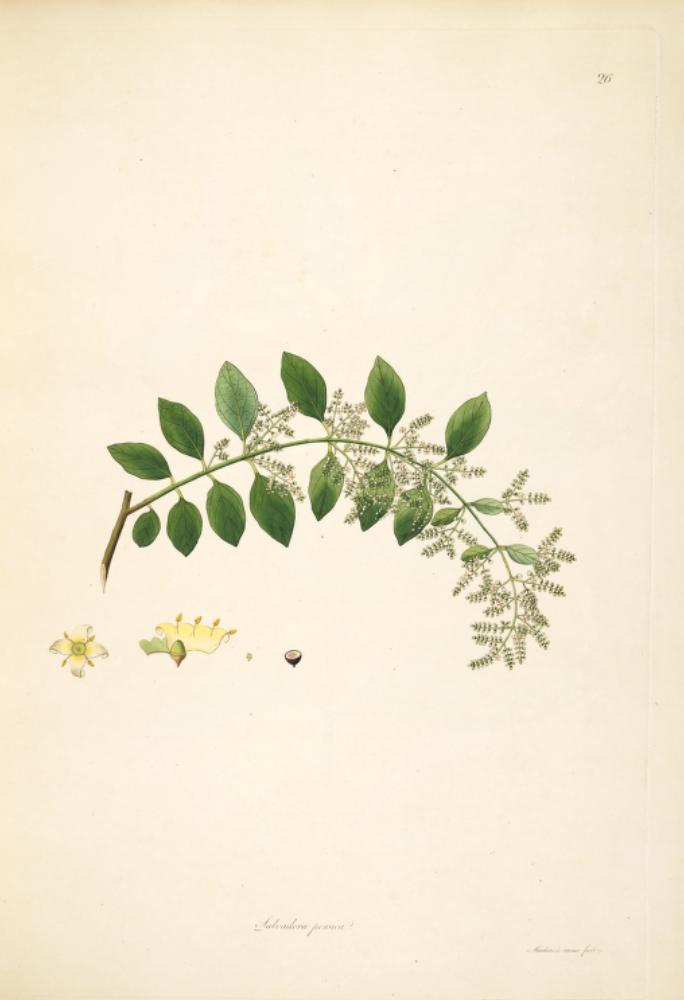
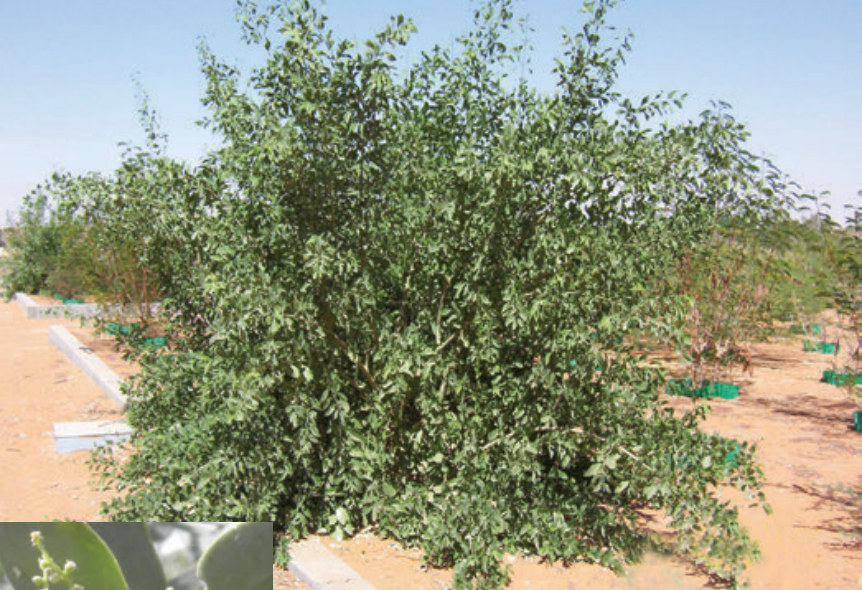
M, color 6 - a small, evergreen, glabrous shrub or small tree, pale Akhdar.
Branches are opposite, frequently branching, cylindrical, drooping, and white.
Leaves are simple, opposite, stipule-like, leathery, oblong, rarely semi-rounded, entire, dull-tipped - or ovate 3-1.5 cm, sometimes acute, with a gradually tapering base to form petioles 3 cm long.
Inflorescences are spike-like racemes, leafy 3-1.5 x 6 cm, dimensions mm, bracts are small.
2 - axillary or terminal: position.
Inflorescences mm.
The calyx is bell-shaped, with four lobes, flowers are small, about tettle-long, length: twice the length of the calyx, lobes overlapping and backward-curved.
Overlapping, fused with the fruit.
The corolla is composed of stamens, which are located on the corolla tube and alternate with the petals; the filaments are free.
The ovary is superior, monoecious, and the male is 8 mm.
The ovule is monoecious.
The fruit is a drupe (a berry-like drupe), spherical, monoecious, and its diameter is [missing information]. Inflorescence occurs from January to April.
Used part
The soft roots of the Arak tree are cleaned and cut into pieces approximately 15 cm long.
chemical components
(By weight of dry stems), and vitamin C, 4%.
The roots contain a high percentage of chloride, fluoride, and silica crystals, and small amounts of saponins, tannins, and flavonoids.
They also contain large amounts of sitosterol, in addition to the glycoside trimethylamine and trimethylamine salvadorine, resins, and alkaloids, the most important of which is salvadorine. Sinigrin is a sulfite with a sharp and burning taste.
Properties and medical uses
The tannins in miswak possess antiseptic, antiseptic, and astringent properties that help stop gum bleeding.
Sitostrol and trimethylamine C11 promote the healing of gum wounds and strengthen capillaries.
The presence of vitamin C helps nourish the blood vessels and protect them from inflammation.
This compound has been shown to lower the pH of saliva, which is a contributing factor to the growth of oral bacteria.
Additionally, sinigrin and salvadurin have been shown to reduce the growth of bacteria that cause tooth decay.
Furthermore, the resins coat the tooth enamel, protecting it from decay.
Chloride and silica crystals have been shown to reduce plaque formation and whiten teeth, and studies have confirmed the inclusion of miswak compounds in some toothpastes.
A decoction of miswak roots is traditionally used to eliminate intestinal bacteria. The fruit is used as a diuretic, expectorant, digestive aid, and antidiarrheal.
Side effects and precautions
Allergic reactions or drug interactions may occur; self-use should be avoided by pregnant and breastfeeding women, children, and patients with chronic diseases.
Other uses
The ripe fruit is eaten fresh or dried and has a sweet taste.
The leaves are used as a tofu, cooked, and used to make salads or sauces.
The tender branches, seeds, and seed oil are also eaten, and edible salt can be obtained from the ashes.
It has good forage value, and cattle and camels consume the leaves and young branches.
The leaves give milk a pleasant taste and aroma, increase milk production in cows that graze on them, and affect the taste of the milk.
It stabilizes sandy soils and resists sand encroachment, and is used for growing shade and ornamental plants, hedges, protective walls, and windbreaks around farms, gardens, and homes, and serves as a forage for bees.
the environment
A desert plant, it tolerates harsh environmental conditions and is characterized by its resistance to diseases and insects, and its rapid growth.
It grows in agricultural and sandy lands, pastures, forests, plains, and other areas.
It is naturally found in regions where the average annual rainfall ranges between 100-500 mm/year.
It is found in alluvial and sandy soils in valleys near saline areas, as well as on the edges of salt lakes and saline soils, in sand dune areas, and in desert plains flooded by rainwater.
The Arak tree grows in hot desert oases, near valleys and riverbanks, on moist soils and saline sands, tolerating salinity and alkalinity well. It flowers and bears fruit year-round.
Agriculture and productivity
It is propagated by seeds (one kilogram contains approximately 3400 seeds) which are dispersed by humans and birds that feed on the fruit.
The seeds are sown without treatment, and germination begins after about a week.
The seedlings are transplanted to their permanent location after 5-7 months.
It is also propagated by hardened cuttings, which are rooted in nurseries in bags and then planted in pre-prepared holes in the permanent location. Viscum album L. Stelin album (L.) Bubani
History and Heritage
The genus was named in honor of Juan Salvador de Bosca (1598-1681), a pharmacist from Barcelona, Spain.
"Persica" means "Persian." Sucking on pieces of the plant's roots leaves an astringent taste in the mouth, which is why it has long been used as a toothbrush.
The Messenger of Allah (peace and blessings be upon him) recommended the use of the miswak (tooth-cleaning stick) when he said, “Were it not that I would impose hardship on my nation, I would have ordered them to use the miswak at every prayer.” He also said, “The miswak purifies the mouth and pleases the Lord.” It is narrated on the authority of Ibn Abbas, attributed to the Prophet (peace and blessings be upon him), that “The miswak has ten benefits: it sweetens and purifies the mouth, strengthens the gums, removes phlegm, eliminates plaque, opens the stomach, conforms to the Sunnah, pleases the Lord, increases good deeds, and gladdens the angels.” In Lisan al-Arab, it is mentioned that the arak tree is a well-known tree, the tree of the miswak, whose branches are used for cleaning the teeth.
Abu Hanifa said that it is the best tree branch to use for cleaning the teeth and the most pleasant grazing for livestock.
“It is the best thing to use for cleaning the teeth because it clears the speech, loosens the tongue, sweetens the breath, whets the appetite, and purifies the brain.
The best way to use it is when moistened with rosewater.” It is said that Ali ibn Abi Talib entered upon his wife Fatima al-Zahra (may Allah be pleased with them both) and saw her using a miswak made from the arak tree.
He said, “You have been blessed.” O twig of the arak tree at her lips, were you not afraid, O twig of the arak tree? If you were one of the warriors, I would have killed you. No one but you has won from me, O twig of the arak tree.
Medical note
This information is for educational purposes only and does not constitute medical advice.
Poisonous or potent plants should only be used under the supervision of a qualified physician or pharmacist.
Related images