Thousand-leaved hollyhock | Medicinal plant in the Akhdar Encyclopedia
An aromatic herb with anti-inflammatory and anti-allergic properties. Its aqueous properties can be utilized to extract antioxidant byproducts. It is used to treat respiratory ailments, diabetes, and hypertension, and possesses antibacterial and antifungal activity. The plant has stimulant and chol…
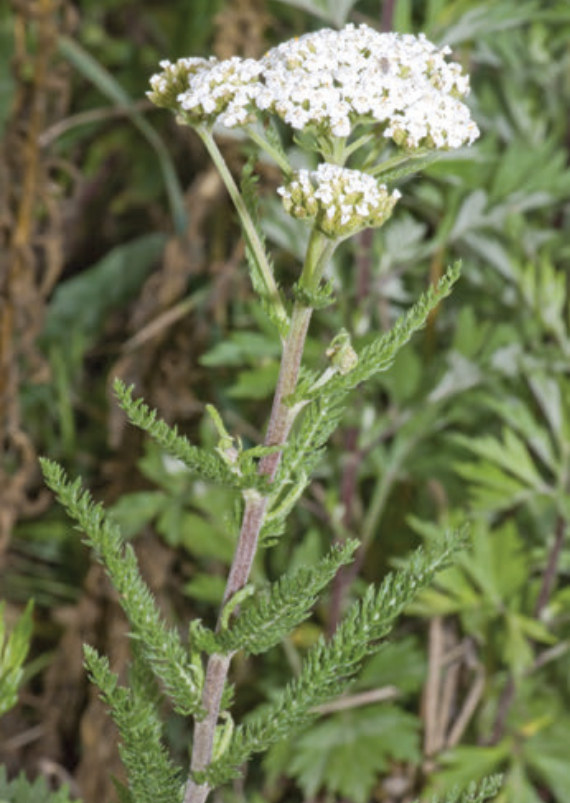
Plant name
The Thousand-Leaf Imagination
Latin name
Achillea millefolium L
Common names
The Thousand-Leaf Imagination
foreign names
Eng. Yarrow, Fr. Mille feuille
The group
Star
Habitat and Geographic Distribution
Southern Europe is likely the natural origin of the species; it is cultivated in America, Canada, China, and many European countries.
Botanical description
A fragrant perennial herb, reaching a height of about 1 meter.
The stem is simple and branches at the level of inflorescence formation.
The leaves are pinnately compound, 1 cm long and 1 cm wide, with leaflets deeply lobed and linear, positioned obliquely on the axis.
The inflorescences are head-like, which in turn are clustered in terminal, semi-comb-like inflorescences.
The flower head is small, 1 mm in diameter, and 5 mm long.
It contains white, pink, or red lanceolate flowers and numerous yellow tubular flowers.
The bracts are arranged in three rows, and the receptacle bears narrow scales.
The fruit is an almost ovoid acinus with a pointed apex, 1.5-2 mm long.
Taxonomically, the species exhibits high morphological, chemical, and cytological variation, with several known subtypes that are difficult to define due to the presence of numerous hybrids. Planting begins in early October, and flowering starts in March.
Used part
Flowering aerial parts. Latin name: Achillea millefolium L.
chemical components
Camphor (40%), chamazulene (its main component being gamma azulene, 0.2-1%), and the flowering aerial parts contain volatile oil and other compounds.
Cineole (1,8-cineole, 23%), beta-pinene (20%), camphor, guaianolides, germacranolides, alpha-peroxyacholides, and achillicin are sesquiterpene compounds, including apigenine, luteolin, and rutin.
Flavonoids include flavonoids such as ponticum oxide, polyenes, L-stachydrine, and L-hydrostachydrine. Betaine is another betaine.
Properties and medical uses
An aromatic herb with anti-inflammatory and anti-allergic properties.
Its aqueous components can be used to extract antioxidants from its byproducts.
It is used to treat respiratory ailments, diabetes, and hypertension, and possesses antibacterial and antifungal properties.
The plant possesses stimulant and cholagogue properties (germacranolides, guaianolides), spasmolytic properties (favonoids), and anti-inflammatory properties (chamazulene).
It is used to treat loss of appetite and diseases of the liver, gallbladder, and digestive system.
A decoction of the plant is used topically to treat wounds, hemorrhoids, and varicose veins.
The aqueous extract of Achillea millefolium inhibits the growth of cancer cell lines, and the hexane extract of the flowers has shown a significant decrease in systolic and diastolic blood pressure, mainly due to the presence of leucodin and achillin compounds (epimers).
Organic extracts have shown vasodilatory activity.
Examination of three mono- and sesquiterpene-actones (isocotanapartolide, artelodosinolide A, and millifolide A) isolated from Achillea millefolium has shown inhibitory effects on lung cancer cells (possibly through the induction of apoptosis).
Most of these effects are attributed to...
The antioxidant and anti-inflammatory properties of this herb are due to its flavonoid content.
Side effects and precautions
Achilles tendencies are not described for the dreamer
the environment
The plant grows in pastures, meadows, along roadsides, and in fields.
It spreads primarily in cold regions, tolerating cold during its vegetative and flowering periods.
It can withstand frost, and it has been observed that cultivating it in areas as low as -25°C to high mountainous regions, where low temperatures and high humidity lead to a decrease in the amount of its active ingredient.
It thrives in silty and sandy-silty soils and can grow in alkaline soils with a pH of 8.8 to 8.8. It tolerates soil salinity and alkalinity.
Agriculture and productivity
The plant is propagated by seeds or by dividing vegetative and root growth, but seed propagation is more economical. It is cultivated.
History and Heritage
This means the plant has thousands of leaflets (a thousand leaves).
The genus name, millefolium, was mentioned previously, while the descriptive toxin for the species is...
Medical note
This information is for educational purposes only and does not constitute medical advice.
Poisonous or potent plants should only be used under the supervision of a qualified physician or pharmacist.
Related images


