Myrobalan | A medicinal plant in the Akhdar encyclopedia
The fruit, due to its content of halophilic acid, possesses antioxidant, immunosuppressive, hepatoprotective, and alpha-glucosidase inhibitory properties (an enzyme found in the human stomach and important in studies of diabetes). The fruit extract has demonstrated activity against certain types of…
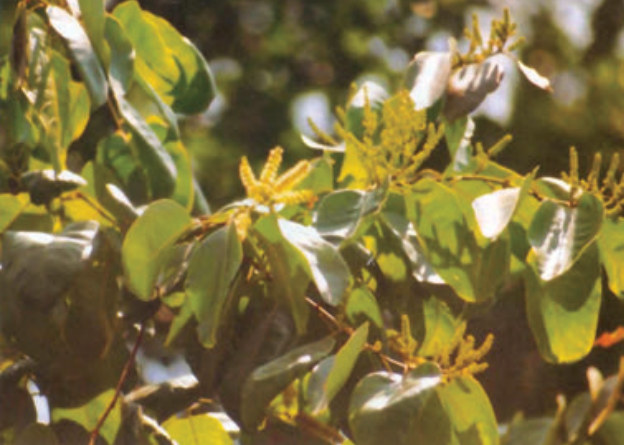
Plant name
Ahleelj
Latin name
Terminalia chebula Retz
Common names
Ahlij, Balilj, Indian Sha'ari (Bald al-Sham), Al-Alub, Meter al-Abeed
foreign names
Eng. Indian almond, Black myrobalan, Fr. Badamier chébule
The group
Cucurbitaceae
Habitat and Geographic Distribution
It is grown in India, Malaysia, Pakistan, Iran, and Sudan, and in many other countries.
Botanical description
A medium to large tree, m.
Its branches are 30-30 cm long, spreading, pale green, the cuticle gray and smooth.
The leaves are alternate, 15- to nearly opposite, 8-8 cm long, elliptical or 8-3 cm long, oblong, rounded or heart-shaped at the base, leathery, covered with silky hairs when young, becoming bare later.
The petioles bear two glands at their tips, 4-15 cm long.
The inflorescence is a terminal spike, reddish-brown and hairy.
The flowers are hermaphroditic, about 1 mm long, yellowish, with linear, hairy bracts, 4-1 mm long, deciduous.
The calyx tube is glabrous on the outside, hairy on the inside, with very short, triangular teeth.
The petals are absent.
The male flowers are stamens.
The ovary is solitary.
The fruit is a drupe, elliptical or obovate, 1 cm long. The five ribs are not distinct. Flowering occurs from April to June.
Used part
The fruits (picked after ripening), the leaves.
chemical components
The fruits contain tannins (20-45%), including gallotannins, punicalagin, terflavin, terchebulin, chebulinic acid, and quinic acid.
They also contain 2% fruit acids, including sugars such as glucose, fructose, and sucrose, and shikimic acid. The seeds contain proteins and fatty oil.
Properties and medical uses
The fruit, due to its content of halophilic acid, possesses antioxidant, immunosuppressive, hepatoprotective, and alpha-glucosidase inhibitory properties (an enzyme found in the human stomach and important in studies of diabetes).
Fruit extracts have demonstrated activity against certain types of bacteria and viruses (viral hepatitis).
Studies have also identified several precursor chemicals in the fruit used in hormone synthesis and contraceptives.
Research has shown the antitoxic properties of the leaves and their effect in reducing liver cell damage caused by inhaling harmful chemicals.
A decoction or infusion of the fruit is popularly used for its cholesterol- and lipid-lowering properties to cleanse the digestive system.
Its laxative and astringent properties are beneficial in treating constipation, diarrhea, coughs, asthma attacks, and reducing mucus formation in the respiratory tract.
It is also used to treat burning urination and hematuria (blood in the urine).
A decoction of the fruit is used topically to treat wounds, bleeding ulcers, and leprosy.
Side effects and precautions
Allergic reactions or drug interactions may occur; self-use should be avoided by pregnant and breastfeeding women, children, and patients with chronic diseases.
Other uses
The ripe fruit is used in bread making and soup preparation.
The bark was formerly used as a vermifuge and a soap substitute.
In some countries, the fruit pulp is used to treat stagnant water and kill parasites.
the environment
M.
2000 – The plant tolerates high temperatures, but it does not tolerate frost and drought. It is found at higher altitudes and prefers fertile soil.
Agriculture and productivity
The myrobalan is propagated by seed.
After collecting and drying the seeds, the dry, fleshy outer layer is removed.
The hard outer layer can be broken without damaging the pulp, and then the seeds are soaked in cold water for 36 hours.
This method gives a good germination rate.
Other species include Bryonia cretica subsp. dioica (Jacq.), Bryonia ruderalis Salisb., and Bryonia scarlatina Dumort.
History and Heritage
The name is from Persian (1978) Qomi.
Al-Shahabi - Alawi - mentions that it means terminus, a genus name from Latin and of Sanskrit origin.
Medical note
This information is for educational purposes only and does not constitute medical advice.
Poisonous or potent plants should only be used under the supervision of a qualified physician or pharmacist.
Related images


