Mother of Labida | Medicinal plant in the Akhdar Encyclopedia
The plant, containing saponins, flavonoids, coumarins, and tannins, possesses diuretic and antispasmodic properties. Research indicates the effectiveness of the plant extract in treating kidney, bladder, and urinary tract infections, and in reducing stone formation by decreasing the size and number…
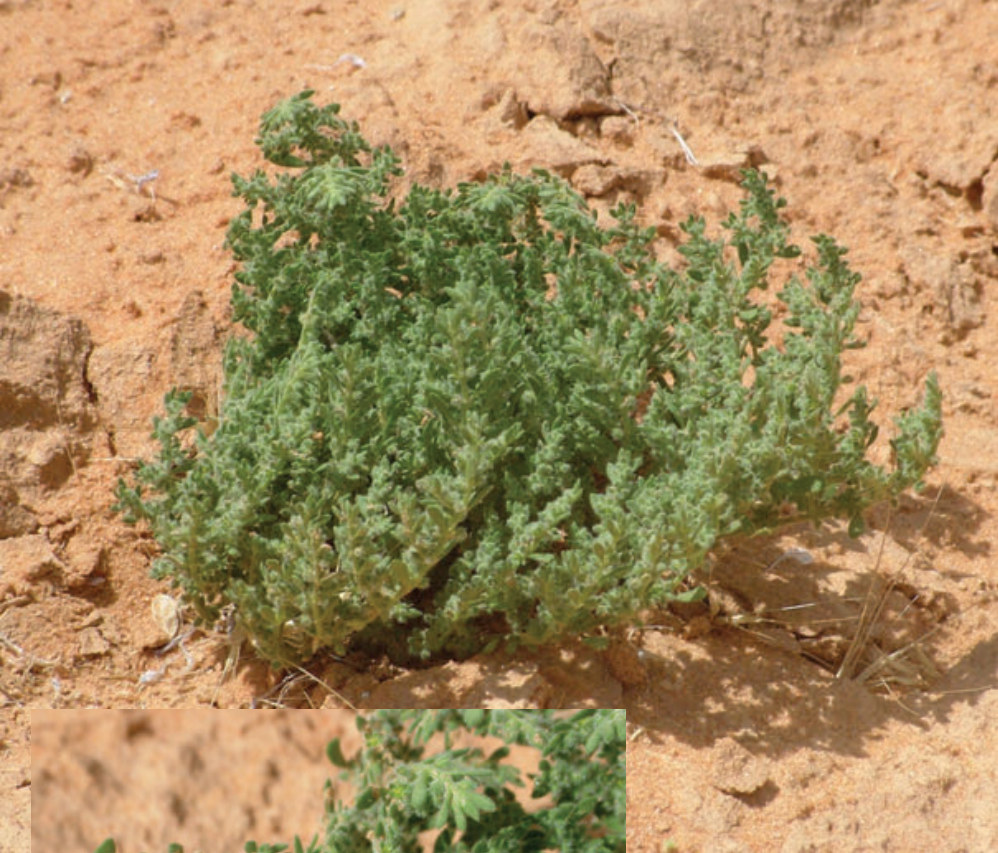
Plant name
Umm Labidah
Latin name
Herniaria hirsuta L
Common names
Umm Labida, Umm Waja' Kabd, Hashishat al-Fatq, Numan, Mukar, Suwayqa
foreign names
Eng. Hairyrupture word; Fr. Turquette
The group
clove
Habitat and Geographic Distribution
Multi-regional
Botanical description
An annual herb (sometimes becoming perennial) 15 cm.
Covered with bristly hairs, its stems are prostrate, sometimes growing in clusters.
The leaves are simple, sessile, - mm long, the lower ones opposite, uterine10 - linear, tapering to - elliptic to oblong at the base, with hairy margins.
The stipules and bracts are dry, membranous, and ciliated.
The flowers are small, sessile, clustered in cymes.
The calyx lobes are rough, straight or hooked at the apex, approximately equal in length to the width of the calyx.
The ovary is solitary, with a single stigma ending in a stigma.
5 - thread-like.
The stamens are squamous, cerulean, and cerulean.
The fruit is sac-like, nearly spherical, emerging from the calyx.
The seeds are spherical to lenticular, with a dark luminal sac. Flowering occurs from March to April.
Used part
Flowering plant, Latin name: Herniaria hirsuta L., Herniaria diandra Bunge, Herniaria permixta Guss., Herniaria cinerea DC
chemical components
Gypsogen, medicagen, and herniaria saponins: triterpene saponins (triterpene saponins; the percentage of these compounds increases during the flowering period).
Hydroxycoumarins, including hyperosides, flavonoids with an unpleasant odor, and paronychine, are also present, along with traces of volatile oil and alkaloids (0.06%). Tannins are also present.
Properties and medical uses
The plant, containing saponins, flavonoids, coumarins, and tannins, possesses diuretic and antispasmodic properties.
Research indicates the effectiveness of the plant extract in treating kidney, bladder, and urinary tract infections, and in reducing stone formation by decreasing the size and number of calcium oxalate crystals and preventing their aggregation and adhesion to kidney epithelial cells, thus facilitating their excretion in urine.
The plant extract has also proven effective in dissolving gallstones.
A decoction of the plant is traditionally used as a mild astringent, in treating respiratory disorders, and for blood purification.
The plant extract is used topically to treat neuritis, rheumatism, gout, wounds, boils, and skin ulcers, and as an eyewash for cleansing and disinfection.
The aqueous extract can be used as a substitute for soap to soften the skin.
The plant has been used as an expectorant, in the treatment of hernias, and to accelerate ulcer healing.
The ethanolic extract has antibacterial properties against Escherichia coli. The aqueous extract has significant antioxidant activity.
Side effects and precautions
Allergic reactions or drug interactions may occur; self-use should be avoided by pregnant and breastfeeding women, children, and patients with chronic diseases.
the environment
The plant spreads along roadsides, in fields, and on steppes in semi-arid or arid regions.
It prefers sunny locations in valleys with sandy loamy soils and on sandy slopes.
It does not tolerate excessive moisture, grows well in gypsum-rich soils, and is an indicator of these soils. It also thrives in vertebrate soils.
Agriculture and productivity
Alternatively, small pots can be grown in a nursery and then transplanted to the permanent field.
The plant is propagated by seed.
It is preferable to sow the seeds in bags after a year and then plant them in the field at the beginning of spring.
History and Heritage
It means hernia, and its use in the past was to treat hernias.
The species name hernia comes from the Greek word meaning "hairy," i.e., long-thorny and hard. hirsuta.
Medical note
This information is for educational purposes only and does not constitute medical advice.
Poisonous or potent plants should only be used under the supervision of a qualified physician or pharmacist.
Related images


