Nile Acacia | Medicinal Plant in the Akhdar Encyclopedia
A decoction of the stem bark (tannins) is used in folk medicine to treat gum disease, inflammation of the oral and throat mucous membranes, diarrhea, and vaginal discharge. It is also used as an enemas for hemorrhoids. The plant is traditionally used to treat a variety of ailments, including type 2…
Plant name
Nile acacia
Latin name
Acacia arabica (Lam.) willd, (1)
Common names
Nile acacia, arabic acacia, Nile acacia, Arabic gum
foreign names
Eng. Acacia gum, Egyptian thorn, Black thorns, Prickly acacia, Fr. Akacia d'arabie
The group
Acacia (Fabaceae)
Habitat and Geographic Distribution
The range of the Nile acacia extends from southern Africa to Iraq and northward to India. It grows in Egypt, Sudan, Libya, Mauritania, Oman, and Saudi Arabia.
Botanical description
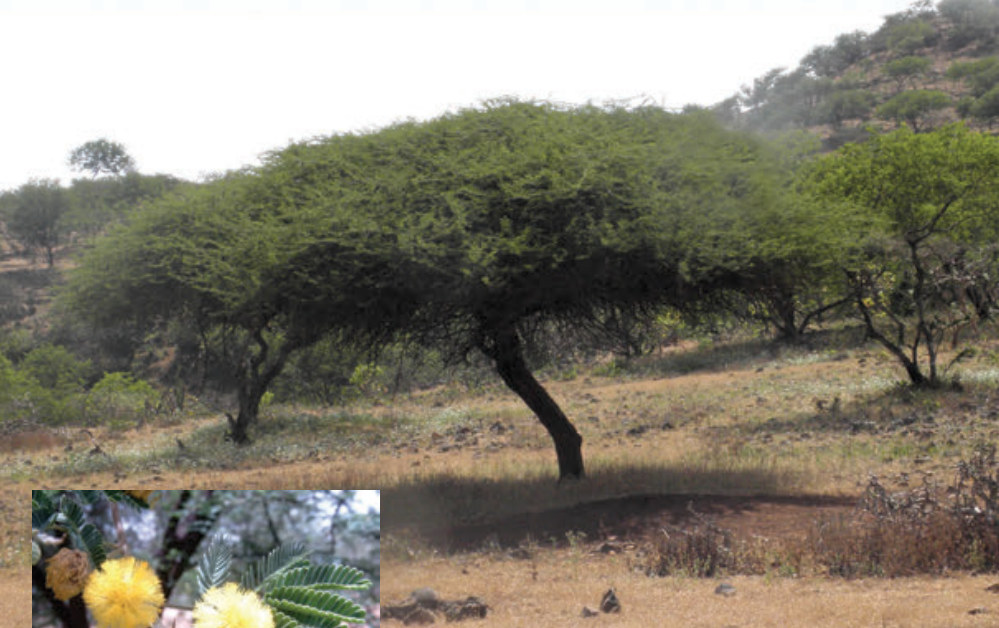
The older branches are bare, while the younger ones are 2.5-14 mm tall and brown, with downy undergrowth.
The cuticle is thin, rough, fissured, and reddish.
The leaves are slightly curved, reaching a gland at the base of the petioles, and other glands at the base of each secondary axil or at the base of each leaflet.
Each secondary axil bears only the upper ones.
The secondary axils are 1.5-0.5 mm long, bare or downy.
The 7-1.5 mm long, oblong, blunt at the apex, and axillary, are arranged in clusters on young branches.
The bracts are found at the base of the head, 2.5-3.5 mm in diameter, bare to downy.
The corolla is the head of the inflorescence or its lower half.
The flowers are bright yellow.
The calyx is 22-20 cm long, straight, and rough; the petals are fused, and the outer surface is smooth to hairy.
The pod is linear, gray, and open, measuring one seed's length.
The seeds are smooth or curved, smooth or hairy, swollen, narrow, brown, black, and compressed to about 7 mm in diameter.
The flowers are nearly spherical, with a diameter of 7 mm. Inflorescence occurs from October to December.
Used part
Stem sap, fruit (pods), and gum
chemical components
The fruit and bark contain tannins.
Properties and medical uses
A decoction of the stem bark (tannins) is used in folk medicine to treat gum disease, inflammation of the oral and pharyngeal mucous membranes, diarrhea, and vaginal discharge.
It is also used as an enema for hemorrhoids.
The plant is traditionally used to treat a variety of ailments, including type 2 diabetes, as a dietary supplement, or as a source of anti-diabetic compounds.
The use of a hot water extract increases insulin secretion, and isolated plant components, including quercetin and kaempferol, have been shown in vitro to increase insulin secretion and glucose tolerance.
All plant extracts have also demonstrated antiviral activity, particularly against the H9N2 avian influenza virus.
Side effects and precautions
Allergic reactions or drug interactions may occur; self-use should be avoided by pregnant and breastfeeding women, children, and patients with chronic diseases.
the environment
mm/year, on sedimentary layers 750 - It is widespread in hot desert valleys, in areas where the average rainfall ranges from parts per million to 6000 -, and high salinity up to 50°C and loam. It tolerates high temperatures up to
Agriculture and productivity
The plant is propagated by seeds which are sown after being soaked in hot water.
History and Heritage
The Arabian acacia, also known as *Acacia arabica* (meaning gentle or fertile), and the species name *Acacia nilotica* (from the Greek word meaning indigo, i.e., Acacia nilotica of the Nile), is primarily used in tanning leather.
The main importance of its fruits (pods) lies in their use in leather tanning.
Adding ground pods to any other tanning agent imparts a rich reddish-brown color to the leather.
The trees also produce a gum called gum arabic.
*Acacia senegal* is of lower quality than the gum arabic produced by the *Acacia senegal* tree.
Medical note
This information is for educational purposes only and does not constitute medical advice.
Poisonous or potent plants should only be used under the supervision of a qualified physician or pharmacist.
Related images