Arta | A medicinal plant in the Akhdar encyclopedia
Studies have demonstrated the antibacterial, antifungal, and antiparasitic properties of Arta, particularly against various types of bacteria, fungi, and worms (such as Ascaris). Research on laboratory mice has shown Arta's anti-inflammatory properties, which are beneficial in treating peptic ulcer…
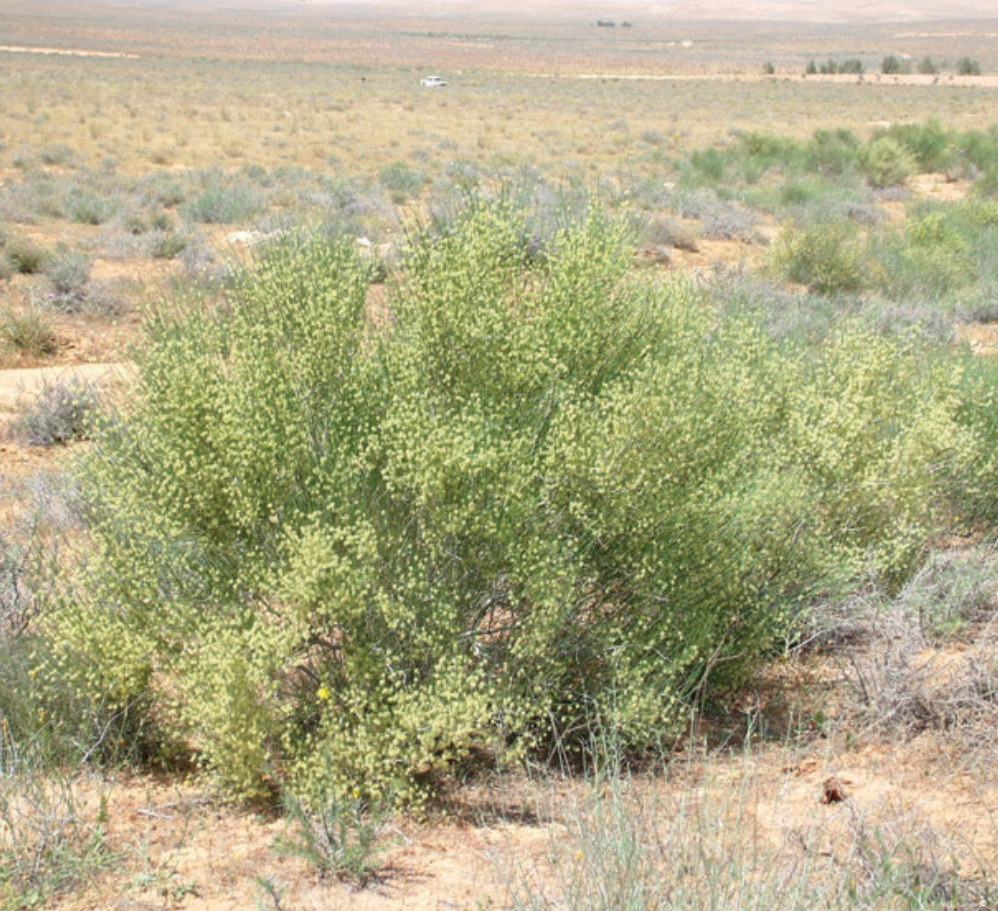
Plant name
Arta
Latin name
Calligonum comosum L'Her
Common names
Arta, Arta Jamil, Abl
foreign names
Eng. Abal, Fr. The wood of the earth
The group
nodular or acidic
Habitat and Geographic Distribution
Saharan – Arab and West Iranian – Turanian.
It is naturally found in the northern, western, and central parts of the North African Sahara in Egypt, Libya, Tunisia, Algeria, Morocco, and Mauritania.
It is also found in Iran, Iraq, Syria, Jordan, Palestine, Kuwait, Qatar, the United Arab Emirates, Saudi Arabia, Oman, and Yemen.
Botanical description
The stem and branches are upright, jointed, and young.
The shrub is barren, highly branched, and reaches a length of about [a certain length].
The leaves are weak, green, gathered in bundles, later woody, and become hard and whitish.
The leaves fall off quickly and are reddish in shape.
The sheath (auricle) formed by the fusion of the two auricles is membranous, very short, 1 x 2.5 mm, with small flowers (1-3 mm in size) along the new branches.
It is hermaphroditic, arranged in groups of 5, and bilobed.
The flowers are small; the inflorescence is mid-articulated and longer than the spathe.
The spathe is simple, voluptate, five-segmented, and white with stamens fused to their bases.
The ovary is four-lobed, ending in a four-branched style and primary stigmas.
It is a fruit.
The male fruit is an acinus, oblong, woody, bearing a row of long, soft hairs.
The branching acinus widens slightly at the base to form short wings.
The fruit measures about 1 mm (excluding the hairs).
The seeds are 6 x 13 mm.
It is oblong.
Flowering occurs from February to April. Fruiting begins in May, and the fruits ripen towards the end of the month.
Used part
The plant's chemical constituents include alkaloids, sterols, triterpene saponins, tannins (6-8%), anthraquinones, coumarins, and flavonoids, the most important of which are kaempferol, quercetin, isoquercetin, procyanidin, phytolacanthin, neolacanthin, violacranthin, and neolacanthin.
chemical components
Enerthaquinones, 8% - The plant parts contain alkaloids, sterols, tertiary saponins, tannins, coumarins, and flavonoids, the most important of which are: kaempferol, quercetin, isocrystine, procyanidin, phaeoxanthin, and neoxanthin
Properties and medical uses
Studies have proven the antibacterial, antifungal, and anti-parasitic properties of *Arta* (also known as Ascaris) against many types of bacteria, fungi, and worms.
Research on laboratory mice has demonstrated *Arta*'s anti-inflammatory properties, which are beneficial in treating peptic ulcers.
The plant has a stimulant and astringent effect, and its hypoglycemic properties have been tentatively established.
A powder made from the tender branches is used traditionally to treat diarrhea, digestive disorders, and stomach ulcers.
A paste made from the tender branches mixed with petroleum jelly is also used as an ointment to treat skin diseases (fungal infections, eczema, itching, scabies).
A decoction of the roots is used as a gargle to treat gingivitis.
In summer, the plant exudes a reddish-brown, molasses-like secretion, which local people use as a cough remedy.
Side effects and precautions
Allergic reactions or drug interactions may occur; self-use should be avoided by pregnant and breastfeeding women, children, and patients with chronic diseases.
Other uses
The tender branches, rich in sugars and proteins, are eaten with rice or mixed with yogurt to enhance its aroma.
Women used to use a paste made from the powdered roots to perfume their hair and give it a beautiful color.
The powdered plant, prepared as an ointment, was used in veterinary medicine to treat skin diseases affecting animals (camels, horses).
The powdered branches (tannins) were used in tanning leather and dyeing clothes and fabrics a milky color.
The plant is excellent for stabilizing sand dunes, and the wood of old, buried branches is used as fuel due to its excellent combustion properties.
Charcoal is also made from it.
The plant is a palatable grazing plant. Camels and goats grazing on its tender edges during the summer
the environment
The plant spreads in the upper part of the warm desert bioclimatic layer.
It grows on dry desert sandy layers, spreads on sandy layers or in areas of shifting or stabilized sand dunes, and in valleys with deep sandy layers, as well as on hills with gypsum sandstone.
Agriculture and productivity
The *Arta* plant is propagated by seeds and hardened cuttings.
The seeds are collected before they ripen and dried between two layers of dry sand.
Experiments show that seed germination is inhibited by light; therefore, they must be well buried during planting.
The optimal temperature for germination is 25-27°C, while temperatures as low as 12°C in February prevent germination.
Its growth is most active in the spring.
Polygonum aviculare L.
Centinodia avicularis (L.) Fourr., Centinodium aviculare (L.) Drejer, Polygonum aviculare subsp. latifolium Ehrh
History and Heritage
The scientific name is derived from the Greek words kallos, meaning "beauty," and gonum, meaning "knee." The descriptive name for the species, comosum, means "beautiful." The medicinal uses of Arta have been known for a long time.
The ancient Egyptians used it about 4000 years ago to treat diseases.
Its fruits were mentioned in a medical prescription in the "Hearst Papyrus" for treating tremors, by cooking it with other herbs to make an ointment to be applied to the diseased organs.
In the Arabian Peninsula, a decoction of its roots is used to treat toothache and expel intestinal worms.
Medical note
This information is for educational purposes only and does not constitute medical advice.
Poisonous or potent plants should only be used under the supervision of a qualified physician or pharmacist.
Related images


