Artichoke | Medicinal plant in the Akhdar Encyclopedia
Caffeic acid derivatives and the bitter compound cynarin are among the most important active compounds in artichoke leaves, and their benefits in treating liver disorders and stimulating digestive bile secretion have been proven. Studies have confirmed artichoke's cholesterol- and lipid-lowering pr…
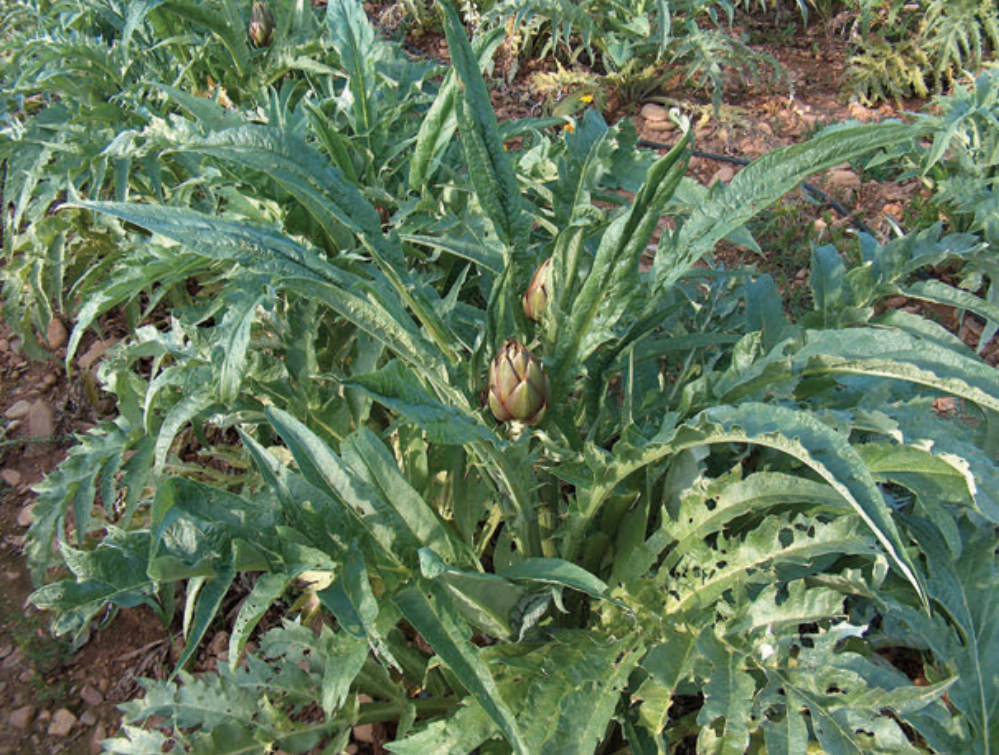
Plant name
artichoke
Latin name
Cynara scolymus L
Common names
Artichoke, artichoke, artichoke, artichoke
foreign names
Eng. Artichoke, Fr. Artichout
The group
Star
Habitat and Geographic Distribution
Its native habitat is the countries surrounding the Mediterranean Sea, and its cultivation is widespread in many countries around the world for food and medicinal purposes.
Botanical description
M.
The leaves are those of a perennial herb with a short rhizome.
The stem is thick and strong, erect, sparsely branched, and can reach a considerable length.
It is large, compound, pinnately arranged, with leaflets that are uterine, hairy, and spiny.
The upper surface is glabrous and odorous, while the lower surface is grayish and densely hairy.
The main inflorescence is large, spherical, and spiny.
The bracts are arranged in several rows, overlapping, and have a milky texture.
Their bases are swollen and can be eaten raw or cooked.
The receptacle is thick, milky, and perforated, containing long, coarse, white hairs within these follicles.
The flowers are tubular, five-lobed, blue, lilac, or white, oblong, and almost quadrangular.
The bracts are arranged in several rows and are fused.
The fruit is an acinus, glabrous, obovate, with its base in a short ring. Flowering occurs from July to August.
Used part
The leaves (once grafted), and the roots
chemical components
The leaves contain caffeic acid derivatives, including cryptochlorogenic acid, chlorogenic acid, neochlorogenic acid, cynarin, scolymosides, cynaroside, and rutin (the most important of which is rutin, 0.5%).
They also contain 4% sesquiterpene lactones (dehydrocynaropicrin, grosheimin, cynaratriol, and cynaropicrin, a bitter-tasting compound), enzymes A and B (oxidase, ascorbinase), and minerals such as potassium, calcium, and magnesium. The roots also contain caffeic acid derivatives.
Properties and medical uses
Caffeic acid derivatives and the bitter compound cynarin are among the most important active compounds in artichoke leaves, and their benefits in treating liver disorders and stimulating digestive bile secretion have been proven.
Studies have confirmed artichoke's cholesterol- and lipid-lowering properties, which are beneficial in reducing arteriosclerosis.
It is also used to treat digestive disorders.
Traditionally, it is used for its appetite-stimulating, diuretic, digestive, and liver-stimulating properties, protecting the liver from toxins and diseases, particularly jaundice, and preventing gallstones.
Artichoke leaf extract contains numerous compounds with antioxidant and anti-inflammatory activity against various diseases, including liver cirrhosis.
It also exhibits several biological activities, including inhibition of NF-κB activity, anti-hepatitis C activity, and anti-trypanosomiasis activity.
Side effects, interactions, and precautions: It may cause allergic reactions on the hands.
Those suffering from rheumatism, arthritis, gout, urinary tract diseases, and allergies should avoid consuming artichoke.
Artichoke roots and leaves should not be given to patients with bile duct obstruction, as the compounds found in the leaves and roots of this plant are cholagogue (bile-stimulating) compounds. It should not be used during pregnancy or breastfeeding.
Side effects and precautions
It can cause allergic reactions on the hands.
Artichokes should be avoided by those suffering from rheumatism, arthritis, gout, urinary tract diseases, and allergies.
Artichoke roots and leaves should not be given to patients with bile duct obstruction, as the compounds in the leaves and roots of this plant are cholagogue (bile-stimulating). It should not be used during pregnancy or breastfeeding.
the environment
Moderate atmospheric and soil humidity is essential, as excessive humidity leads to root rot.
The plant requires a temperature of 16°C at the beginning of its growth cycle, but excessive soil humidity can cause root rot.
It is sensitive to temperatures below 170°C and is a light-loving plant, requiring sufficient light exposure to increase its resistance to frost. The growing season is one of its life stages.
Agriculture and productivity
It is propagated by offsets, which are small plants (with both a root system and a vegetative system).
One-third of the vegetative system is pruned, the roots are trimmed, and then they are planted in the permanent location in the presence of water, ensuring the root and a small portion (approximately 1 cm) of the stem base are buried under a layer of soil.
The land is thoroughly plowed, leveled, and divided into 1-meter-wide beds after the addition of a mixture of organic fertilizer, superphosphate, and potassium sulfate.
Irrigation is carried out according to the soil type and environmental conditions.
The surrounding environment and the plant's age are important factors.
Generally, watering should be frequent during the plant's early stages, and the plants should not be allowed to dry out during this period.
The interval between waterings should then be gradually increased starting with the onset of winter and the drop in temperature.
In spring, when temperatures begin to rise, the interval between waterings should be reduced.
The flower heads should be cut back to 5 cm of the stem before the purple flowers appear at their tips, usually in late summer and early autumn.
Gundelia tournefortii L.
Gundelia tournefortii var.
araneosae DC., Gundelia glabra Mill., Gundelia tenuisecta Freyn & Sint., Gundelia tournefortii var. glabra (Mill.) DC., Gundelia tournefortii var. Tenuisecta Boiss
History and Heritage
The name skolymus comes from the Greek scolymus.
The descriptive name for the species is Kinara, or Kynara, the scientific name for the genus, also from Greek, referring to its thorny quality.
Artichokes are plants that have been cultivated since ancient times, with their knowledge dating back to the time of the pharaohs, who depicted them on temple walls alongside hieroglyphic writings.
The Arabs adopted them, recognizing their benefits and cultivating them, as did the Greeks and Romans.
Artichokes were introduced to England in the early 6th century as a culinary vegetable and were also used for ornamental purposes in monastery gardens.
Medical note
This information is for educational purposes only and does not constitute medical advice.
Poisonous or potent plants should only be used under the supervision of a qualified physician or pharmacist.
Related images


