Adonis vernalis | Medicinal plant in the Akhdar encyclopedia
This drug has a tonic effect on the heart and blood vessels. It is used in cases of mild hypotension accompanied by neurological symptoms, arrhythmia, and nervous heart rhythm disorders. Its effects are similar to those of hawthorn (Hawthorn igitalis sp.) and senna (Crataegus sp.) (similar in the e…
Plant name
Adonis Rabi'i
Latin name
Adonis vernalis L
Common names
Adonis Rabi'i, Nab al-Jamal, Anni al-Jamal, Nuqtat al-Dam
foreign names
Eng. False hellebore, Fr. Spring Adonis
The group
The buttercup
Habitat and Geographic Distribution
Countries surrounding the Mediterranean Sea.
Botanical description
cm, the plant.
The leaves are cm.
The basal leaves are semi-scaled, about 35 cm long.
A perennial herb with a rhizome that divides into linear lobes.
The stem has broad bases, forming a sheath-like structure, deeply divided by sepals attached to the petals, ovate-elliptical to cm.
The calyx is 8 cm long.
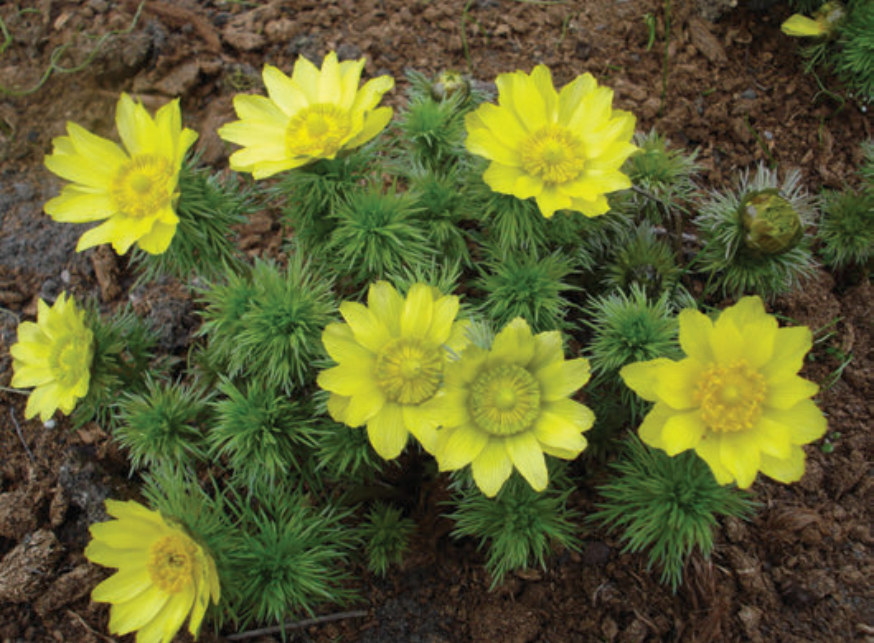
The flowers are solitary and terminal, often arranged in a single petal, flattened, yellow, bearing a white spot at the base, flat, obovate, with a hairy margin.
The corolla is the length of the sepals.
The male has many stamens, narrower than the petals, and the anthers are yellow.
The female is 1.5 mm long, and its length is approximately 35 cm.
It consists of a large number of free carpels that are arranged on a receptacle.
The fruiting heads are composed of a large number of carpels, 3.5-5.5 mm long, and are convex.
The acinus is downy, measuring 15-12 x 20 cm.
It is spherical to ovoid, with short, strongly curved dimensions.
Flowering occurs from April to May.
Other species of Adonis (A.
aestivals) closely related in chemical composition and medicinal properties include: Adonis dentate (summer Adonis) and Adonis autumnal (toothed Adonis).
Adonis vernalis is distinguished by its yellow flowers, while Adonis dentate and Adonis autumnal are both red. Both are less potent than Adonis vernalis.
Used part
Flowering plant (basic colors must be preserved to ensure the effectiveness of the ingredients)
chemical components
Adonitoxin, including: adonitoxin, cardenolides (a poisonous plant containing asteroid glycosides that stimulate the heart), strophanthoside, cymarin, luteolin, vitexin, and adonivernith (falvonoids, including adonivernith)
Properties and medical uses
This drug has a tonic effect on the heart and blood vessels.
It is used in cases of mild hypotension accompanied by neurological symptoms, arrhythmia, and in cases of nervous heart rhythm disorders and neurological heart problems.
Its effects are similar to those of hawthorn (Hawthorn igitalis sp.) and crataegus sp.
(similar in the effectiveness of digoxin found in crataegus).
It is generally used during breaks from digoxin treatment, but it is slower-acting due to its lack of accumulation in the body.
The drug is used traditionally as a diuretic, to treat chronic kidney inflammation, to reduce the formation of kidney and bladder stones, to treat muscle spasms, fever, and menstrual disorders.
A.
autumnals: A chemical substance called sodium hyaluronate is extracted from Adonis autumnalis.
It helps in wound healing, facilitates the insertion of contact lenses, and increases the flexibility of limbs and joints affected by rheumatism, which may lead to the complete relief and elimination of rheumatic pain.
Side effects and precautions
The saman plant should be used under medical supervision.
It should be avoided when used with digitalis heart tonics, diuretics, or in cases of potassium deficiency. Overdosing can cause digitalis-like poisoning.
Other uses
It is used as an ornamental plant because of its attractive yellow flowers.
Food uses
It is not used for food due to its toxicity.
the environment
Species of this genus are widespread in fields, steppes, pastures, and on sunny slopes, especially calcareous ones, and on the edges of forests where seed germination and seedling emergence are prevented above coniferous forests.
They are sensitive to frost, as temperatures below the soil surface are detrimental.
These species require moderate temperatures during vegetative growth; high temperatures inhibit growth and reduce the content of the active ingredient.
They can be cultivated in most soils, especially moist, light, well-drained ones, and tolerate gypsum soils.
They are best cultivated in slightly saline and moderately saline soils because they are sensitive to soil acidity.
Agriculture and productivity
It propagates by mature seeds (store for a maximum of 3 years).
It is sown in spring (cold regions) or autumn (temperate regions).
Early sowing increases the active ingredient.
It is sown broadcast in light soils or in rows (65 cm between rows, 25 cm between holes) at a rate of 2-3 seeds per hole.
Irrigate after sowing and stop irrigation during flowering.
It responds well to chemical fertilization.
The aerial parts are harvested at the beginning of flowering when they are 5 cm tall at midday.
Yield of Adonis serrata: 2-3 tons/hectare (dry herb); Adonis vernalis: 33-71 kg/hectare (dry flowers).
History and Heritage
The name Adonis is derived from the Greek word for a remarkably handsome young man, the son of Cyrene.
According to Greek mythology, the goddess Ishtar transformed the legendary, exceptionally beautiful Adonis into a poppy after he was killed by a wild boar to escape the underworld.
The myth recounts that the goddess of love and beauty grieved for Adonis and buried him in the mountains of Cyrene, commanding that drops of his blood should sprout into beautiful plants.
note
Harvesting the plant at midday is preferable to preserve the quality of the active ingredients.
Medical note
This information is for educational purposes only and does not constitute medical advice.
Poisonous or potent plants should only be used under the supervision of a qualified physician or pharmacist.
Related images


