Dog rose | Medicinal plant in the Akhdar encyclopedia
The pectins and organic acids found in the fruit pulp have diuretic and laxative properties. Rosehip fruits, rich in vitamins C, are used as an additional source of vitamin C. A decoction of the fruits is popularly used for its diuretic properties and to treat kidney and urinary tract stones, vitam…
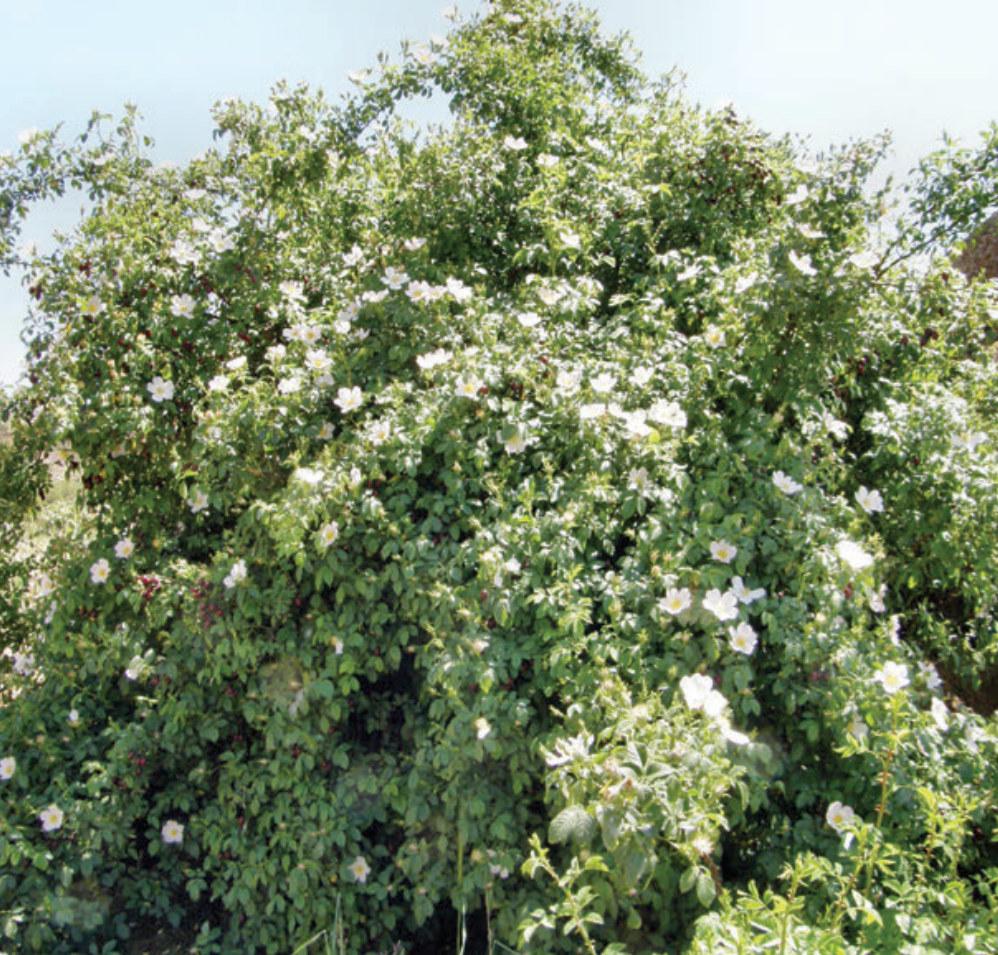
Plant name
Dogs' roses
Latin name
Rosa canina L
Common names
Dog rose, wild rose, hedge rose, spring rose, garden rose
foreign names
Eng. and - rose, Fr. Eglantier
The group
Pink
Habitat and Geographic Distribution
It is native to Europe, Siberia, the Mediterranean, and western Taurine.
Its cultivation spread to Iran, the Arab countries, and other parts of the world.
Botanical description
The stems are numerous, arching, bearing flat, broad, curved, equal or nearly equal thorns.
The stipules are fused to the leaf stalks, broad, and 15 cm in size.
The leaves are compound pinnate-tipped, alternate, in pairs, ovate or elliptical, with toothed margins.
Note that the upper teeth are clustered.
The leaflets are glandular and 1 cm long.
The inflorescence is a raceme.
The bracts are broad, 2.5 - 1 x 4 - 1.5 cm or compact, blunt or pointed at the apex, glabrous or pubescent, measuring cm.
The flowers are capitate and fragrant.
The calyx tube, 2.5 - 0.5 cm long, bears glandular hairs and hairs to varying degrees.
The flower stalks (which arise from the fusion of the bases of the sepals, stamens, and petals) are glabrous, with five lobes, retracted downwards, complete, or bearing lateral appendages, either hairy or glandular.
The petals are five, 1 cm long, pink (rarely white), and 4 cm long, with lobes.
The stamens are numerous.
The female is composed of a large number of free carpels, the ovary is inferior, and the lobes are free, glabrous, or hairy.
The fruit is a free acinus found within a 2 cm long, bright red calyx that turns blackish to crimson. Flowering occurs from May to August.
Used part
The part used varies depending on the type and preparation; a reliable or competent reference should be consulted before use.
chemical components
The pulp of the fruit contains malic acid, carotenoids, flavonoids, organic acids (most importantly malic acid, ascorbic acid, and vitamin C (2%), vitamins (including vitamin C, 25%), pectins (12-15%), and citric acid sugars. The leaves of the lemon tree also contain tannins.
Properties and medical uses
The pectins and organic acids found in the fruit pulp have diuretic and laxative properties.
The fruit of the rosehip, rich in vitamins, is used as an additional source of vitamin C.
A decoction of the fruit is popularly used for its diuretic properties and to treat kidney and urinary tract stones, vitamin deficiencies, influenza, to regulate stomach acidity, anemia, and scurvy.
The leaves are used for their astringent properties (tannins) and to treat diarrhea, wounds, and burns.
Side effects and precautions
Allergic reactions or drug interactions may occur; self-use should be avoided by pregnant and breastfeeding women, children, and patients with chronic diseases.
the environment
This plant grows naturally on sunny mountain slopes and hillsides.
It tolerates winter frosts during its dormant period, but it does not tolerate low or high temperatures during its vegetative and flowering stages.
It grows in various soil types, preferring light sandy soils and fertile loamy and silty soils.
It thrives in well-drained and aerated clay soils.
It tolerates moderate soil acidity but does not tolerate waterlogged or saline soils.
Agriculture and productivity
The plant is propagated by hardened cuttings taken from a branch older than one year, as well as by suckers and rarely by seed.
Apply 3 kg of fertilizer to the plant.
Place the cuttings in the planting hole (40x40x40 cm) before planting.
Plant the cuttings in holes 25 cm apart, ensuring they are of organic length, and water as needed.
Maintenance continues after planting in the permanent location, including irrigation, fertilization, weeding, and pruning.
History and Heritage
The scientific name for the genus is canine poison, i.e., the plant's altinoid, canina.
The term "dog rose" refers to its use in treating rabid dog bites since Roman times.
Roses, in their various forms, have a long history in the beauty of medicine, and their oil was considered one of the most important and expensive essential oils.
The Greeks, Romans, and ancient Egyptians introduced rose cultivation to many regions.
Arabs and Persians were familiar with the process of extracting essential oil from the flowers.
The ancient Egyptians knew the rose as "wartu," while the Arabs called it "al-jal," the red variety "al-hawjam," and the white variety "al-watriya." It was mentioned by al-Antaki, Ibn Sina, and al-Ghassan.
During World War I, Ibn al-Baytar noted that the flower of the wild rose (Cynorrhododens cynorrhodon) was more potent than its leaves.
Its fruit was used as a source of vitamin B2, replacing rare citrus fruits. (The part used is the pulp of the fruit, excluding the seeds and leaves.)
Medical note
This information is for educational purposes only and does not constitute medical advice.
Poisonous or potent plants should only be used under the supervision of a qualified physician or pharmacist.
Related images


