Sorrel | A medicinal plant in the Akhdar encyclopedia
Sorrel possesses properties that stimulate bile flow and cleanse and purify the liver and glands, removing toxins. Its effect on bile flow contributes significantly to its detoxifying effect, as toxins and waste products are excreted through the bile ducts. It is used traditionally as an appetite s…
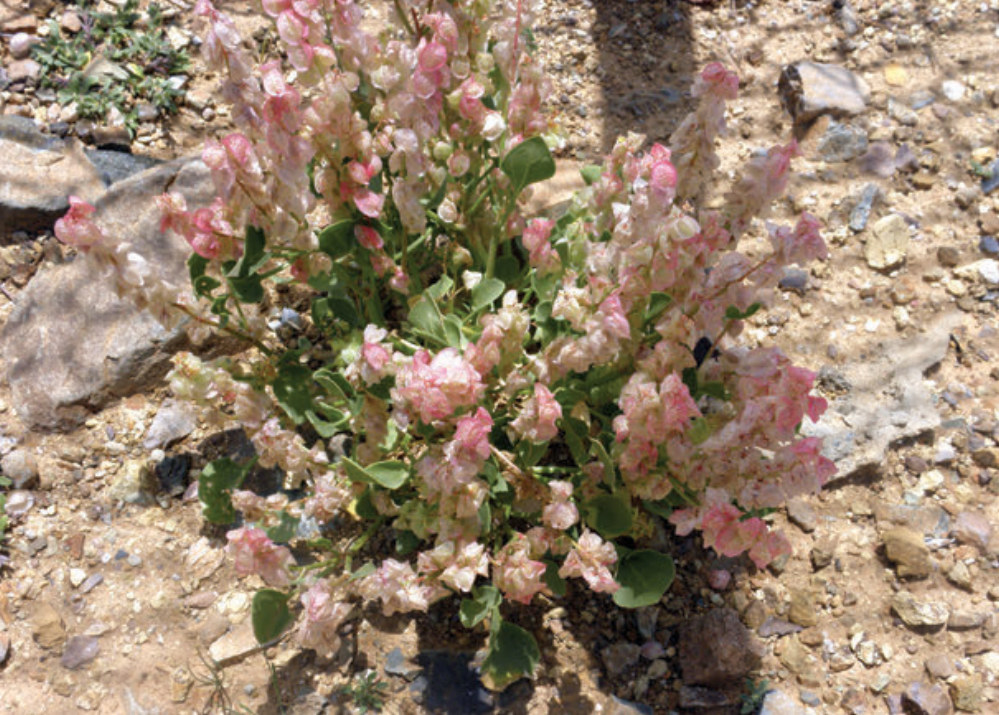
Plant name
acidity
Latin name
Rumex vesicarius L
Common names
Sorrel, squash, cauliflower
foreign names
Eng. Bladder dock, Sorrel; Fr. Bladder dock
The group
nodular or acidic
Habitat and Geographic Distribution
Native to the Mediterranean and Sudanese regions, it is widespread in the Arabian Peninsula, Iraq, Syria, the Sahara, Palestine, North Africa, southern Iran, Pakistan, and Afghanistan.
Botanical description
The stem is branched from the base, somewhat thick, prostrate or 50-blue, glabrous, biennial herb, Akhdar, ovate to triangular or oblong, 7×4 pedicel, ascending.
The leaves are alternate, petiolate, reaching about [missing information] in length, lobed or sub-cardioid at the base, acute to blunt apex, entire margin.
Their membranous auricles are fused to form a sheath surrounding the stem, which we call the stamen.
The flowers are hermaphroditic or unisexual, with articulated spikes, gathered in clusters or racemes.
The calyx is segmented in a reddish-brown color, arranged in two rhizomes.
The outer third segments are flattened or retracted in a simple structure composed of 2 cm, with a perfect margin.
The inner segments develop into membranous valves surrounding the fruit.
These valves are sinusoidal in shape, folded longitudinally, and purplish in color.
Their surface bears a network of equal, nearly spherical, heart-shaped ribs, but the marginal rib is absent.
Two of the third valves have projections at their bases.
The stamens are arranged in two rhizomes.
The ovary is triangular, uniovate, triclinic, with fringed stigmas.
The fruit is an acinus, the male scrophule being 1 mm or longer, triangular, ovate, and acuminate. Flowering occurs from February to April.
Used part
The plant, Sima, leaves and seeds
chemical components
Mucilage), and salivary substances (3-5% phthalates, including quercetin, tannins, orientin, iso-orientin, orientin, isovitexin, vitexin, glycosides, including vitexin, lapathine, rumicin, chrysophanol, emdin, anthraquinones, citric acid, malic acid, and citric acid, tocopherols, organic acids, and minerals, the most important of which are calcium, iron, copper, and magnesium. And vitamins
Properties and medical uses
Sorrel possesses properties that stimulate bile flow and cleanse and purify the liver and glands, removing toxins.
Its effect on bile flow contributes significantly to its detoxifying effect, as toxins and waste products are excreted through the bile ducts.
It is used traditionally as an appetite suppressant, carminative, laxative, stomach tonic, and detoxifier. Powdered sorrel seeds are used to treat liver diseases and jaundice.
Side effects and precautions
It should be avoided in cases of increased uric acid and kidney stones. It should not be used during pregnancy and breastfeeding.
Other uses
Oxalis uses sorrel as a type of vegetable, as its leaves are preferred for their sourness, which is similar in taste to sorrel and is usually added to salads.
the environment
The loam tree grows in steppes, deserts, and mountain slopes.
It prefers moisture—spreading in sandy and sandy soils at a rate of 100 mm/year—and requires approximately 7 mm of rainfall and moderate fertility. It tolerates salinity and low temperatures.
Agriculture and productivity
Optimal temperature: 3°C - Propagated by seeds collected in autumn and sown in spring.
Seeds germinate at a certain temperature.
If temperatures rise and water is unavailable, the plant will flower to complete its life cycle.
The soil is shaken several times during the growing season to allow for plant growth.
Productivity varies from 3 ton/hectare after the addition of organic and mineral fertilizers.
Irrigation is required in drought conditions.
Green matter yield varies depending on the region, environmental conditions, and services, and often exceeds 17 tons/hectare.
History and Heritage
Sorrel was known to the Arabs in ancient times and they used to eat its leaves.
Abu Saeed Abdul Malik Al-Asma’i mentioned it in his book Al-Zar’ (H) that it grows in the mountains of Jund, as Ibn Sina mentioned it in his book “Al-Qanun”. 216 - 128.
Medical note
This information is for educational purposes only and does not constitute medical advice.
Poisonous or potent plants should only be used under the supervision of a qualified physician or pharmacist.
Related images


