St. John's wort | Medicinal plant in the Akhdar Encyclopedia
The drug possesses properties that relieve nervous tension, are antidepressant, anti-inflammatory, antibacterial, antitumor, antioxidant, stimulate the secretion of steroid hormones, lower blood sugar, and promote wound healing. The plant is used to treat depression, psychological disorders, anxiet…
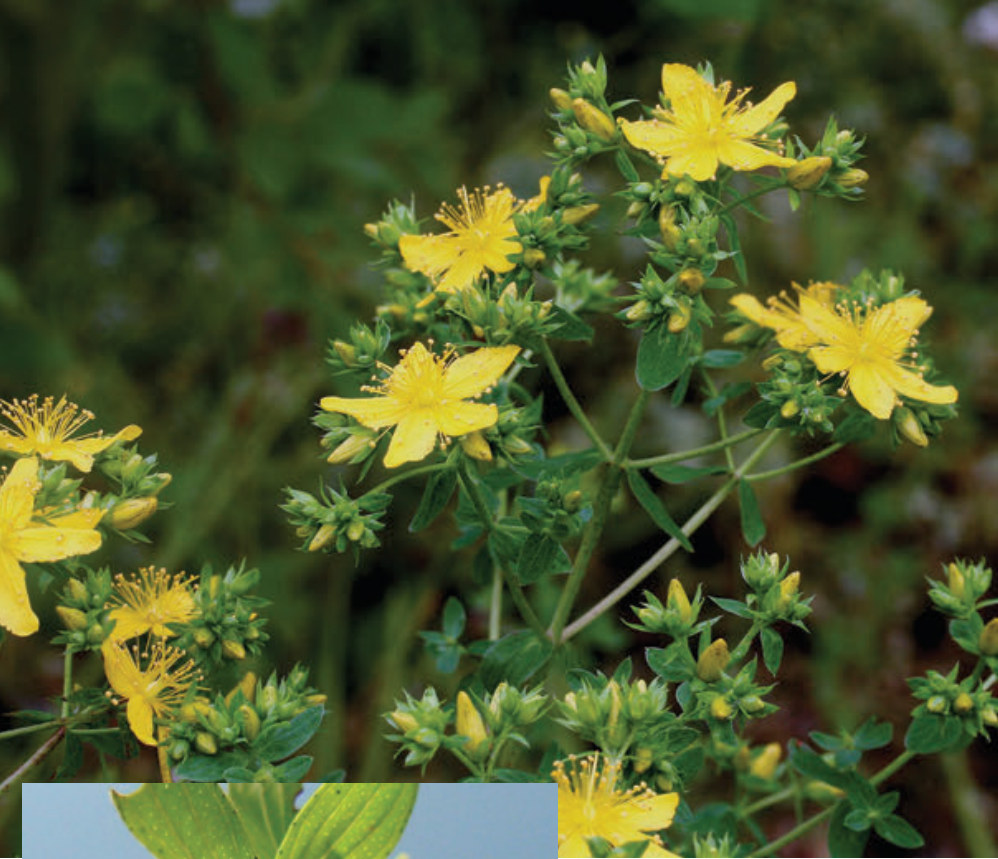
Plant name
St. John's wort, leaf-pierced
Latin name
Hypericum perforatum L
Common names
St. John's wort, heartwort, St. John's wort, Sidi Yahya
foreign names
Eng. Saint - Johns wort, Fr. Millepertuis
The group
The Daadhiya
Habitat and Geographic Distribution
Europe and Western Asia
Botanical description
The stem is 100 cm long and glabrous.
It is a perennial herb, erect or ascending, bearing leafy lateral branches.
It has two prominent longitudinal ribs.
The leaves are opposite, pinnate, and ellipsoidal, bearing translucent glandular dots, giving the leaf a perforated appearance.
The margins have widely spaced black "glands," and the margins are curled downwards to varying degrees.
The flowers are grouped in primary cymes, which in turn are grouped in broad terminal, comb-like inflorescences.
The calyx is flat and yellow, bearing two hairs that secrete from the corolla.
The sepals are complete, acutely pointed, non-glandular, and mottled.
The petals are in clusters.
The female is a trifoliate carpel surmounted by black bands and cymes at its margin.
The male is multi-stamened, with long, red stamens that fuse.
The fruit is an obovate-red capsule, characterized by parallel vesicular bundles, and is trifoliate.
The seeds are numerous, and their surface bears microscopic fossils. Flowering occurs from May to July.
Used part
The aerial parts, especially the flowering tops
chemical components
The flowers and leaves of the plant contain a volatile oil rich in hydrocarbons called "Red Hypericum." It also contains pseudohypericin, the most important of which are: herpesin, naphthone, dianthrone, naphthodinarton compounds (a red pigment), hyperforin (naphthodianthrones), phloroglucinol derivatives such as herpeforin, catechin tannins such as quercitrin, rutin, amentoflavone, and hyperoside (hyperin): of which 4% are flavonoids, 7-15% are catechin tannins, chlorogenic acid, caffeic acid, and organic acid derivatives such as caffeic acid, linoleic acid, and 30% palmitic acid.
The flowering tops contain a fixed oil, the most important fatty acids of which are palmitic acid and 13% linoleic acid.
The oil is prepared by soaking a quantity of flowers in olive oil: in a sealed bottle under strong sunlight for several weeks until the oil turns the color of blood, then it is strained and used.
Properties and medical uses
The drug possesses nervous tension-relieving, antidepressant, anti-inflammatory, antibacterial, antitumor, antioxidant, steroid hormone secretion stimulant, hypoglycemic, and wound-healing properties.
It is used to treat depression, psychological disorders, anxiety (tension), fear, and lack of concentration.
It is also used in phototherapy for HIV.
Topically, it is used to treat dermatitis, suppurating wounds, and burns.
It is used to treat herpes simplex virus infections, psoriasis (raised, scaly patches), and warts.
Traditionally, the drug is used to treat insomnia, mild to moderate depression, bronchitis, asthma, biliary diseases, gastritis and gastric ulcers, kidney diseases, gout, rheumatism, nocturnal enuresis, burns and wounds, bleeding, insect bites and stings, scabies, and hypothyroidism.
St.
John's wort is available as sublingual capsules, tinctures, and liquid extracts, and its products are sold under various names such as Hypericalm, Hypericum, Kira, Mood support, and Ct. john's wort.
Side effects and precautions
The use of this drug can cause allergic reactions, constipation, dizziness, dry mouth, anxiety, photosensitivity, stomach upset, and sleep problems.
It should be avoided when using this drug with alcohol or other medications that slow the nervous system, such as cold and allergy medications, flu medications, decongestants, narcotic or hypnotic antidepressants, amphetamines, selective serotonin reuptake inhibitors (SSRIs), and tricyclic antidepressants.
The drug should be avoided if an allergic reaction occurs, and it should not be used by people who are sleep-deprived or have a history of illness.
When using this plant, avoid foods and drinks containing triambium, such as wine, wild chervil, aged cheese, chicken liver, chocolate, bananas, and meat tenderizers, and avoid sun exposure.
The source of this plant should be verified before purchasing it, as its quality varies between producers.
the environment
The plant spreads along the edges of forests and forest-steppes, as well as on riverbanks, roadsides, and shady slopes in areas with cold winters. It prefers moist, well-drained, acidic soils.
Agriculture and productivity
Months at a temperature of 3 - kg/ha in basins, and germinate within 4 - It is propagated by seeds and by division.
The seeds are sown at a spacing of 1 cm between them and irrigated in the summer.
The resulting seedlings are planted in the permanent field at a distance of 10 cm from the ground.
25 - The plant is harvested at a height of 950 kg/ha - 1 ton/ha of dry matter. Its seed yield is estimated at 5 - The plant yield is estimated at
History and Heritage
The word "heather" (or "heather") comes from the Greek words "hypericum," referring to the characteristic of the perforated leaf.
The genus name, "heather," derives from the Greek word "perforum," meaning perforated or perforated leaf.
The species name, "St.
John's wort," comes from the Knights of St.
John of Jerusalem.
It is said that the plant acquired its English name from those who used it to treat wounds on the battlefield.
The ancient Egyptians used it to treat various ailments, calling it "balm for wounds." The Greeks and Romans also used it.
Popularly, it was believed that the plant was beneficial for warding off evil spirits, so it was common to hang a bunch of the plant on doorways.
Medical note
This information is for educational purposes only and does not constitute medical advice.
Poisonous or potent plants should only be used under the supervision of a qualified physician or pharmacist.
Related images


