The plant *Athba* | Medicinal plant in the Akhdar Encyclopedia
Research has shown that the *Athba* tree contains a number of active ingredients, some of which strengthen the heart and others that lower blood pressure and stimulate the central nervous system. Studies have also demonstrated the astringent properties of the tree's leaves and bark, which are rich…
Plant name
The thump
Latin name
Ficus salicifolia Vahl
Common names
The thump
foreign names
Eng. Willow-leaved fig, Fr. Figuier sauvage
The group
mulberry
Habitat and Geographic Distribution
The plant is found in India and is widespread in the colder regions of Saudi Arabia, particularly the Asir region. Its distribution extends as far as South America.
Botanical description
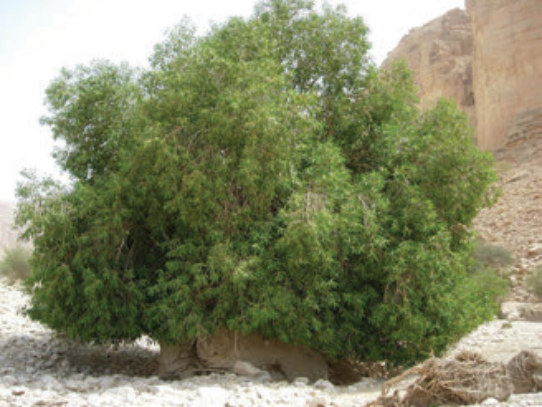
An evergreen tree reaching several meters in height, with bluish-green foliage and dense branches and leaves.
It bears large, semi-peripherical leaves.
The inflorescence is 1-14 cm wide and can reach up to 14 cm in length, with a cylindrical structure the size of a hazelnut, found in clusters on the leaf petioles.
The flowers are unisexual; the female flower consists of two carpels and one ovary containing a single ovule, while the male flower has a single stamen with a straight filament.
The fruit is a false, compound fruit resulting from the growth of the conical or spherical inflorescence, which contains both male and female flowers.
Its fruit resembles that of the common fig, but is smaller, green before ripening, and turns pink when ripe. It is an edible fruit.
Used part
The part used varies depending on the type and preparation; a reliable or competent reference should be consulted before use.
chemical components
The fruits will contain gelatinous and sugary substances.
The leaves will contain a milky sap rich in coumarin and tannin compounds, sterols, flavonoids, and alkaloids. The aerial parts will contain alkaloids.
Properties and medical uses
Research has shown that the plant *Athelium* contains a number of active ingredients, some of which are heart tonics, while others lower blood pressure and stimulate the central nervous system.
Studies have also demonstrated the astringent properties of the leaves and bark of the tree, which are rich in tannins and beneficial in treating diarrhea and dysentery, and in stopping internal or external bleeding.
Studies have also shown that the alcoholic extract of *Athelium* is bactericidal, particularly against *Candida albicans* and fungi.
The fruits, rich in mucilage and sugars, are traditionally used as a laxative for constipation.
The milky sap secreted by the plant is used topically to treat certain skin diseases such as warts and vitiligo.
The sap is also used as an antiseptic eye wash and to treat hemorrhoids, joint pain, and other ailments.
Side effects and precautions
The milky sap should not be used.
the environment
Growing on steep slopes, it is one of the most drought-resistant fig varieties.
Agriculture and productivity
It grows wild and is rarely cultivated.
History and Heritage
The name refers to the willow leaf, due to the shape of its leaves, which resemble those of the willow tree (Salix sp.).
It is said that consuming the fruit fresh may lead to episodes of tremors and hallucinations. The aerial parts of the plant are used.
Medical note
This information is for educational purposes only and does not constitute medical advice.
Poisonous or potent plants should only be used under the supervision of a qualified physician or pharmacist.
Related images


