Smart Agriculture: The Future of Agricultural Production | Agricultural Technology - Akhdar
Smart agriculture is a modern technological revolution aimed at improving agricultural productivity and optimizing the use of natural resources. This technology relies on integrating advanced technology with traditional agricultural practices to achieve maximum benefit. The world's population is in…
Introduction to Smart Agriculture
Smart agriculture is a modern technological revolution aimed at improving agricultural productivity and optimizing the use of natural resources.
This technology relies on integrating advanced technology with traditional farming practices to achieve maximum benefit.
The world's population is increasing by approximately three people every second, equivalent to 250,000 people per day.
By 2025, the global population is projected to reach 8 billion, and by 2050, it is expected to reach approximately 9.6 billion, according to figures from the Food and Agriculture Organization of the United Nations (FAO).
With this significant projected population increase, concerns are growing regarding food security and the preservation of arable land, especially given the escalating problems of climate change, dwindling oil reserves, and water and soil pollution.
To keep pace with this steady increase, farmers must boost food production while protecting the environment and using natural resources wisely.
However, they cannot achieve this alone, and traditional farming methods are insufficient.
Modern technologies play a crucial role in helping meet the growing food needs of the world's population.
This is achieved through the use of data management and analysis systems, remote control technologies, and key Fourth Industrial Revolution technologies such as artificial intelligence, robotics, and the Internet of Things (IoT).
These technologies aim to make agriculture more productive and profitable, less harmful to the environment, and less detrimental to the Earth's resources.
The concept of smart agriculture can be defined as a system that relies on advanced technology to grow food in sustainable and clean ways, while optimizing the use of natural resources, especially water.
Its most prominent features include its reliance on information management and analysis systems to make the best possible production decisions at the lowest cost, as well as automating agricultural processes such as irrigation, pest control, soil monitoring, and crop monitoring.
Smart farms are characterized by their potential to deliver more productive and sustainable agricultural output based on a more efficient approach to resource utilization.
Smart agriculture and the Internet of Things: The Internet of Things (IoT) is one of the most prominent technologies used in smart agriculture.
Simply put, it is the process of connecting any device to another via the internet, from mobile phones to home appliances and machinery used in factories and agricultural fields, enabling their operation, control, and the transmission and reception of data through the internet.
One of the most prominent applications of the Internet of Things (IoT) in smart agriculture is precision agriculture.
This approach utilizes information and communication technologies (ICTs), sensors, remote control systems, and autonomous machinery to manage farms and control crops.
The goal is to obtain precise data and leverage it to guide farming precisely toward higher production at lower costs and higher quality crops.
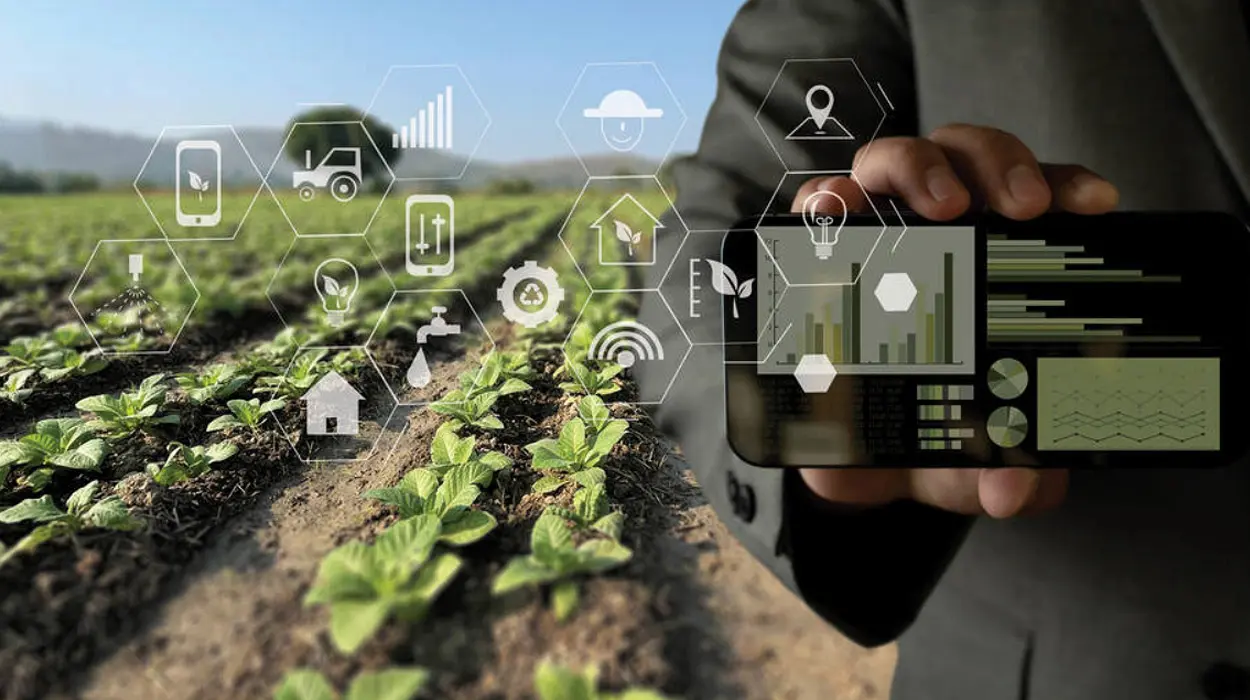
For example, remote sensors placed in fields allow farmers to obtain detailed maps of the terrain and resources in the area, as well as measure variables such as soil acidity, temperature, and moisture.
They can also predict weather patterns for days and weeks ahead.
IoT-enabled precision agriculture helps farmers make better decisions to improve agricultural production.
Furthermore, the data collected and analyzed plays a significant role in monitoring agricultural pests and accurately determining the required amount of pesticides to avoid overuse.
Data collection and analysis also contribute to the efficient use of irrigation water.
Internet of Things (IoT) technologies offer significant benefits to greenhouse owners by monitoring temperature, light levels, humidity, atmospheric pressure, and water consumption within the greenhouse.
An online portal allows farmers to receive notifications whenever any changes occur in this information.
Temperature control devices, lighting levels, and window opening and closing can also be remotely controlled via the internet.
Another important application of IoT in smart agriculture is the use of drones for crop monitoring and evaluation, mapping and surveying farmland, measuring air composition, and spraying pesticides quickly and safely.
The data is then instantly transmitted to software for analysis, guiding farmers toward optimal practices.
Robotic Farms: Late last year, the American company IronOx opened the first farm where robots replace human farmers, performing many tasks.
The company has already launched agricultural products grown by the robot farmer "Angos," which is responsible for the most important operations on the farm.
This robot uses a sophisticated arm to access large water tanks planted with various edible plants.
The machine learning program that powers the robot identifies plants showing signs of pests or diseases and removes them before they spread throughout the basin.
The company aims to produce agricultural products closer to stores and in smaller spaces than traditional farms, which will help it eventually provide fresh, high-quality, and healthy produce at affordable prices for everyone.
Key technologies in smart agriculture
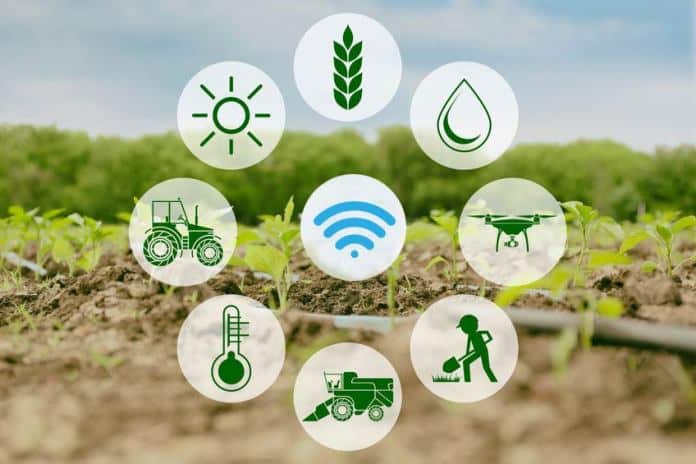
Smart agriculture encompasses a variety of advanced technologies, such as intelligent irrigation systems that use sensors to accurately measure soil moisture and temperature.
Drones are also used to monitor crops and quickly and efficiently identify pests and diseases.
Benefits of applying smart agriculture
Smart agriculture contributes to numerous economic and environmental benefits, including increasing agricultural productivity by up to 70%, reducing water consumption by 50%, and decreasing the use of chemical pesticides. It also empowers farmers to make informed decisions based on scientific data.
Challenges and future prospects
Despite the challenges posed by the high cost of technologies and the difficulty of training, the future of smart agriculture is promising.
With continuous technological advancements, these technologies are expected to become more accessible and effective, contributing to global food security.
At the Arab level, smart agriculture is particularly important in the Arab region, which faces significant environmental crises such as water scarcity, climate change, drought, and desertification.
These factors negatively impact food availability and security.
Therefore, the Arab region is among those most in need of implementing smart agriculture technologies.
However, several obstacles hinder this, most notably the weak telecommunications and internet infrastructure in some Arab countries, the need for skills that many farmers lack, and the financial cost, which poses a significant barrier for many.
Adopting smart agriculture policies requires strengthening joint Arab efforts, exchanging knowledge and ideas about Internet of Things (IoT) technologies, and integrating information and communication technologies (ICTs) as a fundamental driver of sustainable agricultural development.
In this regard, we mention the experience of the first regional forum for smart agriculture, which was held in the Sudanese capital, Khartoum, at the end of last September, under the slogan “Towards sustainable agricultural development through the Internet of Things and new technological trends.” This forum can be considered the first attempt towards adopting smart agriculture policies and exchanging experiences at the Arab and African levels in this field, and enhancing regional and international cooperation in the field of smart agriculture to coordinate efforts and reach sustainable solutions for the future of the agricultural sector.
Finally, despite objections to smart agriculture, which is often seen as a new form of control by large multinational corporations over basic food production, and despite its reliance on advanced technologies, expertise, and capital that most traditional, family-based farmers may lack, there is no doubt that smart agriculture will witness increasing growth in the coming years.
This is true of all modern smart technologies that aim to develop and improve the well-being of society and secure its basic needs.
Furthermore, the widespread adoption of modern technologies, their accessibility to diverse groups, and their ease of use by a large segment of the information age will significantly contribute to the adoption of smart agriculture practices, thus bridging the food gap resulting from population growth and resource scarcity.
Will smart agriculture lead to a "green revolution" that saves humanity from the consequences of overpopulation and environmental degradation? Fortunately, current realities and future indicators suggest so.
Section 5
In conclusion, smart agriculture is a true revolution in the world of agriculture, combining advanced technology and traditional agricultural practices to create a more sustainable and efficient agricultural future.
Related images